Owner’s manual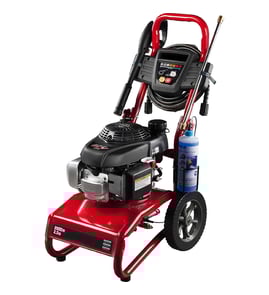



What is a good PSI for a gas pressure washer?
A good PSI for a gas pressure washer depends on what you’re cleaning. For typical home jobs, 1,300 to 2,800 PSI covers most needs. Your Craftsman 580751500 is adjustable up to 1,800 PSI, which is a solid range for general residential cleaning.
Quick PSI guide by task
- 1,300 to 1,800 PSI: cars, patio furniture, grills, light mildew
- 1,800 to 2,400 PSI: decks, fences, siding (use care on softer wood)
- 2,400 to 2,800 PSI: driveways, brick, tougher grime
- Above 2,800 PSI: heavy-duty cleaning; higher risk of surface damage
How to choose the right pressure on model 580751500
We recommend starting low and increasing only as needed. This model lets you adjust pressure at the nozzle and with the pressure control knob; use the widest spray pattern that still cleans effectively.
| What you want | What to do | Why it helps |
|---|---|---|
| Avoid damage | Start with low pressure and a wider fan spray | Reduces etching and splintering |
| Clean faster | Keep the nozzle 8 to 24 inches from the surface | Improves cleaning without overblasting |
| Better detergent results | Apply detergent on low pressure; let it dwell 3 to 5 minutes | Helps break down grime |
Safety and “too much PSI” warning signs
High pressure can damage surfaces and can be dangerous. Follow the safety guidance in the owner's manual.
- Never aim the spray gun at people or animals
- Wear eye protection
- Inspect the high-pressure hose for cuts, bulges, or leaks before each use
- Replace a leaking hose immediately (do not repair a high-pressure hose)
- Do not exceed the pressure rating of the washer and accessories
Why it matters
Using the lowest effective PSI protects paint, wood fibers, seals, and concrete from permanent damage, and it also reduces wear on the pump, hose, spray gun, and nozzles.
Last updated: February 2026
Can you put 87 gas in a pressure washer?
Yes. For the Craftsman 580751500 1800-psi high-pressure washer, regular unleaded gasoline with an 87 octane rating is the correct everyday fuel choice; use fresh fuel and handle it safely because gasoline vapors are flammable and explosive (see the owner's manual).
What to use (and what to avoid)
- Use fresh, clean unleaded gasoline (87 octane).
- Avoid old gas that has been sitting for weeks or months.
- Avoid storing the unit long-term with fuel in the tank.
- Avoid spilling fuel on a hot engine; let the engine cool before refueling.
- Never refuel near sparks, open flames, or smoking materials.
Storage guidance for fuel (important for starting and carburetor health)
The manual notes that alcohol-blended fuels (often called gasohol and commonly containing ethanol) can attract moisture, separate during storage, and form acids that damage the fuel system. If you will not use the pressure washer for more than 30 days, prepare it for storage by addressing the fuel system as outlined in the owner's manual.
Quick fuel-storage checklist
| Situation | What we recommend | Why |
|---|---|---|
| Using it weekly | Buy small amounts of fresh 87 octane | Reduces hard-start and varnish issues |
| Not using it for 30+ days | Follow the manual’s long-term storage steps | Prevents gum deposits and fuel-system damage |
| Refueling during a job | Cool engine first; refuel outdoors | Reduces fire risk from hot surfaces and vapors |
Why it matters
Using the right gasoline and storing it correctly helps prevent hard starting, rough running, and fuel-system problems (carburetor and fuel hose issues are common when fuel degrades). Safe fueling practices also reduce the risk of fire and injury.
Last updated: February 2026
Is it worth repairing a pressure washer?
Yes, repairing a pressure washer is worth it when the fix is small (hose, gun, wand, inlet filter, tune-up items) or when the unit is in otherwise solid condition. For the Craftsman 580751500 1800-PSI gas pressure washer, we use a simple cost rule: if the repair is over about half the cost of a comparable replacement, replacement usually makes more sense.
Quick decision checklist (what we use)
- Repair it if the problem is a leak at a fitting, clogged inlet screen, worn O-ring, or a maintenance item (spark plug, air filter).
- Repair it if the engine runs well and the pump issue is minor (for example, a seal or fitting problem).
- Replace it if the pump is cracked, the engine has low compression, or multiple major parts are failing.
- Replace it if you need it urgently and repair time or parts sourcing will cause too much downtime.
- Always replace a damaged high-pressure hose; never patch or splice it.
Typical repair cost vs. replace guide
| Issue type | What it often involves | Usually worth it? |
|---|---|---|
| Maintenance / tune-up | Spark plug, air filter, oil check, cleaning screens | Yes |
| Water supply / inlet restriction | Cleaning inlet filter and quick-connect screen | Yes |
| Leaks at connections | Tightening, replacing O-rings, replacing worn couplers | Often |
| High-pressure hose damage | Replace hose with correct pressure rating | Yes (but replace the hose, do not repair) |
| Pump or engine major failure | Pump replacement or major engine repair | Often no |
Why it matters
Pressure washers can fail quickly when they are run with restricted water flow or ignored maintenance. The owner's manual calls out routine checks (oil level, inlet filter, hose condition, gun and wand leaks) and emphasizes that a leaking high-pressure hose can inject water into skin, so replacement is the safe, correct fix.
What to check before spending money
- Confirm strong water supply to the pump (no kinked garden hose, fully open spigot).
- Clean the water inlet filter and the quick-connect screen.
- Inspect the high-pressure hose for cuts, bulges, abrasion, or coupling movement.
- Check the gun and wand for leaks at the connections.
- Do a basic seasonal tune-up (spark plug, air filter) if it has been a year.
Last updated: February 2026