Owner’s manual
 Error Codes




How long should a Kenmore gas stove last?
A Kenmore gas range like model 36273281890 typically lasts about 15 years with normal household use. Regular cleaning, correct flame/ignition operation, and safe gas and electrical connections help you get the full service life; see the 36273281890 owner's manual for care and operating details.
Most gas ranges reach their expected life when these areas are kept in good shape:
- Burner ignition reliability (surface and oven)
- Clean burner ports and stable flame pattern
- Proper gas pressure and regulator operation
- Good electrical supply for electric-ignition models
- Reasonable heat exposure to knobs, wiring, and insulation
We recommend these practical habits for a Kenmore gas stove:
- Keep cooktop burner heads and caps clean and dry after spills.
- Wipe the oven bottom and remove heavy baked-on grease that can affect burner ignition.
- Confirm surface burners light promptly; after air is purged from the gas line, ignition should be quick.
- Watch flame quality: soft blue flames are normal for natural gas; yellow flames need service.
- Replace worn ignition parts instead of repeatedly re-lighting or cycling the oven.
If the range is getting older, these symptoms often point to serviceable parts:
| Symptom | Common cause | What to check first |
|---|---|---|
| Oven takes long to light or won’t heat | Weak igniter or burner issue | Bake burner ignition WB13X40208, burner tube alignment, debris |
| Oven heat is uneven | Burner or airflow issue | Bake burner WB16K10035, burner ports, oven bottom cleanliness |
| Surface burner flame is yellow/sooty | Air-fuel mix or pressure issue | Burner caps seated, regulator and supply pressure |
A gas range can run for years with minor wear, but ignition and flame quality affect safety, cooking performance, and fuel efficiency. Keeping flames stable and ignition consistent reduces stress on the gas valve and burner system.
Last updated: February 2026
How to take the top off a Kenmore gas range?
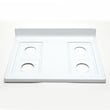
On the Kenmore 36273281890 gas range, we remove the grates first, then lift off burner caps and heads (bases) as equipped; once any retaining screws are out, the cooktop top can be lifted up or removed for service. Use the 36273281890 owner’s manual for model-specific cautions.
- Turn all burner knobs to OFF.
- Let the grates and cooktop surfaces cool completely before touching them.
- If you smell gas, shut off the gas supply at the manual shut-off valve and stop.
- Unplug the range (or switch off the breaker) before working near wiring or switches.
- Clear the cooktop; items left on top can heat up from venting and become a hazard.
- Remove the grates and set them aside.
- Lift off burner caps (and any removable burner heads/bases).
- Look for mounting screws:
- Some models use screws at the burner bases, under trim, or along the front lip.
- Remove any screws holding burner tubes or brackets to the top.
- Lift the top:
- Many gas ranges use a hinged top that lifts from the front and props up.
- Others lift off after releasing front clips and rear alignment tabs.
- Support the top so it cannot fall while you inspect igniters, wiring, or gas tubing.
| Area | What it affects | Common issue signs |
|---|---|---|
| Surface burner area | Burner flame and ignition | Clicking, uneven flame, slow lighting |
| Oven ignition circuit | Bake ignition | No bake, long preheat, gas smell without ignition |
| Manifold and valves | Gas flow to burners | Burner won’t adjust, weak flame |
A very common cause is a weak or failed oven igniter. For this model, the bake burner ignition WB13X40208 is a key part to check when the oven won’t light or takes too long to ignite.
Removing the cooktop top correctly prevents bent gas tubing, pinched wires, and misaligned burner parts, which helps your Kenmore range light reliably and burn safely.
Last updated: February 2026
What model is my Kenmore gas range?
Your Kenmore gas range model number is printed on the serial plate; for model 36273281890, you will typically find that plate on the front frame behind the broiler compartment, storage drawer, or kick panel. Use the exact model number from that label when ordering parts.
Check these common label locations first:
- Behind the storage drawer (pull the drawer out fully and look at the front frame)
- Behind the broiler compartment (if your range has a broiler drawer/compartment)
- Behind the kick panel at the bottom front
- On the front frame just inside the lower opening
- On the back of the range near the vent area (less common, but worth checking)
For diagrams and the exact label location for this series, use the 36273281890 owner's manual.
The serial plate usually includes several fields. Record them exactly as shown:
- Model number (this is what we use to match parts)
- Serial number (helps identify production details)
- Gas type (natural gas or LP/propane, if listed)
| Label field | Example of what it does | Why we need it |
|---|---|---|
| Model number | Identifies the exact range design | Ensures correct part fit |
| Serial number | Identifies the specific unit | Helps narrow variations |
| Gas type | Natural gas vs. LP | Prevents wrong burner/orifice selection |
Kenmore ranges can look similar across multiple model numbers, but internal parts like the oven igniter, bake burner, and control valve can differ. Using the model number from the serial plate prevents ordering the wrong replacement part and avoids installation delays.
Last updated: February 2026
Why isn't my Kenmore gas oven heating up?
If your Kenmore gas range model 36273281890 isn’t heating, the most common cause is an ignition or gas-flow issue. This oven uses electric ignition and should light within 30 to 90 seconds after you set a temperature; if it does not, focus on power, the igniter, and the oven gas shut-off lever (if it was bumped).
- Confirm the range has power (the oven cannot ignite during a power outage).
- Set Bake and wait a full 90 seconds for ignition.
- Make sure the oven vent openings at the rear of the cooktop are not blocked.
- Check that the oven gas shut-off lever has not been moved during cleaning or moving.
- If you are on LP gas, contact the installer who performed the conversion.
| What you notice | Most likely cause | What to do next |
|---|---|---|
| No heat and no ignition activity | No electrical power to ignition system | Restore power; retry Bake |
| Igniter glows but burner never lights | Weak igniter or gas valve not opening | Inspect igniter; consider replacing |
| Burner lights after a long delay | Weak igniter | Replace igniter |
| Range was recently moved/cleaned | Oven gas shut-off lever closed | Locate lever and set to open |
If basic checks point to an ignition failure, these model-matched parts are common fixes:
- Bake burner ignition WB13X40208 (glow bar igniter that heats to open the gas valve)
- Bake burner WB16K10035 (burner assembly that distributes the flame)
On model 36273281890, the oven and broil burners rely on electric ignition; gas flow is designed to stop if the igniter is not hot. That protects against unburned gas and also explains why a weak igniter can prevent heating.
For control locations, shut-off lever access, and normal ignition timing, use the 36273281890 owner’s manual.
Last updated: February 2026