Error Codes



How do you reset a Frigidaire side by side refrigerator?
To reset your Frigidaire FRSS2323AW7 side-by-side refrigerator, we recommend doing a full power reset: turn the refrigerator off by unplugging it (or switching off the breaker) for about 5 minutes, then restore power and allow the controls to reboot.
Quick reset steps (power reset)
- Unplug the refrigerator from the wall outlet, or switch OFF the circuit breaker.
- Wait about 5 minutes (this lets the control board fully power down).
- Restore power.
- Wait 1 to 3 minutes for the display and cooling system to restart.
- Confirm your temperature settings are still where you want them.
What a reset can and cannot fix
A reset is most helpful for temporary control glitches, display issues, or after a brief power outage. It will not correct a failed component.
| Symptom after reset | What it usually means | What to check next |
|---|---|---|
| Display returns to normal | Temporary control glitch | Monitor temps for 24 hours |
| Still not cooling | Cooling system or airflow issue | Evaporator fan, frost buildup, condenser airflow |
| Temps seem wrong | Sensor or control issue | Thermistor/temperature sensor, settings |
| Lights or dispenser act odd | Door switch, UI, or board issue | Door closure, wiring, user interface |
If the problem comes back quickly
These checks often pinpoint the real cause:
- Make sure both doors close and seal tightly; warm air leaks can mimic “not cooling.”
- Listen for the evaporator fan running; no airflow can cause warm fridge temps.
- Look for heavy frost on the back freezer panel (possible defrost problem).
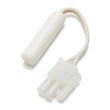
- If temperatures swing or read incorrectly, a sensor can be the culprit; see refrigerator temperature sensor 5303918775.
- If you’re seeing an error code, use Frigidaire refrigerator error codes to match the code to the likely failure.
Why it matters
A proper reset clears minor electronic faults and restores normal control logic. If symptoms return, the repeat failure pattern helps us narrow the issue to airflow, defrost, sensors, or the main control system.
Last updated: January 2026
Does Frigidaire make a 33 inch wide refrigerator?
Yes. Frigidaire makes refrigerators in the 33-inch width class, including side-by-side and other styles. Your FRSS2323AW7 is a Frigidaire side-by-side refrigerator model; exact cabinet width varies by model and configuration, so we match by model number when you need parts or fit.
How to confirm a refrigerator is truly “33-inch wide”
Manufacturers often market “33-inch” as a width class; the actual cabinet width can be slightly under or over 33 inches.
- Check the product spec sheet for the exact width measurement (not just the width class).
- Measure the cabinet (not the doors/handles) at the widest point.
- Allow clearance for door swing and airflow at the sides and top.
- If you are replacing an older unit, measure the opening width, height, and depth.
- If you have tight clearance, confirm hinge and handle projection.
Common 33-inch width class sizes (what you typically see)
These are typical ranges we see across many 33-inch class refrigerators.
| Measurement | Typical range | What to measure |
|---|---|---|
| Cabinet width | ~32 7/8 to 33 1/2 in. | Case only, doors closed |
| Depth (case) | Varies widely | Case only, no handles |
| Depth (with handles) | Often deeper | Front of handles to back |
| Height | Model-dependent | Floor to top of case |
Why it matters for parts and fit
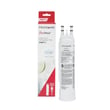
“33-inch wide” helps narrow shopping, but parts and installation fit depend on the exact model. For FRSS2323AW7, we recommend using the model number to select correct items like the Frigidaire refrigerator water filter FPPWFU01 and to avoid ordering a part that looks similar but mounts differently.
Related help for Frigidaire owners
If you are comparing models because of dispenser or ice maker features, our how to replace the water filter in a Frigidaire refrigerator guide helps you identify filter styles and replacement steps.
Last updated: January 2026
Why is my Frigidaire refrigerator side by side not making ice?
If your Frigidaire FRSS2323AW7 side-by-side refrigerator is not making ice, the most common causes are a restricted water supply or a clogged water filter; start by confirming strong water flow to the refrigerator and replacing the filter if it is due.
Quick checks we recommend first
- Make sure the ice maker is turned ON (bail arm down or switch on, depending on your unit).
- Confirm the household shutoff valve is fully open.
- Inspect the water supply line behind the refrigerator for kinks, pinches, or crushing.
- If you have a saddle valve (piercing valve), replace it with a standard shutoff valve; saddle valves commonly restrict flow.
- Replace the filter if it is older than 6 months or water flow at the dispenser is slow.
Water filter and water flow (most common)
A partially clogged filter can reduce water pressure enough that the ice maker will not fill properly.
- Use the correct filter for this model: Frigidaire refrigerator water filter FPPWFU01.
- After replacing the filter, purge air and restore flow: how to purge air from a refrigerator water dispenser video.
What you should see after a filter change
| Check | Normal result | If not normal |
|---|---|---|
| Dispenser flow | Strong, steady stream | Recheck shutoff valve, line kinks, filter seating |
| Ice production | Starts within 24 hours | Continue checks below |
If water flow is good but there is still no ice
These issues can stop ice production even with a new filter:
- Freezer temperature too warm (target about 0°F); ice makers often stop cycling if the freezer is above about 10°F.
- Ice maker fill tube frozen (usually from low airflow or a door not sealing well).
- Door not sealing, causing frost and temperature swings; inspect the gasket for gaps or tears.
- Evaporator fan problem reducing freezer airflow.
Why it matters
Ice makers are very sensitive to water pressure and freezer temperature. Fixing a restriction (filter, valve, kinked line) often restores ice quickly and prevents repeat freezing and slow-fill problems.
Last updated: January 2026
What is the most common problem with Frigidaire refrigerators?
Cooling problems are the most common issue we see with Frigidaire refrigerators, including the FRSS2323AW7. Most “not cold enough” complaints trace back to restricted airflow (dirty coils, blocked vents), a weak evaporator fan, or warm air leaking past a worn door gasket.
Most common symptoms customers notice
- Fresh food section warm but freezer seems OK
- Freezer warm and ice cream soft
- Frost buildup on the back wall of the freezer
- Fan noise changes, or no fan sound with the door closed
- Longer run times and higher energy use
Quick checks you can do first
- Confirm settings: Set freezer to 0°F and refrigerator to 37°F.
- Check airflow: Make sure packages are not blocking vents in either compartment.
- Clean condenser coils: Dusty coils reduce cooling and can mimic bigger failures.
- Listen for the evaporator fan: If it is not running, airflow across the evaporator drops fast.
- Inspect door sealing: Look for gaps, tears, or a door that does not close squarely.
Parts that commonly relate to cooling complaints
If the basic checks point to a component issue, these model-matched parts are common suspects:
- Refrigerator evaporator fan blade 242219302 (air movement across the evaporator)
- Refrigerator temperature sensor 5303918775 (temperature feedback to the control)
- Refrigerator door gasket (white) 241786015 (prevents warm air leaks)
Cooling issue vs. water and ice issue (fast comparison)
| Problem area | What you notice | Most common cause |
|---|---|---|
| Cooling/airflow | Warm temps, frost, long run times | Airflow restriction, fan issue, door leak |
| Water/ice | Slow water, small cubes, no ice | Clogged filter, low water pressure, dispenser/ice maker issue |
For water and ice complaints, we use how to replace the water filter in a Frigidaire refrigerator as the starting point, and the correct filter for this model is Frigidaire refrigerator water filter FPPWFU01.
Why it matters
Cooling problems usually get worse over days, not minutes. Catching airflow restrictions early helps protect food, reduces compressor run time, and prevents heavy frost that can block the evaporator.
Last updated: January 2026