Error Codes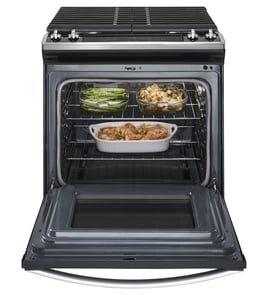





Does the PGB935YP4FS have a self-cleaning feature?
Yes. The GE PGB935YP4FS free standing gas range includes a self-cleaning oven feature, so you can run a high-heat cleaning cycle to burn off baked-on spills and food residue inside the oven cavity.
How to confirm you have the right model
We recommend matching the model number on your range’s ID tag to PGB935YP4FS before relying on feature lists or ordering parts.
- Check the model/serial tag (commonly on the oven frame behind the storage drawer, or on the door frame area).
- Match the full model number exactly, including any letters and numbers.
- If your model number is close but not exact, features can differ.
For help locating the tag, use how to find your appliance model number (and what it means for parts).
Self-clean basics (what to expect)
Self-clean cycles vary by range, but most GE self-clean ovens work similarly.
- Remove oven racks and accessories unless your instructions say they are self-clean safe.
- Wipe out loose crumbs and heavy spills first (it reduces smoke).
- Plan for odors and some smoke; ventilate the kitchen.
- Let the oven cool completely before wiping out ash.
Quick comparison: self-clean vs manual cleaning
| Cleaning method | Best for | Tradeoffs |
|---|---|---|
| Self-clean cycle | Heavy baked-on residue | Heat, odor, longer cycle time |
| Manual cleaning | Light spills, quick touch-ups | More scrubbing time |
Why it matters
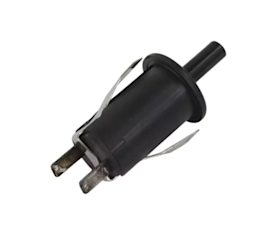
Using the correct cleaning method helps protect oven components like the door switch and temperature sensor, and it can reduce nuisance issues such as excessive smoke or a door that will not unlock after a cycle.
If you are troubleshooting a door that will not unlock or a cycle that will not start, common related parts for this model include the range oven door switch WB24X27550 and the range oven temperature sensor WB24X25557.
Last updated: January 2026
What are the key features of PGB935YP4FS?
The GE PGB935YP4FS free standing gas range is commonly equipped with cooking modes like no-preheat air fry and true convection, plus smart connectivity (built-in WiFi) and a versatile cooktop layout that can include a center oval burner for griddles. Feature sets can vary by configuration.
Key features customers look for on this model
- No-preheat air fry cooking mode
- True convection for more even baking and roasting
- Built-in WiFi with SmartHQ app support
- Fingerprint-resistant stainless finish (on stainless versions)
- Center oval burner designed for a griddle or elongated cookware
- Reversible grill/griddle accessory (when included)
Cooktop and oven highlights (quick view)
| Area | What it does | Why it’s useful |
|---|---|---|
| Center oval burner | Provides a longer flame pattern | Better heat coverage for a griddle or fish pan |
| Extra-large burner | Higher BTU output for fast boiling | Quicker searing and large-pot cooking |
| Convection oven | Circulates hot air | More even browning across multiple racks |
| Air fry mode | Uses high heat and airflow | Crisp results with less oil |
Why it matters
Knowing the feature set helps you choose the right replacement parts and accessories (burner components, griddle parts, control parts) and troubleshoot symptoms correctly, since smart features and convection systems add sensors and electronics that affect operation.
Parts that commonly relate to these features
If you are troubleshooting weak flames, uneven heating, or ignition issues, these model-matched parts are often involved:
- Range extra large surface burner, 18,000-btu WB16X24722 (high-output burner performance)
- Range surface burner cap WB28K10222 (proper flame shape and ignition)
- Range spark module WB13X24741 (spark ignition across surface burners)
Last updated: January 2026
What does F4 mean on a gas stove?
On a GE gas range like model PGB935YP4FS, an F4 code typically points to an oven temperature sensing problem (most often the oven temperature sensor circuit). The fastest next step is to power-reset the range, then check the sensor connection and test the sensor if the code returns.
What to do first (safe, quick checks)
- Turn the oven off; let it cool completely.
- Reset power: switch the breaker off for 1 minute, then back on.
- If F4 returns, avoid using Bake/Broil until you troubleshoot (temperature control can be unreliable).
- If the display shows F4 immediately at power-up, focus on wiring/connection issues.
- If F4 appears only after preheating, focus on the sensor and heat-related wiring.
Most common causes on a gas range
- Loose or corroded connector at the oven temperature sensor
- Damaged sensor harness (pinched, heat-brittle insulation)
- Failed oven temperature sensor
- Control board issue (less common)
Parts that commonly relate to an F4 code
If the sensor tests out of range or the connector is damaged, these are the most relevant parts for this model:
- Range oven temperature sensor WB24X25557
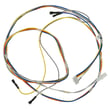
- Harness switches WB18X38063 (if the fault traces to a damaged harness/connector path)
Basic test guidance (what we look for)
We typically verify the sensor circuit before replacing parts.
| Check | What you’re looking for | What it suggests |
|---|---|---|
| Visual inspection | Burnt, brittle, or loose wiring at sensor | Wiring/connection problem |
| Sensor resistance (room temp) | A stable resistance reading (not open/short) | Sensor likely OK |
| Wiggle test at connector | Reading changes when moving harness | Intermittent connection |
Why it matters
The oven temperature sensor tells the control how hot the oven is. When the control sees an invalid sensor signal, it can’t regulate heat accurately, so it triggers F4 to prevent poor baking performance and overheating risk.
Last updated: January 2026