
What is the 3-tooth rule for bandsaws?
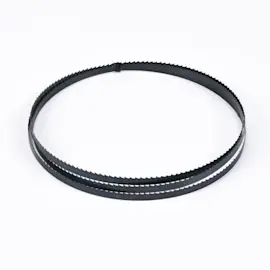
The 3-tooth rule for a band saw (including the Jet JWBS-14CS) means you choose a blade tooth pitch (TPI) so at least 3 teeth are in the cut at all times. This prevents tooth snagging and stripping, improves chip clearance, and helps the blade track and cut more smoothly.
How to apply the 3-tooth rule (quick steps)
- Measure the material thickness at the cut (the distance the blade teeth are engaged).
- Pick a blade where that thickness keeps 3 or more teeth engaged.
- If you are cutting thin stock, use a higher TPI blade.
- If you are cutting thick stock, use a lower TPI blade.
- If the saw starts cutting slowly, burning, or wandering, re-check blade sharpness, TPI, and tension.
Simple TPI selection guide
Use this as a practical starting point for most band saw work.
| Material thickness (approx.) | Typical blade choice | What you will notice if TPI is wrong |
|---|---|---|
| 1/8 in. (3 mm) and thinner | 18 to 24 TPI | Too few teeth can grab and strip teeth |
| 1/8 to 1/2 in. | 10 to 14 TPI | Too many teeth packs sawdust, cuts slow |
| 1/2 to 2 in. | 6 to 10 TPI | Too fine a blade overheats and wanders |
| 2 in. and thicker | 3 to 6 TPI | Too fine a blade clogs gullets quickly |
Why it matters on a band saw
When fewer than 3 teeth are engaged, each tooth takes too big a bite and can snag the workpiece. When far too many teeth are engaged, the gullets cannot clear chips, so the blade runs hot, cuts slowly, and can drift.
Related setup help
If your Jet JWBS-14CS still struggles after choosing the right TPI, these guides walk through the most common causes:
Last updated: February 2026
What is the resaw capacity of JWBS-14CS?
The Jet JWBS-14CS band saw has a typical resaw capacity of about 6 inches, which is the maximum thickness of stock you can cut when the saw is set up correctly (blade, guides, and fence aligned).
What “resaw capacity” means
Resaw capacity is the maximum height of material you can cut between the table and the upper blade guide area (or the saw’s cutting height limit). It matters most when you are:
- Resawing boards into thinner slabs or veneers
- Cutting thick hardwoods (oak, maple, walnut)
- Making bookmatched panels
- Ripping tall stock with a fence
What affects real-world resaw performance
Even with a 6-inch resaw capacity, cut quality and speed depend heavily on setup and blade choice.
- Blade width and tooth pattern: Wider blades track straighter for resawing
- Blade sharpness: A dull blade slows cutting and wanders
- Blade tension and tracking: Low tension often causes drift and poor control
- Guide blocks/bearings adjustment: Misadjusted guides let the blade deflect
- Feed rate: Pushing too fast causes drift and rough cuts
Quick setup checklist for straighter resaw cuts
Use this checklist before blaming the motor or saw alignment:
- Install a sharp blade suited for resawing (coarser TPI for thick stock)
- Center the blade on the wheels and confirm stable tracking
- Set side guides close to the blade without pinching it
- Set the thrust bearing just behind the blade
- Square the table to the blade and verify fence alignment
| Symptom while resawing | Most common cause | Best first fix |
|---|---|---|
| Cuts drift off the line | Blade not suited or guides off | Change blade, reset guides |
| Slow cutting | Dull blade or too fine TPI | Replace blade, use coarser TPI |
| Ragged surface | Dull blade or wrong feed rate | Replace blade, slow feed |
Why it matters
Knowing the 6-inch resaw capacity helps you choose the right stock size and blade setup for the Jet JWBS-14CS, so you get straighter cuts, less waste, and safer control during tall rip cuts.
For more help dialing in performance, use our DIY symptom guide for band saw not cutting straight.
Last updated: February 2026
What does 14 mean on a bandsaw?
On a Jet JWBS-14CS band saw, the “14” is the saw’s wheel size class: it refers to a band saw built around approximately 14-inch diameter wheels (the upper and lower wheels the blade rides on). It is a sizing convention, not the resaw height or the throat capacity.
What “14-inch class” tells you (and what it does not)
A 14-inch band saw label is mainly a quick way to group machines with similar overall scale and typical blade lengths.
- It does relate to the wheel diameter the blade wraps around.
- It often correlates with the saw’s frame size and typical blade length range.
- It does not automatically equal the saw’s resaw capacity (max cut height).
- It does not automatically equal the throat (distance from blade to frame).
- It does not guarantee a specific motor horsepower or cutting speed.
Why the number can be confusing
Many woodworkers assume “14” means “14 inches of resaw.” On most band saws, resaw height depends on the frame design and whether a riser block (on some designs) is installed, not the wheel size label.
Quick sizing comparison
| Label on saw | What it usually refers to | What you must check separately |
|---|---|---|
| 14-inch band saw | Wheel diameter class | Resaw height, throat, blade length, motor power |
| Resaw capacity | Max cut height under guides | Wheel size, blade length |
| Throat capacity | Depth from blade to frame | Resaw height, wheel size |
Why it matters for cutting performance
Wheel size influences how tightly the blade bends around the wheels, which affects blade life and what blade widths tend to track well. Cutting performance still depends heavily on setup and blade condition.
If your JWBS-14CS is cutting poorly, these setup issues are the most common:
- Dull blade or wrong tooth pitch (TPI) for the material
- Blade tension too low
- Guides or thrust bearings misadjusted
- Blade tracking off-center on the wheels
- Feed rate too fast for the blade and stock thickness
For step-by-step troubleshooting, we recommend starting with band saw common questions and then using the symptom guides if you have a specific issue.
Last updated: February 2026