Error Codes




How do I reset the error code on my GE oven?
To reset an error code on your GE JB735EP3ES electric range, we start with a simple control reset (Clear/Off), then do a full power reset at the breaker for a few minutes. If the code returns right away, the problem is usually a stuck keypad, a wiring issue, or a failed component.
Step-by-step: reset the code safely
- Press Clear/Off once and wait 30 to 60 seconds.
- If the code stays, turn OFF the range circuit breaker.
- Leave power off for 2 to 5 minutes.
- Turn the breaker back ON.
- Set the clock (if needed) and try Bake for a quick test.
- If the code reappears, stop using the oven until you identify the cause.
What it means if the code comes back
Most repeat error codes are not “memory” problems; they are the control detecting a fault again.
| What you see | Most common cause | What we do next |
|---|---|---|
| Code returns immediately after power-up | Stuck key or failed touch panel/control | Check for stuck buttons; consider control replacement |
| Code appears after preheat starts | Sensor, heating circuit, or wiring issue | Inspect connections; test components |
| Cooktop works but oven throws code | Oven-only circuit problem | Focus on oven sensor, elements, and harness |
Quick checks that often solve it
- Make sure no buttons are being held down by a misaligned control panel.
- Kill power and reseat any accessible connectors (only if you are comfortable doing so).
- Look for heat damage or loose wiring at the back cover area.
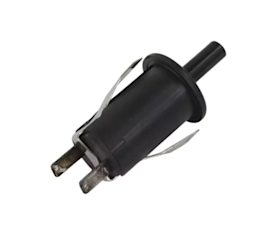
- If you suspect a cooktop control is involved (burner stuck on or erratic), check the related switch such as the GE range surface element control switch WB24X25013.
Why it matters
An error code is the range’s way of preventing unsafe heating or protecting the electronic control. Resetting is useful for a one-time glitch, but a repeating code helps us pinpoint the failing circuit so you can avoid nuisance shutdowns and inconsistent baking.
Last updated: February 2026
What does F3 mean on an electric stove?
On a GE electric range like model JB735EP3ES, an F3 error typically points to an oven temperature sensing problem (most often the oven temperature sensor circuit reading too hot, too cold, or open/shorted). The most common fix is checking the sensor wiring and connections, then testing the sensor and control circuit.
What to check first (safe, quick steps)
- Power reset: Turn the range off at the breaker for 1 minute, then restore power.
- Confirm the symptom: Does F3 appear during preheat, during bake, or immediately at power-up?
- Look for obvious wiring issues: Loose connector, pinched harness, heat-damaged insulation.
- Check for overheating clues: Fan not running, blocked vents, heavy foil use restricting airflow.
- If the oven won’t heat at all: The control may be disabling heat because it “thinks” temperature is out of range.
What F3 usually means (common causes)
F3 is commonly triggered when the control board sees an abnormal signal from the oven temperature sensor circuit.
| Likely cause | What you’ll notice | Typical next step |
|---|---|---|
| Loose or damaged sensor wiring | Error comes and goes | Inspect and reseat connectors |
| Failed oven temperature sensor | Inaccurate temps, F3 during heating | Ohm-test sensor at room temp |
| Control board input issue | F3 at power-up or after wiring checks | Diagnose control circuit |
DIY testing tips (for experienced DIYers)
If you’re comfortable using a multimeter, these checks help narrow it down:
- Unplug the range or shut off the breaker before accessing wiring.
- Test the oven temperature sensor resistance at room temperature (many sensors read around 1,080 ohms at 70°F, depending on design).
- Wiggle-test the harness while measuring to catch intermittent opens.
- If resistance is wildly off, replace the sensor; if resistance is normal, focus on wiring and the control.
For electrical testing basics, we recommend how to use a multimeter to test electrical parts video.
Why it matters
When the control can’t trust the oven temperature signal, it may shut down heating to prevent unsafe operation and to protect components like the control and wiring harness.
Last updated: February 2026
Where is the temperature sensor on a GE oven?
On the GE JB735EP3ES electric range, the oven temperature sensor is mounted inside the oven cavity, typically on the back wall near the upper area. You can usually spot it as a thin metal probe held in place by two screws.
What it looks like and where to look
In most GE electric ranges like model JB735EP3ES, the sensor:
- Protrudes about 1 to 2 inches into the oven cavity
- Sits on the rear wall (occasionally a side wall, depending on design)
- Has a small mounting flange with two screws
- Connects to a wire harness that passes through the rear oven liner
If you are troubleshooting temperature problems, also inspect the wiring and connectors behind the range; heat and vibration can loosen connections.
Basic access steps (safe, typical approach)
We use this general process for a free standing electric range:
- Turn off power at the breaker (240V) and confirm the display is off
- Open the oven door and locate the probe on the back wall
- Remove the two mounting screws while supporting the sensor
- Gently pull the sensor toward you a few inches to expose the connector
- Disconnect the plug (press the locking tab) and remove the sensor
If the connector slips back through the hole, pulling the range forward and removing the rear cover can help you retrieve the harness.
Quick troubleshooting guide
| Symptom | Common cause | What to check first |
|---|---|---|
| Oven too hot or too cool | Sensor out of range | Sensor resistance and connector fit |
| Temp swings widely | Loose connection | Harness plug, pin fit, heat damage |
| No heat and errors | Control issue or open circuit | Sensor circuit continuity to control |
A failed surface control can also cause cooktop heating issues (separate from the oven sensor). If a burner will not regulate heat, check the GE range surface element control switch WB24X25013.
Why it matters
The sensor tells the control board the actual oven temperature. If it reads wrong or the connection is poor, the control can overheat, underheat, or cycle the bake element incorrectly, leading to uneven baking and longer preheat times.
Last updated: February 2026