Installation guide
 Owner’s manual
 Error Codes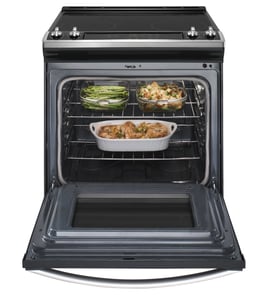



What is the life expectancy of a GE oven?
A GE electric range oven like model JS750SF1SS typically lasts 13 to 15 years with normal household use and basic care (keeping the cooktop clean, avoiding overheating, and fixing small issues early). Use the JS750SF1SS owner's manual for model-specific care and cleaning guidance.
What affects how long a GE range oven lasts?
- Heat stress and ventilation: blocked vents and heavy high-heat use shorten component life.
- Cleaning habits: spills left to bake on can damage finishes and create hot spots.
- Power quality: loose connections or incorrect wiring can stress controls and heating circuits.
- Door use: slamming the door can wear hinges and affect sealing.
- Timely repairs: replacing a failing sensor or thermostat early can prevent bigger failures.
Typical lifespan by major component (what we see most often)
| Component | Typical service life | Common symptom when failing |
|---|---|---|
| Surface radiant element | 8 to 12 years | Burner will not heat or heats unevenly |
| Oven temperature sensor | 8 to 15 years | Oven temperature inaccurate, error codes |
| Control board | 10 to 15 years | Dead display, random beeping, won’t start |
| Door glass and hinges | 10+ years | Heat loss, door won’t close evenly |
Maintenance that helps you reach 13 to 15 years
- Wipe up spills after the range cools; avoid abrasive pads on glass.
- Use flat-bottom cookware sized to the radiant element.
- Keep the oven door gasket area clean so the door seals tightly.
- If baking temps seem off, test with an oven thermometer and address it early.
- Follow the self-clean guidance and safety steps in the manual.
Why it matters
A range that is heating accurately and sealing properly cooks more evenly, preheats faster, and puts less strain on parts like the temperature sensor, safety thermostat, and control board.
Last updated: February 2026
Is GE JS750SF1SS considered high end?
Yes. The GE JS750SF1SS is typically considered an upper-tier (high-end) GE electric range because it is a slide-in design with advanced cooking features and a premium built-in look compared with basic freestanding ranges. For the exact feature set on your unit, use the JS750SF1SS owner's manual.
What “high end” usually means for this model
For ranges like the GE JS750SF1SS, “high end” usually refers to a combination of design, performance, and controls.
Common high-end indicators include:
- Slide-in installation for a more seamless countertop fit
- Radiant glass cooktop with multiple element sizes
- Convection baking/roasting for more even cooking
- Electronic oven controls and special features
- Self-cleaning system with a door lock during cleaning
Quick comparison: where JS750SF1SS fits
| Tier | Typical GE range traits | Where JS750SF1SS usually lands |
|---|---|---|
| Entry | Basic controls, fewer modes, fewer cooktop options | Not typical for this model |
| Mid-range | More modes, better cooktop flexibility | Some overlap |
| High-end | Slide-in look, convection, more cooking modes and features | Most common fit |
Why it matters
Knowing the tier helps you set expectations for performance and repair decisions. Higher-tier ranges often use more specialized components (control boards, convection parts, door lock assemblies), so accurate model matching is important when ordering parts.
Parts that commonly relate to “premium features”
If you are troubleshooting performance issues, these model-matched parts are often involved:
- Cooktop heating issues: range radiant surface element, 8-in WB30T10132 or range radiant surface element, 5-1/2-in WB30T10145
- Oven temperature accuracy: wall oven temperature sensor WB23T10015
- Convection performance: wall oven convection fan motor WB26T10043
Last updated: February 2026
How many watts is a GE JS750SF1SS?
GE JS750SF1SS is an electric range, so it does not have one single “wattage” rating like a microwave. Instead, each heating circuit (surface radiant elements, bake, broil, convection, warming drawer) has its own wattage; we use the JS750SF1SS owner's manual to match the correct element size and power to the right position.
What “watts” usually means on this range
On an electric range, wattage is typically listed per component, not as one number.
Common wattage items include:
- Surface radiant element wattage (varies by element size and whether it is dual or triple)
- Bake and broil element wattage (oven heating circuits)
- Convection fan motor electrical rating
- Oven light bulb wattage
Quick way to identify which wattage you need
Use this checklist so you look up the correct spec for the correct part of the appliance:
- Are you asking about a cooktop burner or the oven?
- Which position: left front, right rear, etc.?
- Is the element a single, dual, or triple radiant element?
- Are you replacing a part, or just checking electrical load?
- Do you have the model and serial label (typically behind the door or drawer)?
Parts that commonly drive “wattage” questions
If you are trying to match a replacement cooktop element, these model-matched parts are common starting points:
| Component | Example part for JS750SF1SS | What it affects |
|---|---|---|
| Small radiant surface element | Range radiant surface element, 5-1/2-in WB30T10145 | Cooktop heating output for that element position |
| Large radiant surface element | Range radiant surface element, 8-in WB30T10132 | Faster heating and higher output for larger cookware |
| Triple radiant surface element | GE range triple radiant surface element WB30T10155 | Multi-ring heating flexibility and higher max output |
Why it matters
Matching the correct wattage and element style helps the cooktop heat properly, prevents nuisance cycling, and ensures the control switch and wiring are operating within the intended electrical load for your GE slide-in range.
Last updated: February 2026
How do I reset my GE oven control board?
To reset the control on your GE JS750SF1SS electric range, press Cancel/Off, then disconnect power to the range for at least 30 seconds and restore power. If the display is blank afterward, reset the home breaker or replace the fuse, then set the clock.
Quick reset steps (recommended)
- Press Cancel/Off to stop any active cooking cycle.
- Turn the range power OFF at the circuit breaker (preferred) or unplug the cord if accessible.
- Wait 30 seconds.
- Restore power.
- Set the clock; re-enter your bake, broil, or convection settings.
If the control is locked or acting “frozen”
Your range has a control lock feature that can make the keypad seem unresponsive.
- Press and hold Lock Controls for 3 seconds to unlock.
- Press Cancel/Off again.
- Retry a basic function like Bake.
For the exact button locations and special features, use the JS750SF1SS owner's manual.
What to do if an error code keeps coming back
If a function error code repeats after a power reset, the issue is usually in a component the control monitors (sensor, wiring, or the control itself).
Common next checks:
- Make sure the range is getting proper power (breaker fully reset).
- Inspect for loose or burned wiring connections (power off).
- If the oven temperature seems inaccurate or you see temperature-related errors, test/replace the wall oven temperature sensor WB23T10015.
Common “reset” actions and what they fix
| Symptom | What to try | Why it helps |
|---|---|---|
| Keypad won’t respond | Unlock controls, then Cancel/Off | Control lock blocks most keys |
| Display blank | Reset breaker or replace fuse | Restores power to the control |
| Error code repeats | 30-second power reset; then check sensor/wiring | Clears a temporary fault; isolates a hard failure |
Why it matters
A proper reset clears temporary glitches after a power surge and restores normal operation. If the problem returns quickly, focusing on the temperature sensor, wiring, or control circuit helps prevent repeat shutdowns and uneven baking.
Last updated: February 2026