Owner’s manual
 Error Codes




Are bottom mount fridges better?
For many households, a bottom-mount refrigerator like Kenmore model 79571355910 is better because the fresh-food section sits at eye and waist level, so you reach everyday items (milk, produce, leftovers) without bending as much; the freezer stays in a lower pull-out drawer.
Bottom-mount designs tend to feel more convenient when you use the refrigerator compartment more than the freezer.
- Easier access to fresh foods you grab daily
- Less bending for refrigerator shelves and crispers
- Wide freezer drawer can fit bulky frozen items
- Better organization for meal prep and cooking
- Good choice for families that store lots of fresh produce
A bottom-mount is not automatically the best fit for every kitchen or user.
| If you want... | Bottom-mount is usually a good fit | A top-freezer may be better |
|---|---|---|
| Fresh-food convenience | Yes | Sometimes |
| Lowest upfront cost | Sometimes | Often |
| Easy freezer access without bending | No | Yes |
| Large frozen-food storage | Often | Sometimes |
We recommend setting up storage so you minimize door-open time and keep temperatures stable.
- Keep most-used items on the middle shelves
- Use crispers for produce to reduce moisture loss
- Avoid overpacking so air can circulate
- Let hot foods cool before loading the refrigerator
- After installation or a move, allow up to 24 hours to reach target temperatures (common for this style)
Ergonomics and organization affect how often the doors stay open, how easy it is to find food, and how hard the cooling system has to work. Using the adjustable shelving correctly also helps prevent damage to glass shelves and improves day-to-day convenience; see the 79571355910 owner's manual for shelf adjustment and use-and-care details.
Last updated: February 2026
How many cubic feet is my Kenmore refrigerator model 79571355910?
Kenmore bottom-mount refrigerator model 79571355910 has a total capacity of 21.8 cubic feet. For the most accurate breakdown and any configuration notes for your exact version, confirm the capacity listing in the 79571355910 owner's manual.
Total capacity is the combined usable space of the fresh food compartment and the freezer.
- Total capacity: 21.8 cu. ft.
- Fresh food (refrigerator) section: 14.5 cu. ft.
- Freezer section: 7.3 cu. ft.
- Capacity is measured with standard shelves and bins installed
- Door-in-door or convenience-door features can change usable space, but not the rated total
| Section | Capacity (cu. ft.) | What it stores |
|---|---|---|
| Refrigerator | 14.5 | Everyday refrigerated foods and drinks |
| Freezer | 7.3 | Frozen foods and ice storage |
| Total | 21.8 | Combined storage volume |
Use these quick checks so the capacity you reference matches your exact appliance.
- Confirm the model/serial tag reads 79571355910 (inside the fresh food section)
- Compare your door style and features to the descriptions in the manual
- Use the manual specs section when planning fit, airflow clearance, or kitchen layout
Cubic feet helps you compare storage space across Kenmore refrigerators and plan organization. It also helps when selecting compatible consumables such as the Kenmore refrigerator water filter 9980 AGF80300805 and the lg refrigerator air filter ADQ73214408.
Last updated: February 2026
How to read Kenmore refrigerator model number?
On a Kenmore refrigerator, we read the model number directly from the appliance’s rating label (not from the control panel). For Kenmore model 79571355910, the label is typically inside the fresh food compartment or freezer area, and it lists the full model number exactly as you should use it for parts.
Check these common locations first (use a flashlight and look for a printed sticker or plate):
- Inside the refrigerator compartment on a side wall (often near the top)
- Inside the refrigerator compartment behind or near the crisper drawers
- Inside the freezer compartment on a side wall
- Along the door frame area (visible when the door is open)
- Behind the lower front toe grille or kick plate area
Once you find the label, we recommend copying the model number exactly as printed.
- Write down every digit in order (example: 79571355910)
- Keep any dashes, suffixes, or extra characters if they appear on the label
- Use the model number (and serial number if listed) when ordering parts or checking diagrams
- If the label shows a series with a color code (common on some Kenmore refrigerators), record the full identifier shown
| Label item | What it tells you | When you need it |
|---|---|---|
| Model number | The exact refrigerator design family | Always, for correct parts lookup |
| Serial number | The specific unit’s production info | Helpful for service, warranty, and revisions |
Kenmore refrigerators can look similar across multiple series, but parts like a water filter, door gasket, or evaporator fan motor are matched to the exact model number. Using the full model number helps prevent ordering the wrong part the first time.
For model-specific label location notes and product record details, use the 79571355910 owner's manual.
Last updated: February 2026
How to tell if a Kenmore refrigerator compressor is bad?
If your Kenmore 79571355910 bottom-mount refrigerator is warm and the compressor runs constantly (or clicks and won’t stay running), the compressor system may be failing. We first rule out airflow blockages, a dirty condenser cover/vents, and door sealing problems that commonly mimic compressor trouble.
- After a move or temperature change, allow up to 24 hours to reach set temperatures.
- Make sure interior air vents are not blocked by food packages.
- Limit long or frequent door openings.
- Vacuum the condenser cover and vents; do not remove the panel covering the condenser coil area.
- Avoid hot locations; this refrigerator should not be operated above 110°F.
- Refrigerator and freezer both stay warm even with long run times
- Repeated clicking every few minutes (start device tries, then stops)
- Compressor becomes very hot after trying to run (use caution)
- Fans run but there is still no meaningful cooling
- Confirm temperature settings are at the recommended positions.
- Listen for the condenser fan and evaporator fan when the compressor is running.
- Check door closing and gasket contact; a leak can cause constant run and poor cooling.
- If it’s clicking, unplug for 5 minutes, plug back in, then observe for 10 to 15 minutes.
| Symptom | Most common cause | Next step |
|---|---|---|
| Runs a lot, cooling weak | Airflow restriction or dirty condenser vents | Clear vents, vacuum cover/vents |
| Clicks, won’t stay on | Start device issue or compressor locked | Technician electrical diagnosis |
| High-pitched/pulsating but temps OK | Normal operation | No repair needed |
A compressor replacement is a major repair. Eliminating airflow, condenser cleaning, and door seal issues first prevents unnecessary parts and restores cooling in many cases.
For model-specific troubleshooting and normal noise descriptions, use the 79571355910 owner's manual. If a technician confirms the compressor is failed, match the replacement by ID, such as the compressor,set assembly TCA36811432.
Last updated: February 2026
What are the most common problems with Kenmore refrigerators?
The most common Kenmore refrigerator problems (including model 79571355910) are weak cooling, ice maker or water dispenser issues, water leaks, frost buildup, and unusual noises. Many of these trace back to airflow blockages, frequent door openings, a clogged condenser cover, or a restricted water filter.
- Not cooling or too warm: blocked air vents, doors opened often, hot room location, or the unit is still stabilizing (allow up to 24 hours after install).
- Ice maker not making enough ice: doors not fully closed, freezer set too warm (target 0°F), or warm air getting in from frequent openings.
- Slow water dispensing: a clogged or exhausted water filter.
- Water leaking or puddles: a restricted/iced drain path or a drain tube issue.
- Noisy operation: normal compressor run time can be 40% to 80% at about 70°F; louder or constant running often points to dirty condenser airflow.
- Frost or ice crystals: frequent door openings or moisture getting in from poor sealing/packaging.
- Confirm temps: 37°F fresh food, 0°F freezer.
- Make sure air vents are not blocked by food packages.
- Reduce long door openings; warm, humid air quickly raises temps and frost.
- If water is slow, replace the filter and flush 2.5 gallons in short cycles.
- If cooling is weak, vacuum the condenser cover and vents (do not remove the panel over the condenser coil area).
| Symptom | Common fix | Example part for this model |
|---|---|---|
| Slow water flow, bad taste/odor | Replace water filter | Genuine Kenmore refrigerator water filter 9980 AGF80300805 |
| Odors in fresh food section | Replace air filter | Lg refrigerator air filter ADQ73214408 |
| Water under fridge or in freezer | Clear/repair drain path | Refrigerator drain tube 5251JA3003D |
| Warm temps, fan noise, poor airflow | Check evaporator fan | Refrigerator evaporator fan motor EAU63923603 |
Cooling and ice/water problems often get worse when airflow is restricted or doors do not seal well; that forces longer run times and can lead to temperature swings, frost, and leaks. For model-specific troubleshooting steps and control settings, use the 79571355910 owner's manual.
Last updated: February 2026
What is the average lifespan of a Kenmore Elite refrigerator?
Most Kenmore Elite refrigerators, including Kenmore model 79571355910, typically last 12 to 15 years with normal household use. Consistent cleaning, good airflow around the cabinet, and keeping the doors sealing properly are the biggest factors that help you reach (or beat) that range.
A refrigerator’s sealed system (compressor, condenser, evaporator) is built to run for years, but everyday conditions determine how hard it has to work.
- Ventilation and condenser cleanliness: dust buildup makes the compressor run hotter and longer
- Door seal condition: air leaks force longer run times and can cause frost and moisture issues
- Ice maker and water system health: slow fills and leaks add stress and create nuisance failures
- Temperature settings and loading: overpacking blocks airflow and causes warm spots
- Power quality: frequent outages or surges can shorten control board and compressor life
Use this as a simple routine to extend the life of your Kenmore bottom-mount refrigerator.
- Vacuum and brush the condenser area every 6 to 12 months
- Confirm the doors close easily and stay shut; clean the gasket sealing surfaces
- Replace the water filter on schedule to protect the valve and dispenser flow
- Keep vents inside the fresh food and freezer sections unblocked
- Set temps to typical targets: 37°F fresh food and 0°F freezer
| Item type | Examples | What it usually means |
|---|---|---|
| Routine maintenance | Water filter, air filter | Normal upkeep that helps performance |
| Wear and tear parts | Door gasket, fan motor, inlet valve | Fixing these early prevents bigger issues |
| Major system repairs | Compressor, sealed system | Higher-cost repair; evaluate age and condition |
If you are chasing odors or airflow issues, replacing the air filter such as the lg refrigerator air filter ADQ73214408 is a common maintenance step.
A refrigerator that is running efficiently holds temperature better, protects food, and reduces strain on high-cost components like the compressor. Small fixes (like a good door seal and clean condenser) often add years of reliable service.
For model-specific care and cleaning intervals, follow the 79571355910 use & care guide.
Last updated: February 2026
What is the bottom part of a refrigerator called?
On a Kenmore 79571355910 bottom-mount refrigerator, the “bottom part” most people mean is the compressor compartment area (where the compressor and condenser components live) or the freezer section (because it’s a bottom-freezer design). The exact names of major sections and features are shown in the 79571355910 use and care guide.
- Freezer compartment: the lower drawer area where frozen food is stored
- Compressor compartment: the lower rear area that houses the compressor and cooling-system parts
- Base grille or toe grille (on some models): the lower front cover near the floor
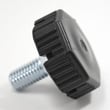
- Leveling legs and rollers: the hardware that supports and levels the cabinet
- Drain pan area: where defrost water can evaporate (location varies by design)
Use this quick check to match the term to what you are seeing.
| What you see at the bottom | What it’s usually called | What it does |
|---|---|---|
| Large pull-out drawer(s) | Freezer drawer / Durabase | Stores frozen food and supports bins/dividers |
| Humming unit at lower back | Compressor | Pumps refrigerant through the sealed cooling system |
| Fan and coil area at lower back | Condenser and condenser fan | Rejects heat so the refrigerator can cool |
| Water on the floor near the front | Drain system issue (often drain tube) | Routes defrost water to the drain pan |
Using the right name helps you order the correct Kenmore parts and follow the right troubleshooting steps. For example, “freezer drawer” issues point to drawer hardware, while “compressor area” issues point to cooling-system airflow, fans, or the compressor.
Your manual’s Parts and features section lists items such as the Durabase, Durabase divider, air filter, and water filter, which helps you describe exactly what you need when shopping for replacement parts.
Last updated: February 2026