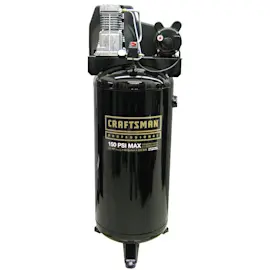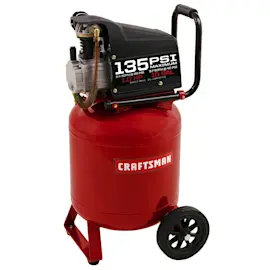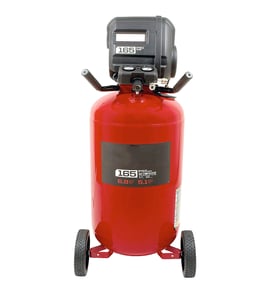
How to tell if an air compressor regulator is bad?
On a Craftsman air compressor model 919163550, a bad regulator shows up as unstable outlet pressure: it creeps up after you “set it,” drops hard when a tool runs, or leaks air from the regulator area. A quick check is to set the outlet pressure, stop airflow, and watch for the outlet gauge to rise on its own.
- Pressure creep: outlet pressure slowly increases even when you are not using air
- Pressure droop: outlet pressure falls sharply when you pull the trigger on a nailer, impact, or blow gun
- Won’t adjust smoothly: knob is hard to turn, jumps, or will not hold a setting
- Constant hissing: air leaks from the regulator body, knob, or vent
- Tool performance issues: tools surge, stall, or feel weak even with a full tank
- Fill the tank to normal cut-out pressure.
- Set the regulator to a mid-range outlet pressure.
- Close airflow (disconnect tool or close the outlet).
- Watch the outlet gauge for 2 to 5 minutes.
| What happens at the outlet gauge | What it usually means | What to do next |
|---|---|---|
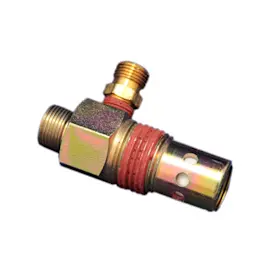
| Pressure rises by itself | Regulator is leaking internally (creep) | Replace or rebuild regulator; also check the tank check valve |
| Pressure drops quickly with no air use | External leak at regulator/fittings | Soap-test fittings; reseal or replace leaking connections |
| Pressure drops only when tool runs | Regulator restricted or worn; tool demand too high | Try higher tank pressure, larger hose, or regulator replacement |
| Knob changes nothing | Regulator mechanism failed | Replace regulator assembly |
A regulator that creeps or droops can over-pressurize downstream hoses and tools, cause inconsistent nail depth or torque, and make the compressor cycle more often than it should.
- Tank won’t hold air: leaks at drain valve, safety valve, fittings, or tank check valve
- Can’t adjust output pressure: regulator issue or a blocked outlet/gauge
- Compressor won’t build pressure: pump, reed valves, or major system leak
For step-by-step symptom checks, use our DIY guides: air compressor can't adjust the output air pressure and air compressor air leaks.
Last updated: February 2026
What is the most common cause of air compressor failure?
The most common cause of air compressor failure (including on the Craftsman 919163550) is poor maintenance that leads to heat and wear: dirty intake filtration, moisture and contamination in the tank and lines, and worn seals and valves. Overheating and lubrication issues (when applicable) accelerate internal damage.
In real-world use, these issues show up before major pump damage:
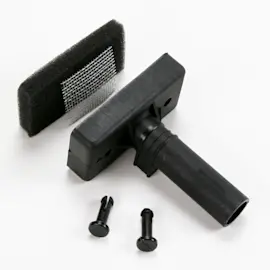
- Clogged or dirty air intake filter restricting airflow
- Moisture left in the tank causing internal corrosion and debris
- Air leaks at fittings, regulator, drain valve, or check valve
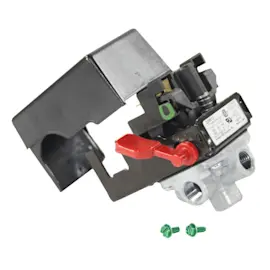
- Pressure switch problems (won’t start, won’t stop, or short-cycling)
- Overheating from poor ventilation, long run times, or high ambient temps
- Worn reed valves, piston seal, or cylinder components (low output, slow fill)
Use these steps to narrow the failure cause fast:
- Confirm power and reset: verify outlet power, cord condition, and any reset on the motor
- Listen at shutdown: a brief hiss is normal; constant leaking points to a valve or fitting issue
- Watch the gauges: if pressure rises very slowly, suspect leaks or pump wear
- Spray soapy water on fittings and connections to find bubbles (leaks)
- Drain the tank after use; water and sludge are common root causes
| What you notice | Most common cause | What to do next |
|---|---|---|
| Won’t start | Pressure switch, power issue, motor overload | Follow air compressor won't start |
| Runs but won’t build pressure | Leak, check valve, worn pump valves/seals | Follow air compressor won't build tank pressure |
| Tank loses pressure sitting | Leak at drain/fittings, check valve | Follow air compressor tank won't hold air |
| Safety valve pops | Overpressure control issue, bad valve, regulator problem | Follow air compressor safety valve keeps popping open |
Most “sudden” compressor failures are the end result of heat, moisture, and restriction. Keeping airflow clean, draining the tank, and fixing small leaks early prevents the pump and motor from running hotter and longer than designed.
Last updated: February 2026
Is it worth it to repair a compressor?
For a Craftsman 919163550 air compressor, repair is worth it when the problem is a single, clearly identified part (like a pressure switch, check valve, or regulator) and the tank and pump are in good condition. Replacement makes more sense when the pump is worn out or repairs keep repeating.
Use these checks before spending money on parts or labor:
- Repair if the compressor runs but has a control issue (won’t start, won’t shut off, won’t regulate pressure).
- Repair if the issue is an air leak at a fitting, drain valve, unloader line, or check valve.
- Repair if it builds pressure slowly but the pump still sounds smooth and consistent.
- Replace if the pump is knocking/grinding, seizing, or repeatedly tripping breakers after basic electrical checks.
- Replace if the tank is compromised (deep rust, pitting, or any sign of structural weakness).
Helpful troubleshooting paths we use:
Typical repair decisions come down to parts cost, time, and how many systems are affected.
| Situation | Typical fix | Usually worth repairing? |
|---|---|---|
| Won’t start, motor hums/clicks | Pressure switch, unloader, electrical checks | Yes |
| Won’t build pressure | Check valve, intake valve, gasket, leak hunt | Often |
| Can’t adjust outlet pressure | Regulator service/replacement | Yes |
| Loud mechanical noise, oil-free pump wear | Pump rebuild or major pump parts | Often no |
If you suspect pump wear, follow a structured approach before committing to major work: how to rebuild an air compressor pump
A “small” control or leak problem can make a good compressor seem dead, while a worn pump can turn into a cycle of repeat repairs. Deciding based on the tank condition, pump condition, and type of failure prevents wasted time and unsafe operation.
Last updated: February 2026
How to read compressor model numbers?
Air compressor model numbers identify the exact unit so we can match the right parts and diagrams. For Craftsman model 919163550, the model number is the primary identifier; the rest of the information you need (tank size, PSI, SCFM, voltage) comes from the data plate and the compressor’s specification label.
Look for a sticker or metal tag on the tank or frame. Record these items exactly as shown:
- Model number (example: 919163550)
- Serial number (used to identify production run and revisions)
- Voltage and amperage (often 120V, sometimes 240V-capable)
- Max tank pressure (PSI) and cut-in/cut-out pressures
- SCFM/CFM rating at common pressures (often listed at 40 PSI and 90 PSI)
- Pump type (oil-free vs. oil-lubricated) and motor HP (may be “peak” or “running”)
Unlike refrigeration compressors (where the model string often encodes refrigerant and displacement), most consumer air compressors use the model number mainly as an ID. Use this workflow instead:
- Match the model number first to pull the correct parts breakdown.
- Use the data plate to confirm electrical and performance specs.
- Identify the subsystem you’re working on (pressure switch, regulator, check valve, pump, gauges).
| Identifier | What it tells you | What we use it for |
|---|---|---|
| Model number | Exact product family and configuration | Correct parts list and diagrams |
| Serial number | Build sequence and revisions | Confirming compatible replacements |
| Spec label (PSI/SCFM/voltage) | Performance and electrical requirements | Troubleshooting and safe setup |
A single digit off can point to a different Craftsman air compressor with a different pressure switch setting, regulator style, or pump configuration. Using the exact model number plus the data plate specs prevents ordering the wrong replacement and helps you troubleshoot faster.
If you’re reading the label because the compressor is acting up, these guides map symptoms to the most likely parts and checks:
- Air compressor won't start
- Air compressor won't build tank pressure
- Air compressor air leaks
- Air compressor can't adjust the output air pressure
Last updated: February 2026
What company makes Craftsman air compressors?
Craftsman air compressors (including model 919163550) have been built by multiple manufacturers over the years because Craftsman is a brand name used on tools made by different OEMs. The most accurate way to identify the maker for your specific unit is to read the manufacturer information on the compressor’s data plate.
Use the physical ID information on the compressor; it ties your exact build to the correct parts and repair approach.
- Find the data plate on the tank, frame, or shroud (often near the motor or pump)
- Record the full model number 919163550 and any type/serial numbers
- Look for an OEM name, city/state, or a compliance listing label that names the manufacturer
- Note electrical ratings (voltage, amps) and pressure ratings (cut-in/cut-out) for matching controls
- Compare your control layout (pressure switch, regulator, unloader line) to repair instructions before disassembly
Model prefixes are sometimes used as a quick reference, but they are not a reliable manufacturer ID by themselves.
| Identifier | Where to find it | What it’s good for |
|---|---|---|
| Model number (919163550) | Data plate, paperwork | Finding the correct parts diagrams and repair info |
| Serial/type number | Data plate | Matching production run details |
| Manufacturer name | Data plate label | Confirming who built your specific compressor |
Different OEM builds can use different pressure switches, check valves, regulators, and pump designs even when the compressor is branded Craftsman. Confirming the manufacturer from the data plate helps you avoid ordering incompatible parts and speeds up troubleshooting.
Start with symptom-based steps to narrow the problem to electrical start-up, air delivery, or controls.
- No run condition: air compressor won't start
- Runs but won’t pressurize: air compressor won't build tank pressure
- Hard restart with air in tank: air compressor won't start with a full air tank
Last updated: February 2026