Owner’s manual
 Error Codes


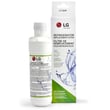
Are all LG refrigerator water filters the same?
No. LG refrigerators do not all use the same water filter; the correct filter depends on the exact model and filter housing design. For LG model LRFDC2406D, the owner's manual lists replacement cartridges such as LT1000P, LT1000PC, LT1000PCS, or ADQ747935.
How to confirm the right filter for LRFDC2406D
We recommend matching the filter by model and by what the refrigerator’s filter compartment accepts.
- Check the replacement cartridge list in the owner's manual
- Replace the filter about every 6 months, or when the Replace Filter icon turns on
- If water flow slows at the dispenser, replace the filter even if it has been less than 6 months
- After installing the new filter, press and hold Water Filter for 3 seconds to reset the indicator
- Flush 2.5 gallons of water after replacement (about 5 minutes) to clear air and contaminants
What “not the same” usually means
Different LG filters can vary by:
- Physical fit (tabs, threads, quarter-turn style)
- Rated capacity (commonly around 200 gallons for many LG systems)
- Flow rating (often around 0.5 gpm)
- Certification and contaminant reduction claims
Quick comparison: what to match
| What to match | Why it matters | What to look for |
|---|---|---|
| Model compatibility | Prevents leaks and poor fit | LRFDC2406D listed in the manual |
| Cartridge type | Ensures proper sealing | LT1000P family or ADQ747935** |
| Replacement interval | Maintains taste and flow | About every 6 months |
Why it matters
Using the correct filter helps maintain water taste, protects the water valve and dispenser system, and reduces the chance of leaks caused by a poor seal or incorrect cartridge fit.
For step-by-step help, use our how to replace the water filter in an LG refrigerator guide.
Last updated: February 2026
How do you reset the bottom ice maker?
On the LG LRFDC2406D bottom-mount refrigerator, we reset the bottom ice maker by power-cycling it and re-seating the ice bin so the shutoff sensor reads correctly. After reset, the ice maker will only run once it is cold enough (15 °F or below) and turned ON.
Reset steps (safe, no tools)
- Remove the ice bin/bucket and empty it; shake it to level ice if it was stacked unevenly.
- Turn the ice maker OFF using the ice maker power switch/button.
- Wait 30 seconds.
- Turn the ice maker back ON.
- Reinstall the ice bin fully and close the ice compartment door tightly.
- Allow up to 24 hours to confirm normal production.
What to check if it still will not make ice
- Temperature: the ice maker will not operate until it reaches 15 °F (–9 °C) or below.
- Water supply: if the water line is not connected or the supply is shut off, keep the ice maker OFF to prevent valve buzzing and potential damage.
- Ice bin full or misread: unevenly stacked ice can make the ice maker think the bin is full; leveling the ice helps.
- Door not sealing: if the ice compartment door is not closed tightly, cold air loss can stop ice production.
- Shutoff sensor path blocked: keep a clear path so the sensor can detect the bin level.
Quick reference
| Symptom | Most likely cause | What we do first |
|---|---|---|
| No ice at all | Ice maker OFF or not cold enough | Turn ON; verify freezer is at or below 15 °F |
| Stops early, bin not full | Ice stacked unevenly | Empty and shake/level ice bin |
| Buzzing sound, no water connected | Ice maker left ON without water | Turn ice maker OFF until water is connected |
| Ice clumping in bin | Infrequent dispensing | Dump old ice; make a fresh batch |
Why it matters
A proper reset clears false “bin full” readings and ensures the ice maker only runs when temperature, door sealing, and water supply conditions are correct. That prevents nuisance stoppages and protects the water valve.
For model-specific control locations and operating notes, use the LRFDC2406D owner's manual.
Last updated: February 2026
How to tell if an LG refrigerator compressor is bad?
If your LG LRFDC2406D isn’t cooling and you’re hearing repeated clicking, short cycling, or the unit runs almost constantly while temperatures stay warm, the compressor or its start components may be failing. First rule out normal long run times from warm rooms, frequent door openings, or a clogged condenser cover.
Quick checks before blaming the compressor
Many “bad compressor” symptoms are caused by airflow, door sealing, or normal operating sounds.
- Confirm the doors close fully and seal tightly (a door left ajar makes the compressor run longer).
- Check room temperature; at about 70°F, it’s normal for the compressor to run roughly 40% to 80% of the time.
- Clean the condenser cover and vents with a vacuum attachment (do not remove the rear panel).
- Listen for normal sounds like gurgling (refrigerant flow) and whooshing (fans).
- Make sure the refrigerator is level and not vibrating against a wall or cabinet.
For model-specific operating and troubleshooting guidance, use the LRFDC2406D owner's manual.
Signs that point to a compressor problem
These symptoms are more consistent with a sealed-system or compressor issue:
- Refrigerator and freezer both warm after 24 hours of operation
- Repeated clicking every few minutes (trying to start, then stopping)
- Short cycling (starts and stops quickly) with little or no cooling
- Very hot compressor area combined with poor cooling
- No ice production because the freezer never reaches proper temperature
Normal vs. not normal (sound and run behavior)
| What you notice | Often normal | More likely a problem |
|---|---|---|
| High-pitched or pulsating hum | Yes (efficient compressor) | Only if cooling is poor |
| Clicking occasionally | Yes (controls cycling/defrost) | Repeating start-click pattern |
| Runs a lot | Yes (doors opened, warm room) | Runs constantly and stays warm |
Parts that are commonly involved
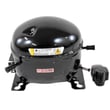
If diagnosis confirms a compressor failure, the replacement for this model is the refrigerator compressor TCA36811409. If the issue is cooling performance tied to defrost problems (ice buildup, warming), a sensor issue can mimic compressor trouble; the refrigerator defrost sensor assembly 6615JB2005R is one related part used in the defrost system.
Why it matters
A true compressor or sealed-system failure affects both compartments and won’t improve with cleaning or temperature adjustments. Ruling out door sealing, condenser airflow, and normal operating sounds prevents unnecessary part replacement and gets you to the right repair faster.
Last updated: February 2026