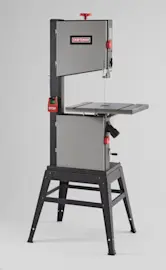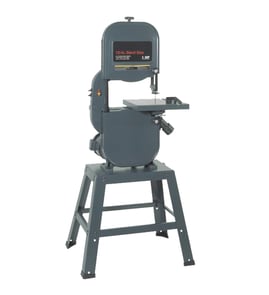

What are the top 5 bandsaw uses?
For the Sears 10324300 12" band saw, the top uses are making curved cuts, ripping and crosscutting stock, resawing thick boards into thinner pieces, cutting joinery and notches, and trimming small parts accurately. The right blade width and tooth count make the biggest difference in results.
- Curved cuts and patterns (scroll-style work): Use a narrower blade; keep blade tension and tracking steady.
- Ripping and crosscutting lumber: Use a wider blade for straighter cuts; use a fence or straightedge.
- Resawing (thick to thin boards): Use the widest blade your saw supports; go slow and use a tall resaw fence.
- Joinery and shaping (tenons, notches, tapers): Use a sharp blade and a miter gauge or jig for repeatability.
- Small-part trimming and craft work: Use a fine-tooth blade; support the workpiece with a stable table and push sticks.
| Task | Blade width (typical) | Tooth style (typical) | Why it helps |
|---|---|---|---|
| Tight curves | 1/8" to 1/4" | Fine tooth | Turns tighter without binding |
| General woodworking | 3/8" to 1/2" | Medium tooth | Balanced speed and finish |
| Resawing | 1/2" to 3/4" | Coarser tooth | Clears sawdust and tracks straighter |
| Thin stock, plastics | 1/8" to 3/8" | Fine tooth | Reduces chipping and grabbing |
Matching the blade to the job reduces drift, burning, and rough edges, and it also lowers strain on the motor, wheels, and guides. That means cleaner cuts and fewer adjustments on your Sears 10324300.
- Keep blade guides close to the work to reduce deflection.
- Check wheel tires and guide bearings if the blade wanders or chatters.
- Replace dull blades early; a dull blade is the most common cause of poor cuts.
- Unplug the saw before changing blades or adjusting guides.
You can look up diagrams and replacement items for the Sears 10324300, or search by model number on Sears PartsDirect.
Last updated: February 2026
What is the 3-tooth rule for bandsaws?
The 3-tooth rule for a band saw means you choose a blade tooth pitch (TPI) so at least 3 teeth are in the cut at all times when using your Sears 10324300 12-inch band saw. This prevents tooth snagging, reduces vibration, and helps the blade track and cut smoothly.
- Measure the material thickness at the cut (the direction the blade travels through).
- Pick a blade where that thickness keeps 3 or more teeth engaged.
- If the cut is rough or the blade grabs, move to a finer TPI.
- If the blade burns or loads up with sawdust, move to a coarser TPI.
- For mixed-thickness cuts, choose TPI based on the thinnest section.
Use this as a practical starting point for most 12-inch band saw work.
| Material thickness being cut | Typical blade pitch to keep 3+ teeth engaged |
|---|---|
| 1/8 inch (0.125) | 18 to 24 TPI |
| 1/4 inch (0.25) | 10 to 14 TPI |
| 1/2 inch (0.50) | 6 to 10 TPI |
| 1 inch and thicker | 3 to 6 TPI |
When fewer than 3 teeth contact the work, the blade tends to hook and chatter, which can pull the workpiece, damage teeth, and make the cut wander. Keeping multiple teeth engaged spreads the cutting load across the blade for better control and longer blade life.
- Blade tension: Too loose causes drift and flutter; too tight stresses bearings.
- Guide blocks/bearings: Set close to the blade without pinching it.
- Feed rate: Let the teeth cut; forcing the stock dulls the blade faster.
- Blade condition: Dull teeth mimic the symptoms of the wrong TPI.
If you are shopping for a replacement blade or other parts for model 10324300, start with the parts list for your saw, or search by model number on Sears PartsDirect.
Last updated: February 2026
What size band saw blade for sears 12 in?
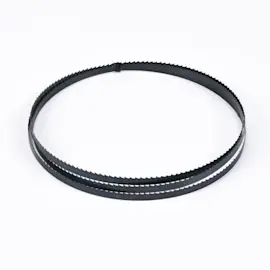
For the Sears 10324300 12-inch band saw, the correct blade size is the one that matches your saw’s required blade length and your cutting needs for blade width and TPI. We recommend confirming the blade length from your current blade or by measuring before ordering on Sears PartsDirect.
Start with blade length because it determines whether the blade can tension and track correctly on the wheels.
- Blade length: must match your saw’s design (most critical)
- Blade width: choose based on curve radius and cut stability
- TPI (teeth per inch): choose based on material thickness and finish
- Blade type: wood, metal-cutting, or general-purpose
These are common selections for 12-inch band saws once you have the correct length.
| What you’re cutting | Typical blade width | Typical TPI | Why it works |
|---|---|---|---|
| Tight curves, scroll work | 1/8 in. to 1/4 in. | 10 to 14 | Turns tighter with less binding |
| General wood cutting | 1/4 in. to 3/8 in. | 4 to 6 | Good balance of speed and control |
| Thin wood, plastics | 1/4 in. | 6 to 10 | Cleaner cut, less grabbing |
| Metal (with a metal-rated blade) | 1/4 in. | 14 to 24 | Smoother feed, less tooth snagging |
Use one of these reliable methods:
- Check your current blade for printed specs (often shows length, width, and TPI)
- If the blade is off the saw, lay it flat and measure the full end-to-end length
- If the blade is broken, align the ends and measure the total length
- If the blade is installed, mark a point on the blade, rotate the wheels by hand one full loop, then measure the distance traveled
A blade that is even slightly off in length can prevent proper tensioning, cause poor tracking, and increase the chance of the blade coming off the wheels. Correct width and TPI improve cut quality and reduce burning and wandering.
Last updated: February 2026