Owner’s manual
 Error Codes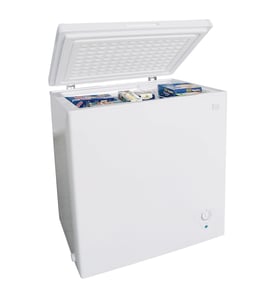




Where is the model number on a Kenmore chest freezer?
On a Kenmore chest freezer like model 25312812510, the model and serial number are on the serial plate inside the appliance compartment (typically on an inside wall). We recommend recording both numbers exactly as shown for parts lookup and service reference in the owner's manual.
Common places to check on a Kenmore chest freezer
Look for a paper or metal rating label in these spots:
- Inside the freezer compartment on an interior side wall
- Near the top edge of the opening, just under the lid
- On the left exterior wall on some chest models (near the temperature control area)
- Behind or near the front lower area if your unit has a trim panel
- On the back of the cabinet (less common, but possible)
What the label looks like and what to write down
The serial plate usually includes both identifiers. Copy them exactly, including punctuation.
| What to record | Example format you may see | Why you need it |
|---|---|---|
| Model number | 253.12812510 (may appear with a dot after 253) | Ensures you get the correct Kenmore parts list |
| Serial number | Letters and numbers | Helps match production run details for certain parts |
Why it matters
Kenmore model numbers often share the same first digits across multiple freezer sizes and feature sets. Using the exact model number from the serial plate helps us match the correct diagrams and parts (such as a temperature control thermostat, lid hinge, or door key) for your specific freezer.
Last updated: February 2026
Do chest freezers have coils to clean?
Yes, many chest freezers have condenser coils (or a condenser surface) that can collect dust and should be cleaned periodically; on the Kenmore 25312812510, the best way to confirm the coil location and cleaning approach is to follow the care and cleaning guidance in the owner's manual.
How to tell if your freezer has coils that need cleaning
Look for signs that your condenser area is exposed to household dust:
- A visible coil or tubing near the compressor compartment
- A warm-to-hot exterior wall area where heat is rejected
- Pet hair and lint collecting near the lower rear or side areas
- Longer run times than normal (especially after seasonal changes)
- Reduced cooling performance after the freezer has been in a dusty space (garage, basement)
Safe coil-cleaning basics (what we recommend)
Before cleaning, protect the sealed system and electrical components.
- Unplug the freezer before cleaning around the compressor area
- Use a soft brush and vacuum to remove dust; avoid bending tubing
- Keep water and cleaners away from wiring, relays, and the control area
- Maintain airflow clearance around the cabinet after cleaning
- If you see heavy dust buildup, clean more often (pets and garages usually need it)
What to clean inside vs. outside (quick guide)
The manual focuses heavily on defrosting and cleaning the cabinet surfaces; coil cleaning is separate from interior cleaning.
| Area | What to use | What to avoid |
|---|---|---|
| Inside surfaces | Baking soda and warm water | Abrasive cleaners, metallic scouring pads |
| Removable parts | Mild detergent and warm water | Dishwasher cleaning |
| Outside cabinet | Mild liquid detergent and water | Harsh/alkaline solutions |
| Condenser area (if accessible) | Vacuum and soft brush | Spraying water directly on components |
Why it matters
A dusty condenser cannot shed heat efficiently, so the compressor may run longer and temperatures can drift. Keeping the condenser area clean supports stable freezing and can help reduce energy use.
Related part that can be involved in cooling-system service
If you are doing sealed-system service (typically technician work), the refrigeration circuit may include a filter dryer such as the dryer filter 5303305677.
Last updated: February 2026
Why is my Kenmore chest freezer beeping?
Your Kenmore chest freezer model 25312812510 typically beeps to alert you to a temperature or power-related condition, most commonly after the freezer has been unplugged or power was interrupted. Resetting the alarm and confirming the temperature control setting usually stops the beeping; use the 25312812510 owner's manual for the exact alarm behavior on your unit.
Common reasons a chest freezer beeps
- Recent power interruption or the freezer was unplugged and restarted
- Lid left open or not sealing tightly (warm air entering the cabinet)
- Freezer temperature is too warm after loading a lot of unfrozen food
- Control setting was changed and the cabinet has not stabilized yet
- Electrical supply issue (outlet controlled by a wall switch, GFCI outlet nuisance trips)
What to do first (quick checks)
- Make sure the lid is fully closed and nothing is preventing it from sealing.
- Check the temperature control knob setting; return it to your normal setting if it was bumped.
- If you recently added food, allow several hours for temperatures to recover.
- Verify the freezer is plugged into a dedicated, always-on grounded outlet (not a wall switch or pull-cord controlled outlet). The manual also advises avoiding GFCI outlets for this type of appliance.
- If the beeping is paired with a light or indicator, note what you see and compare it to the alarm section in the manual.
Parts that can be involved (if the alarm is tied to a lid or control issue)
If the beeping is triggered by a lid-open condition or a control problem, these model-compatible parts are commonly involved:
| Symptom | What it points to | Example part for this model |
|---|---|---|
| Beeps when lid is closed, light behavior seems wrong | Lid/door switch not actuating | Freezer door switch 216822900 |
| Temperature seems unstable or control feels inconsistent | Temperature control component issue | Freezer temperature control thermostat 216714600 |
| Control knob is missing, cracked, or slipping | Knob not turning the control correctly | Freezer temperature control knob 216707200 |
Why it matters
A beeping alarm is your freezer’s way of warning that food-safe temperatures may not be maintained. Addressing power, lid seal, and temperature control issues quickly helps prevent thawing and excessive frost buildup.
Last updated: February 2026
What can cause a chest freezer to stop working?
A Kenmore chest freezer model 25312812510 can stop working because of a power supply problem, airflow or frost issues, or a failed cooling-system component such as the temperature control or compressor start parts. Start with simple checks, then move to control and compressor diagnostics using the 25312812510 owner's manual.
Quick checks first (most common causes)
- Confirm the outlet has power (try a lamp) and the breaker is not tripped.
- Make sure the temperature control is not set to OFF or too warm; the control is adjustable and typically located on the left exterior wall on chest models.
- Keep the lid closed as much as possible; frequent opening warms the cabinet quickly.
- Avoid overloading with warm food; the manual recommends freezing only about 3 lb of fresh food per cubic foot at one time and distributing packages evenly.
- Check for heavy frost buildup; if the defrost indicator/button area is fully covered with frost (on models that have it), it is time to defrost and clean.
- Verify the drain plug is fully installed after defrosting; an open drain lets warm air enter.
Parts that commonly cause a “won’t run” or “stopped cooling” symptom
If basic power and settings look good, these model-matched parts are common suspects:
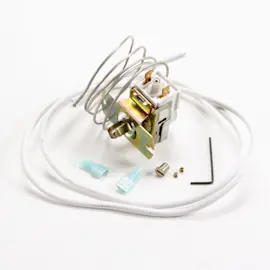
- Failed temperature control: freezer temperature control thermostat 216714600
- Broken or loose control knob: freezer temperature control knob 216707200
- Compressor not starting (clicking, humming, then stopping): freezer compressor overload and relay clamp 216954300 or Kenmore elite refrigerator compressor start relay 297259505
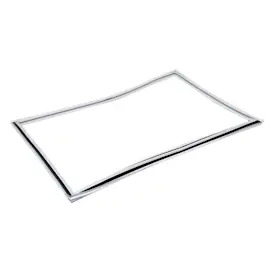
- Lid not sealing or not closing correctly (warm air leaks, frost, poor cooling): inspect gasket/liner fastening points; consider frigidaire freezer gasket and liner fastener kit 5304406520
Symptom-to-cause guide
| What you notice | Likely cause | What to do next |
|---|---|---|
| No lights, no sound | No power, tripped breaker, bad outlet | Verify outlet power and reset breaker |
| Runs but not freezing | Frost buildup, lid leak, warm load | Defrost, check seal, reduce warm load |
| Clicking near compressor | Start device/overload issue | Inspect/replace start components |
| Temperature won’t change | Control knob or thermostat issue | Check knob fit; test/replace thermostat |
Why it matters
A chest freezer that stops running can keep food frozen for a limited time if kept closed (the manual notes at least 24 hours in many power-failure situations). Fast troubleshooting helps protect food quality and prevents excessive frost and warm-air intrusion.
Last updated: February 2026
How big is a Kenmore chest freezer model 25312812510?
Kenmore chest freezer model 25312812510 is a full-size chest freezer; most Kenmore chest freezers in this series are roughly 40 to 50 inches wide, 30 to 35 inches tall, and 20 to 30 inches deep, with about 10 to 15 cu. ft. of capacity. For the exact published dimensions for your unit, use the 25312812510 owner's manual.
Get the exact size from the manual
Use the specifications section so you have the manufacturer’s numbers for delivery and fit.
- Look for dimensions (W x H x D) and capacity (cu. ft.)
- Check whether depth is listed with lid/handle closed and whether any trim is included
- Note required clearances for airflow around the cabinet
- Confirm electrical requirements and recommended placement details
Measure your freezer at home (so it matches the specs)
Measure at the widest points; chest freezers often have small protrusions that change the real-world fit.
- Width: widest point of the cabinet (include hinges or corner trim if they stick out)
- Depth: front to back at the deepest point
- Height: floor to the top of the closed lid
- Lid clearance: space above and behind so the lid opens fully
| What you need | What to measure | Typical planning allowance |
|---|---|---|
| Fit through doorways | freezer width and depth | add 1 to 2 inches for maneuvering |
| Final placement | width, depth, height | leave a few inches for airflow |
| Usable storage | capacity (cu. ft.) | baskets reduce “bulk” space slightly |
Why it matters
Correct dimensions prevent delivery surprises and protect performance; tight installs restrict airflow, which makes the compressor run longer and increases energy use.
Last updated: February 2026