Error Codes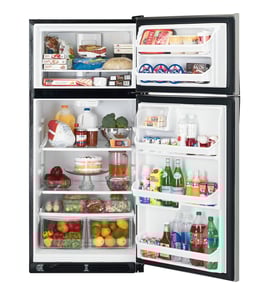



What number should my Hotpoint fridge freezer be set at?
For a Hotpoint HPS18BTNFRBB top-mount refrigerator, we set the fresh food control near the middle (typically 3) and then adjust to keep the refrigerator at 37°F and the freezer at 0°F. Give the unit about 24 hours to stabilize after each change.
Recommended starting point
- Start at 3 (mid-setting) for both sections if you have separate controls.
- If your dial runs 1 to 5, 5 is coldest on most Hotpoint-style controls.
- If your dial runs 1 to 9, start around 4 to 5.
- Adjust in one-step increments only.
How to fine-tune the setting
Use a fridge thermometer (or two) and make small changes based on actual temperatures:
- Too warm in refrigerator (over 40°F): turn the refrigerator control colder 1 step
- Freezer too warm (over 5°F): turn the freezer control colder 1 step
- Items freezing in refrigerator: turn the refrigerator control warmer 1 step
- Frost buildup or weak airflow: check the evaporator fan operation (see how to fix your evaporator cooling fan)
- Door not sealing well: inspect and clean the gasket sealing surface; replace if torn (see refrigerator door gasket (black) WR14X27235)
Quick guide: what the numbers usually mean
| Dial setting | What it typically does | When to use it |
|---|---|---|
| 1 to 2 | Warmest | Lightly loaded fridge, cool room temps |
| 3 | Normal | Most households, everyday use |
| 4 to 5 (or higher) | Coldest | Hot kitchen, frequent door opening, heavy load |
Why it matters
Correct settings protect food safety and reduce compressor run time. Keeping the refrigerator near 37°F helps prevent spoilage, and keeping the freezer near 0°F helps prevent thawing and ice quality problems.
Last updated: February 2026
Is an 18 cu ft refrigerator enough?
Yes. An 18 cu. ft. top-mount refrigerator like the Hotpoint HPS18BTNFRBB is the right size for 1 to 2 people and many small households; it typically holds a week of groceries if you shop regularly and do not buy bulky items in bulk.
Quick sizing guide (who 18 cu. ft. fits best)
- 1 to 2 people: Great fit for weekly shopping and leftovers
- Small family (3 people): Works if you shop more often and keep fewer bulk items
- 4+ people or bulk shoppers: Usually feels tight, especially in the freezer
- Meal prep heavy households: Space fills fast with containers and sheet pans
- Entertaining often: You may want more shelf and door-bin capacity
What to consider before you decide
Even when the cubic feet look right, day-to-day usability depends on how the space is laid out.
| Your habit | 18 cu. ft. outcome | What helps |
|---|---|---|
| Weekly shopping | Usually enough | Use clear bins and keep a “use first” shelf |
| Bulk buying (warehouse clubs) | Often not enough | Choose fewer bulky packages, repackage into containers |
| Lots of frozen foods | Freezer gets crowded | Rotate stock, avoid oversized boxes |
| Fresh produce heavy | Can be enough | Use crispers correctly and avoid blocking vents |
How to make an 18 cu. ft. fridge feel bigger
- Set the refrigerator to about 37°F and freezer to about 0°F for efficient storage
- Leave airflow space around vents so cooling stays even
- Use stackable containers to reduce wasted shelf height
- Keep door bins for condiments and drinks, not items that need the coldest temps
- Clean spills and odors early so food does not get tossed unnecessarily (see how to get rid of refrigerator smells)
Why it matters
Choosing the right capacity helps food stay colder, reduces overstuffing that blocks airflow, and can cut down on temperature swings that lead to spoilage and freezer burn.
Last updated: February 2026
How wide is a 18.3 cubic foot refrigerator?
Most 18.3 cubic foot top-mount refrigerators measure about 30 inches wide; for your Hotpoint HPS18BTNFRBB, plan on a typical 29 3/4 to 30 1/4 inch cabinet width and confirm the exact cutout by measuring your unit (no model-specific width data is provided here).
Quick sizing guidance (what to measure)
Use a tape measure and record these three numbers:
- Cabinet width: left side to right side of the refrigerator case (not the doors)
- Overall width: widest point with doors closed (handles can add width)
- Clearance width: opening width plus side clearance for airflow and door swing
Typical width ranges for this size class
Most 18 to 19 cu. ft. top-freezer models fall into these ranges:
| Measurement | Typical range | Notes |
|---|---|---|
| Cabinet width | 29 3/4 to 30 1/4 in. | What most people mean by “30-inch fridge” |
| Overall width (with doors/hinges) | 30 to 31 1/2 in. | Depends on hinges, door contour, and handles |
| Recommended side clearance | 1/8 to 1/2 in. each side | Helps airflow and reduces vibration noise |
Fit and airflow checklist
- Leave enough room for the doors to open without hitting walls or cabinets.
- Make sure the refrigerator can slide out for cleaning and service.
- Keep the condenser area clear; restricted airflow can raise temperatures.
- If the doors do not seal well after moving the fridge, inspect the gasket.
- If you are correcting a poor seal, the refrigerator door gasket (black) WR14X27235 is a common wear item on this model.
Why it matters
Width is only part of the fit. Door swing clearance and ventilation space affect cooling performance, energy use, and whether the doors close tightly (which helps prevent frost and temperature swings).
Last updated: February 2026