Owner’s manual
 Error Codes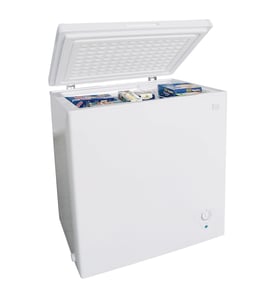

How much meat can you fit in a 7 cu ft freezer?
A 7 cu. ft. chest freezer like the GE FCM7DUFWW typically holds about 200 to 250 lb of packaged meat, depending on cut size, packaging, and how tightly it’s stacked. For best results, freeze meat in batches so the freezer can pull temperatures down quickly (see the FCM7DUFWW owner’s manual).
Packaging and organization change real-world capacity more than the cubic-foot rating.
- Whole/half animal orders: A 7 cu. ft. freezer commonly fits about a half hog or a quarter to half beef, depending on how it’s wrapped.
- Boxed meat (retail packs): Expect closer to the high end if you repackage into flat, stackable portions.
- Bone-in cuts: Take more space than boneless cuts.
- Air gaps: Wasted space adds up fast; use baskets and stack flat packages.
- Freeze in stages: The manual notes a freezer is designed to freeze about 3 lb per cubic foot at one time (about 21 lb at once for 7 cu. ft.).
| Freezer size | Typical packaged meat capacity | “Freeze at one time” guideline |
|---|---|---|
| 7 cu. ft. chest freezer | 200 to 250 lb | About 21 lb |
- Rewrap into flat, uniform packages (they stack like books).
- Label with cut and date on the broad side.
- Group by type (ground, steaks, roasts) and use a top basket for frequent items.
- Keep a simple inventory list on the lid.
Overloading a warm freezer with too much unfrozen meat at once slows freezing, which can reduce food quality and make the freezer run longer. Freezing in batches helps the GE temperature control maintain safe, consistent temperatures.
Last updated: January 2026
Is the GE chest freezer 7 cu ft any good?
Yes. The GE FCM7DUFWW 7 cu ft chest freezer is a solid choice when you want reliable extra frozen storage with simple manual-defrost operation. It is designed for steady temperature control and practical everyday use; setup, operation, and care details are covered in the FCM7DUFWW owner's manual.
A chest freezer is “good” when it holds temperature consistently, runs normally without excessive noise, and fits your storage needs.
Key strengths most owners look for:
- Consistent freezing performance when the lid stays closed
- Simple temperature control (no complicated settings)
- Efficient storage for bulk items
- Straightforward cleaning and odor control
- Predictable behavior during short power outages
The manual notes that keeping the lid closed helps food stay frozen during an extended power failure (about 24 hours if warm air is not admitted). It also gives guidance for longer outages (dry ice, moving food to a locker). These are the kinds of real-world details that matter when judging overall value.
| Topic | What to expect | What helps most |
|---|---|---|
| Temperature stability | Stable temps with normal use | Limit lid openings, avoid overloading warm food |
| Power outage holdover | About 24 hours if kept closed | Keep lid shut, add dry ice if needed |
| Odor control | Odors can build over time | Baking soda box, replace every 3 months |
| Cleaning | Manual defrost and wipe-down | Unplug before cleaning, avoid abrasives |
- Keep the lid closed as much as possible; frequent openings warm the cabinet.
- Follow the manual’s guidance on how much unfrozen food to add at one time (based on freezer capacity).
- For odors, use an open box of baking soda and replace it every three months.
- Unplug the freezer before cleaning, changing a light bulb, or doing any repair work.
- If you need to defrost it, plan ahead and protect floors from meltwater.
Chest freezers are long-term storage appliances; day-to-day habits (lid openings, loading warm food, cleaning) have a bigger impact on satisfaction than extra features. When used as intended, this GE chest freezer delivers dependable storage and predictable operation.
Last updated: January 2026
What are the common chest freezer problems?
Common problems on the GE FCM7DUFWW chest freezer include warm temperatures, heavy frost buildup, constant running, water leaks during defrosting, and unusual noises. Most issues trace back to airflow and loading, lid sealing, or temperature control settings; the FCM7DUFWW owner's manual covers normal operation and safe defrosting steps.
- Freezer too warm: lid not sealing, control set too warm, frequent lid openings, or a failing temperature control
- Freezer too cold or freezing unevenly: control set too cold, poor air circulation from overpacking
- Excessive frost: lid left open, moisture entering through a poor seal, or long time between defrosts
- Compressor runs a lot: warm room, heavy loading, lid openings, or frost buildup reducing efficiency
- Water on floor: defrost drain not capped, drain plug missing, or water overflow during defrosting
- Confirm the control setting: return it to your normal setting after any power outage or cleaning.
- Check loading and airflow: avoid packing food tightly against interior walls; leave space for cold air movement.
- Defrost when frost reaches about 1/2 inch: the manual notes many climates need defrosting about twice per year, and scraping should be done with a plastic or wood tool (not sharp metal).
- Use the drain correctly during defrost: chest models have a front defrost drain; reinstall the internal drain plug and the outside cap when finished.
- Listen for “normal” sounds: gentle humming and occasional clicks are typical; loud buzzing, repeated clicking, or grinding points to a component issue.
| Symptom | Most likely cause | Best next step |
|---|---|---|
| Too warm | Lid not sealing, control issue | Verify seal and setting; consider freezer temperature control thermostat WR50X10085 if temps will not stabilize |
| Heavy frost | Moisture intrusion, delayed defrost | Defrost properly; reduce lid-open time |
| Water leak during defrost | Drain cap/plug not installed | Check the drain cap and consider replacing the drain stopper WR01X28051 |
| Constant running | Warm load, poor airflow, frost | Defrost, improve airflow, limit openings |
Temperature swings and frost buildup make the freezer work harder, increase energy use, and can shorten compressor life. Keeping frost under control and using the drain correctly also prevents messy leaks during manual defrost.
Last updated: January 2026