Owner’s manual
 Error Codes

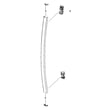
Can you get parts for a Samsung refrigerator?
Yes. For the Samsung RF22R7351SR refrigerator, we can help you find compatible replacement parts by matching your exact model number to the correct component list and diagrams. Use the RF22R7351SR user manual to confirm features (ice maker, water filter, FlexZone) before ordering parts.
How we match the right part to your refrigerator
Samsung model families can share similar names, but parts can vary by version. For RF22R7351SR, we recommend confirming these details first:
- Verify the full model number on the rating label matches RF22R7351SR
- Identify the symptom (no cooling, no ice, leaking, noisy operation)
- Confirm whether your unit uses a water line and filter
- Compare the part description to the location in the refrigerator diagrams
- Use the manual’s “Refrigerator at a glance” section to identify assemblies
Example of a model-matched part
One example part listed for this model is the compressor assembly: cmp, comp, refrigerator, r-600a NF54M7151ANE01. This is a sealed-system component; we recommend professional service for diagnosis and replacement.
| Part type | What it affects | Typical signs it’s involved |
|---|---|---|
| Compressor (sealed system) | Cooling in both fridge and freezer | Warm temps, long run time, clicking, no cooling |
Why it matters
Ordering by the exact model number helps prevent returns and delays. It also ensures the part you install fits correctly and supports proper temperatures, ice production, and water dispensing performance.
Last updated: January 2026
What is the average life expectancy of a Samsung refrigerator?
A Samsung refrigerator typically lasts 10 to 15 years with normal household use. For your Samsung RF22R7351SR, regular maintenance (especially keeping airflow clear and cleaning dust from the rear area) helps you reach the upper end of that range; see the care guidance in the RF22R7351SR user manual.
What affects lifespan the most
These factors usually make the biggest difference in how long a refrigerator runs reliably:
- Condenser and rear-area dust buildup (can increase run time and heat)
- Door seal condition (air leaks force longer compressor run time)
- Vent blockage inside the fresh food section (restricted airflow causes warm spots)
- Room temperature and clearance (tight spaces and heat sources add stress)
- Water filter and ice maker upkeep (clogs and low water pressure can create ongoing issues)
Maintenance checklist to help your RF22R7351SR last longer
We recommend these habits for Samsung bottom-mount models like RF22R7351SR:
- Keep the freezer at 0°F and the fridge at 37°F (recommended settings)
- Leave space around interior air vents; do not pack food tightly against vents
- Vacuum dust from the rear panel area about once or twice a year
- Clean and inspect door gaskets so doors close fully and seal evenly
- Replace the water filter when the indicator reminds you (typically about every 6 months)
Quick “repair vs. replace” guide by age
This is a practical way to think about value as the unit gets older:
| Refrigerator age | Typical approach | Why |
|---|---|---|
| 0–5 years | Repair is usually worthwhile | Most components still have strong remaining life |
| 6–10 years | Depends on the repair | Balance repair cost vs. remaining service life |
| 11–15 years | Repair only if minor | You are near typical end-of-life |
| 16+ years | Replacement often makes sense | Efficiency and reliability usually decline |
Why it matters
Knowing the typical lifespan helps you plan for maintenance and avoid food-loss surprises. A refrigerator that is kept clean, properly ventilated, and correctly temperature-set usually runs more efficiently and puts less strain on the sealed system.
Last updated: January 2026
What is the most common problem with Samsung refrigerators?
Across Samsung refrigerators (including the Samsung RF22R7351SR), the most common customer-reported issues are cooling performance problems, ice maker or dispenser troubles, and water dispensing or leaking concerns. On this model, many of those symptoms trace back to airflow restrictions, door sealing, or water supply and filter conditions.
Most common symptoms and what they usually point to
Start with these quick checks because they address the most frequent, non-invasive causes.
- Confirm the set temperatures are 37°F (fridge) and 0°F (freezer) (recommended in the manual).
- Make sure food packages are not blocking interior air vents.
- Check that doors close fully and the gaskets seal all the way around.
- If the display shows “0” (fridge) and “FF” (freezer), exit Cooling Off (Shop) mode.
- If water dispenses slowly, replace the water filter and reset the filter indicator.
For the exact button sequences (Cooling Off mode, Filter Reset, Control Lock), follow the RF22R7351SR user manual.
Symptom-to-cause guide
| Symptom you notice | Likely cause | What to do next |
|---|---|---|
| Fridge warm, freezer OK | Airflow restriction or frost buildup | Clear vents, verify door seal, check for heavy frost patterns |
| Fridge and freezer warm | Settings, ventilation clearance, or cooling system issue | Verify settings, allow time after changes, ensure cabinet airflow |
| Ice maker buzzing | Ice maker on but no water supply | Turn ice maker off until the water line is connected and turned on |
| Water flow weak | Clogged filter or low water pressure | Replace filter, confirm supply pressure is in range |
When a part may be involved
If the refrigerator is not cooling at all and a qualified diagnosis points to a sealed-system or compressor problem, one compatible component listed for this model is the cmp, comp, refrigerator, r-600a NF54M7151ANE01. Sealed-system repairs typically require a trained technician.
Why it matters
Cooling, ice, and water issues can lead to food spoilage, clumped ice, and longer run times that increase energy use. Addressing airflow, door sealing, and filter maintenance early helps prevent repeat problems.
Last updated: January 2026
What is the difference between force defrost FD and RD?
On the Samsung RF22R7351SR, “FD” and “RD” are not defined in the owner’s documentation as normal, customer-facing modes. When customers see FD or RD, it’s typically tied to a diagnostic or service routine used to melt frost; the exact behavior can vary by control setup.
What we can confirm for RF22R7351SR
Our RF22R7351SR user manual explains that this refrigerator defrosts automatically during normal operation, and it provides troubleshooting guidance for frost, airflow, and temperature issues. It does not list FD or RD as standard display codes.
What FD and RD usually mean (general Samsung service terminology)
Because FD/RD aren’t defined for this exact model in the owner’s manual, we treat them as commonly used service abbreviations rather than guaranteed, model-specific codes.
- FD is commonly used to mean forced defrost (a manually initiated defrost routine)
- RD is commonly used to mean refrigerator defrost (often interpreted as a defrost routine focused on the fresh-food section)
- Either routine is typically used to melt frost quickly during diagnosis or after an icing event
- During a forced defrost routine, cooling behavior can change (for example, fans may stop and you may hear water sizzling on the heater)
Quick comparison
| Display | Common meaning (general) | What it’s used for |
|---|---|---|
| FD | Forced defrost | Clearing heavy frost when troubleshooting |
| RD | Refrigerator defrost | Targeting frost symptoms mainly in the fridge section |
Why it matters
Forced defrost can remove ice temporarily, but it won’t fix the underlying cause. If frost returns, cooling and airflow can drop again.
What to check if you’re dealing with frost or warm temps
- Make sure doors close fully and the gaskets seal all the way around
- Keep packages from blocking interior air vents
- Use recommended settings: 37 °F fridge and 0 °F freezer
- If the ice maker or dispenser is acting up after icing, review why your Samsung fridge stopped making ice and how to fix it
- If you suspect a sealed-system issue (poor cooling, long run times), consider professional service; the compressor is a sealed-system component such as cmp, comp, refrigerator, r-600a NF54M7151ANE01
Last updated: January 2026