Owner’s manual
 Error Codes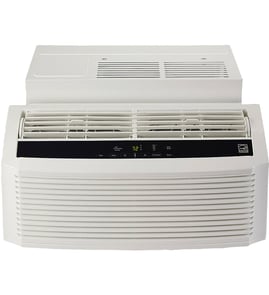



How big of a room can a 24000 BTU AC cool?
A 24,000 BTU room air conditioner like the GE AEE24DTH3 typically cools about 1,000 to 1,500 sq. ft. In very hot sun, high ceilings, or poor insulation, plan closer to 1,000 to 1,200 sq. ft. for better comfort and humidity control (check operating details in the owner's manual).
Quick sizing guide (24,000 BTU)
- Best fit: 1,000 to 1,500 sq. ft.
- Hot climate or lots of sun: 1,000 to 1,200 sq. ft.
- Open floor plans: expect uneven cooling; use fans to move air
- High ceilings (9 ft+): size toward the lower end of the range
- Poor insulation or leaky windows: size toward the lower end
Adjust the estimate for your space
Use this table to decide whether 24,000 BTU is the right match.
| Room conditions | Recommended coverage target | What you may notice if oversized/undersized |
|---|---|---|
| Average insulation, typical sun | 1,000 to 1,500 sq. ft. | Stable temps when set correctly |
| Heavy sun, hot upstairs, many windows | 1,000 to 1,200 sq. ft. | Undersized: runs constantly, still warm |
| Very tight, well-insulated space | Up to 1,500 sq. ft. | Oversized: short cycles, clammy feel |
Why it matters
Correct sizing helps your GE AEE24DTH3 maintain a steady temperature without excessive compressor cycling. When the unit is too small, it struggles to pull down temperature; when it is too large, it can cool fast but leave humidity behind.
Tips to get the best cooling from this model
The manual notes the thermostat range and normal compressor behavior; use these settings to improve comfort:
- Set Cool mode and start with Med or High fan for pull-down cooling.
- For nighttime comfort, use Low fan with a moderate set temperature.
- If you switch from Fan to Cool (or turn the unit back on), allow about 3 minutes for the compressor to start.
- Use Energy Saver based on occupancy: ON cycles the fan with the compressor; OFF runs the fan continuously.
For troubleshooting if cooling performance still seems off, use our window air conditioner running but not cooling guide.
Last updated: February 2026
What are the most common issues with AEE24DTH3?
For the GE AEE24DTH3 room air conditioner, the most common problems are poor cooling, the unit not turning on, weak airflow, water leaking or pooling, and unusual noise or vibration. These issues usually trace to airflow restrictions, electrical supply problems, or a failing fan or control component.
Most common symptoms and what they usually mean
- Not cooling well: dirty coils, blocked airflow, or a sealed-system problem (compressor or refrigerant circuit)
- Won’t power on: outlet or cord issue, internal electrical fault, or control board problem
- Fan runs but little airflow: dirty filter/evaporator, iced coil, or a weak fan motor
- Water dripping indoors: unit not tilted correctly, clogged drain path, or a damaged tray/valve
- Rattling or buzzing: loose hardware, fan blade contact, or worn motor mounts
Quick checks we recommend first
- Confirm the unit is plugged in firmly and the circuit is not tripped.
- Set mode to Cool and lower the set temperature; wait a few minutes for the compressor to start.
- Clean the air filter and clear any blockage at the front grille.
- Inspect for ice on the evaporator area; if iced, run Fan Only to thaw and improve airflow.
- Check that the cabinet is slightly tilted to the outside so condensate drains correctly (setup details are in the AEE24DTH3 owner’s manual).
Parts that commonly relate to these issues
If basic checks do not resolve the problem, these model-matched parts are often involved:
| Symptom | Common part involved | What it affects |
|---|---|---|
| Dead display, erratic operation | Room air conditioner electronic control board WJ26X25626 | Power distribution and command signals |
| No fan or weak airflow | Fan motor WJ95X10036 | Indoor/outdoor fan operation |
| Humming, hard start, trips breaker | Capacitor WJ20X20541 | Motor and compressor starting |
| Water pooling in base | Water tray WJ05X10064 or drain valve WJ58X10044 | Condensate collection and draining |
Why it matters
Room air conditioners like the GE AEE24DTH3 depend on steady airflow across the evaporator and condenser. When airflow is restricted or an electrical component is failing, cooling drops quickly and icing, leaks, and noise become more likely.
Last updated: March 2026
How do I find the model number on my AEE24DTH3?
The model number for your GE room air conditioner is printed on the rating label; on model AEE24DTH3, GE places that label on the side of the air conditioner cabinet. Use the model number and serial number from that label when ordering parts or checking specifications in the owner's manual.
Where to look on the unit
Check these common spots first (with the unit powered off):
- A label on the side of the air conditioner (most common for AEE24DTH3)
- The side panel area behind the front grille (if your installation blocks the side label)
- Near the power cord entry point or electrical/control area cover
- On the outer cabinet near the window mounting side
What the label looks like and what to write down
The rating label typically includes both identifiers you need.
| Label item | What it’s used for | Example format |
|---|---|---|
| Model number | Matching the correct diagrams and parts | AEE24DTH3 |
| Serial number | Identifying production run details | Letters and numbers |
Tips if the label is hard to read
If the sticker is worn, a quick cleanup usually makes it legible.
- Wipe dust off with a dry cloth first
- Use a slightly damp cloth; avoid soaking the label
- Take a close-up photo and zoom in to read characters
- Copy the model number exactly, including all letters and numbers
Why it matters
GE room air conditioner parts, controls, and wiring can vary by model and production run. Using the exact AEE24DTH3 model number helps ensure the right fit for items like the electronic control board, fan motor, or power cord.
Last updated: March 2026