Owner’s manual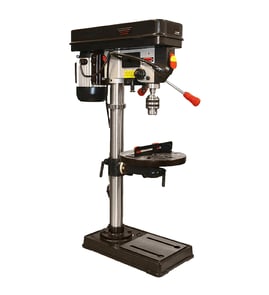

What are the three types of drill presses?
The three most common drill press types are benchtop, floor (standing), and magnetic drill presses. Your Craftsman 113213100 is an 8-inch benchtop drill press, designed for smaller workpieces and shop or garage use; see the 113213100 owner's manual for operating and safety details.
| Type | Typical use | Key advantage | Common limitation |
|---|---|---|---|
| Benchtop drill press | Light to medium drilling in wood, plastic, light metal | Compact and easy to mount on a bench | Less throat depth and table travel than floor models |
| Floor drill press | Larger stock, repeated drilling, heavier-duty work | More stability, capacity, and leverage | Needs more floor space |
| Magnetic drill press | On-site drilling in steel (fabrication, structural work) | Portable; magnet base holds to ferrous metal | Requires clean, flat steel surface and proper safety setup |
This model is built around a belt-and-pulley drive with three spindle speeds: 620 RPM, 1300 RPM, and 3100 RPM. We set speed by moving the belt positions inside the belt guard, then drilling with the correct feed pressure and work support.
- Clamp the workpiece to the table for larger holes so it cannot spin.
- Use backup material under wood to reduce splintering on the underside.
- Keep the belt guard closed during operation.
- Remove the switch key when you step away from the drill press.
- Avoid prohibited accessories (for example, do not use wire wheels or fly cutters on this drill press).
Choosing the right drill press type affects accuracy, safety, and results. A benchtop press like the Craftsman 113213100 is ideal when you want controlled, repeatable drilling without needing the size and capacity of a floor model.
If you need replacement parts for this drill press, we recommend searching by model number on Sears PartsDirect.
Last updated: February 2026
What is a good horsepower for a drill press?
For the Craftsman 113213100 8-inch drill press, a good horsepower is the motor size that matches your typical bit size and material; this model is rated at a maximum developed 1/3 HP, which is a solid fit for light-duty drilling in wood and smaller holes in metal when you use the correct speed and feed. For shopping or comparing motors and parts by model, use the parts list for 113213100 or search by model on Sears PartsDirect.
A 1/3 HP bench drill press like the Craftsman 113213100 is designed for controlled, lighter work where setup and technique matter as much as power.
- Drilling small to medium holes in wood with standard twist bits
- Light metal drilling with sharp bits, cutting oil, and slower speed
- Using the depth stop for repeatable holes
- General hobby, craft, and home shop tasks
If you routinely drill large-diameter holes, use Forstner bits often, or work thick steel, more horsepower helps maintain torque and reduces stalling.
- Frequent large bits (for example, larger spade bits or hole saws)
- Hard metals or thicker stock
- Production-style drilling where you want faster feed rates
- Accessories that increase load (always follow tool limitations)
This drill press has three spindle speeds; matching RPM to the material and bit size helps prevent overheating, bit dulling, and motor strain.
| Speed (RPM) | Typical use case | Why it helps |
|---|---|---|
| 620 | Larger bits, metal, harder materials | More torque, less heat |
| 1300 | General drilling in wood | Balanced speed and control |
| 3100 | Small bits in wood/plastics | Cleaner cuts with small diameters |
For the exact belt positions and operating limits, follow the 113213100 owner's manual.
Choosing the right horsepower and speed combination protects the motor, improves hole quality, and reduces the chance of grabbing, chatter, or broken bits, especially when drilling metal.
Last updated: February 2026
What is the 4 inch rule for drill press?
The 4-inch rule for a drill press means we keep our hands and fingers at least 4 inches away from the rotating drill bit, chuck, and spindle while the Craftsman 113213100 drill press is running. This reduces the risk of accidental contact and serious injury.
- Clamp the workpiece to the table whenever possible so your hands are not near the bit.
- Use a vise, hold-downs, or a fence for small parts instead of hand-holding.
- Keep the table support lock handle tightened and the head locked before drilling.
- Remove the chuck key immediately after tightening the bit.
- Let the bit cut at its own pace; do not push so hard that your hands drift toward the bit.
- Wear ANSI Z87.1 safety goggles and avoid loose sleeves, gloves, or jewelry.
Our Craftsman 113213100 manual calls out several drill-press-specific safety points that support the same goal as the 4-inch rule: keep the machine stable, keep the setup locked, and control the workpiece.
| Safety item | What we do | Why it helps |
|---|---|---|
| Stability | Bolt the drill press to the bench if it tends to tilt or move | Prevents shifting that can pull hands toward the bit |
| Workpiece control | Clamp large hole-cutting work firmly to the table | Reduces grabbing and spinning |
| Speed awareness | Use the correct belt position for the needed RPM | Helps prevent bit grabbing and loss of control |
| Accessory limits | Use only accessories designed for this drill press | Reduces thrown parts and sudden binding |
Most drill press injuries happen at the point of operation. Keeping a 4-inch buffer forces us to rely on clamps and proper setup instead of our hands, which is especially important when a bit grabs, the workpiece shifts, or the spindle is at higher RPM.
We recommend reviewing the safety section in the 113213100 owner's manual before operation, and using the parts list on this model page or searching by model number on Sears PartsDirect when you need replacement parts.
Last updated: February 2026
Where can I buy Craftsman replacement parts?
For your Craftsman drill press model 113213100, we recommend buying replacement parts by matching the model number and the exact part number from the parts list in the 113213100 owner's manual. You can also search and order by model number on Sears PartsDirect.
Use the drill press parts list and diagrams to identify the exact part number before ordering.
- Confirm the model number 113213100 (typically on a plate on the left side of the head)
- Find the part in the repair parts list (example items include the V-belt, spindle pulley, chuck, and quill bearings)
- Order by part number, not by the diagram key number
- Match the part description (for example, belt size and type)
- If you are replacing an electrical item, verify voltage and grounding requirements first
The manual’s repair parts section for the Craftsman 8-inch drill press model 113213100 lists many serviceable items. Here are examples you may see when shopping:
| Area | Example part type | What it affects |
|---|---|---|
| Drive system | V-belt, pulleys | Speed changes, slipping, vibration |
| Quill/spindle | Bearings, spindle shaft | Runout, noise, drilling accuracy |
| Chuck | Chuck, chuck key | Bit holding, wobble |
| Table/support | Table, support lock handle | Work support and alignment |
Ordering by the correct model number and part number prevents fit issues and saves time, especially on older power tools where similar Craftsman drill presses can use different belts, bearings, or chuck styles.
Last updated: February 2026