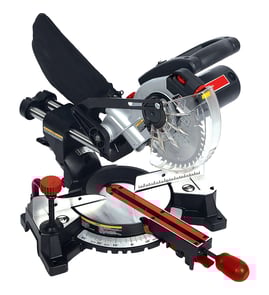

What should you never cut with a miter saw?
For a Craftsman miter saw model 137285550, never cut material that the saw is not designed to control safely, especially anything that can grab the blade, shatter, or shift during the cut. Avoid rip cuts, freehand cuts, and any workpiece that is too small or unstable to clamp.
- Very small pieces that put your fingers close to the blade; use a clamp and a stop block instead.
- Boards lengthwise (rip cuts); a miter saw is for crosscuts, miters, and bevels, not ripping.
- Ferrous metals (steel, iron) unless your saw is specifically equipped and rated for metal cutting.
- Masonry products (brick, concrete, tile) unless using a tool and blade rated for masonry.
- Warped, twisted, or bowed lumber unless it can be fully supported and clamped flat.
- Anything thicker or wider than the saw’s cutting capacity; forcing the cut increases binding and kickback risk.
- Cutting freehand without the fence support.
- Cutting with the workpiece not tight to the fence.
- Cutting without supporting long stock (it can lever up and pinch the blade).
- Cutting with a dull, damaged, or wrong-type blade.
| Check | What “good” looks like | Why it matters |
|---|---|---|
| Workpiece control | Clamped or firmly held against fence | Prevents shifting and binding |
| Blade match | Blade rated for the material and saw RPM | Reduces grab and tooth loss |
| Stock support | Long boards supported level on both sides | Prevents pinch and kickback |
| Cut type | Crosscut, miter, or bevel (not rip) | Keeps the tool in its safe use case |
A miter saw is safest when the fence, table, and blade guard can control the workpiece. The biggest hazards come from movement, pinching, and unexpected material failure (metal, masonry, or unstable wood).
If you need to identify guards, fences, clamps, switches, or other components for Craftsman 137285550, use the model’s parts diagrams first, or search by model on Sears PartsDirect.
Last updated: February 2026
Why is 31.6 on a miter saw?
The 31.6° mark on a miter saw (including Craftsman model 137285550) is a built-in shortcut for compound crown molding cuts when you lay the crown molding flat on the saw table. It pairs with a common bevel setting (often 33.9°) to create tight corner joints without doing the angle math.
Most miter saws include 31.6° because it is one of the standard compound settings for crown molding with common “spring angles.” It helps you quickly set the saw for inside and outside corners.
Common situations where you use it:
- Cutting crown molding laid flat (not nested against the fence)
- Making inside corner and outside corner joints
- Repeating the same corner cuts accurately for trim work
- Reducing setup time on a compound miter saw
These presets are based on common crown molding spring angles. Your exact molding profile matters, but these are the “go-to” starting points.
| Crown molding spring angle | Typical miter setting | Typical bevel setting |
|---|---|---|
| 38° (common) | 31.6° | 33.9° |
| 45° (less common) | 35.3° | 30.0° |
Use this quick checklist so the preset actually works the way it is intended.
- Confirm your crown molding spring angle (often listed on the packaging or profile spec).
- Decide whether you are cutting inside or outside corners.
- Keep the molding flat on the table and consistently oriented (same face up each time).
- Set the miter to 31.6° and set the bevel to the matching value (commonly 33.9° for 38° spring angle).
- Make a test cut on scrap first, then fine-tune if your walls are not perfectly 90°.
Crown molding corners are rarely perfect 90° in real rooms. The 31.6° preset gives you a reliable baseline so you can dial in fit with small adjustments, instead of starting from scratch each time.
If you are looking up diagrams or replacement items for your Craftsman 137285550 miter saw (guards, switches, brushes, hardware), start with the model parts list and ordering tools on Sears PartsDirect.
Last updated: February 2026
Will a 10 inch miter saw cut a 4x4 post?
Yes, a 10-inch miter saw can cut a 4x4 post (actual size about 3-1/2 in. x 3-1/2 in.), but whether it’s a one-pass cut depends on the saw’s design. With a 10-inch sliding miter saw, it’s commonly a single cut; with a non-sliding 10-inch saw, you often need to flip the post.
A 4x4 is thick enough that the key spec is maximum cut depth at 90° (and sometimes at 45° if you’re doing bevel cuts).
- 10-inch sliding miter saw: commonly cuts a 4x4 in one pass at 90°
- 10-inch non-sliding (standard) miter saw: commonly requires a flip cut
- 12-inch miter saw: more likely to handle 4x4s easily, including some angled cuts
If your Craftsman 137285550 miter saw does not have enough vertical capacity for a one-pass cut, a flip cut works well when done carefully.
- Mark the cut line on all four faces of the post
- Clamp the 4x4 firmly against the fence (do not hand-hold it)
- Make the first cut slowly, letting the blade reach full speed
- Rotate the post 180° (keep the same face tight to the fence) and finish the cut
- If there’s a small “step,” clean it up with a light trim cut or sanding
Use this simple check to predict whether you’ll need to flip the post.
| What you’re checking | What it tells you | Practical target for a 4x4 |
|---|---|---|
| Max cut depth at 90° | One-pass vs. flip cut | About 3-1/2 in. |
| Sliding rails (yes/no) | Extra crosscut capacity | Sliding helps most |
| Fence height and clamp clearance | Stability and safety | Enough room to clamp |
Trying to force a one-pass cut when the saw cannot reach through the full thickness can pinch the blade, burn the wood, or pull the workpiece out of position. Matching the cut method to the saw’s capacity gives you straighter cuts and safer control.
For replacement parts and diagrams for the Craftsman 137285550, start with the model parts list, or search by model number on Sears PartsDirect.
Last updated: February 2026
Will any miter saw stand work with any miter saw?
No. A miter saw stand is not truly “one size fits all”; even with a Craftsman miter saw model 137285550, you need to match the stand’s mounting method and hole spacing to your saw’s base so it bolts down securely and stays square during cuts.
Most stands are either brand-specific or “universal” with adjustable mounting rails. Fit comes down to these checks:
- Mounting hole spacing on the saw base vs. the stand’s bracket/rail range
- Mounting hardware (bolt size, washers, lock nuts) and whether the stand includes it
- Base footprint (will the saw sit flat without rocking)
- Weight capacity of the stand vs. the saw’s weight
- Fence and bevel clearance (controls must move freely without hitting the stand)
Use this process for the Craftsman 137285550 and any other saw:
- Measure the front-to-back and side-to-side distance between mounting holes on the saw base.
- Confirm the stand’s mounting brackets can slide to those measurements.
- Verify the stand can be tightened so the saw cannot shift under load.
- If the stand uses quick-release brackets, confirm they can clamp the saw base securely.
| Stand type | Typical compatibility | Best for |
|---|---|---|
| Universal stand with adjustable brackets | Works with many saws after measuring | Most DIY and jobsite setups |
| Brand-specific stand | Best direct fit for that brand/model family | Fast setup, fewer adjustments |
| Shop-built bench or plywood adapter plate | Fits almost anything when drilled correctly | Permanent shop station |
A stand that does not match the saw’s mounting pattern can let the saw twist or creep during a cut. That leads to inaccurate miters, binding, and higher kickback risk. A solid bolt-down fit keeps the saw stable and your cuts repeatable.
If you are matching accessories or replacement items to this saw, search by the full model number 137285550 so you get the right diagrams and compatible items; we also make it easy to search by model on Sears PartsDirect.
Last updated: February 2026