Owner’s manual
 Error Codes


What are the dimensions of Samsung fridges?
Samsung refrigerator dimensions vary by model, so there is no single “standard” size. For the Samsung RF28HMEDBSR, our model-specific manual lists a cabinet width of about 35 3/4 inches, a cabinet height of about 68 7/8 inches, and a cabinet depth of about 34 inches (measuring methods can vary). See the RF28HMEDBSR user manual for the full dimension chart and clearance guidance.
RF28HMEDBSR dimensions (from the manual)
Use these as planning dimensions for doorways, alcoves, and cabinet cutouts.
- Width (cabinet): ~35 3/4 in (908 mm)
- Height (cabinet): ~68 7/8 in (1749 mm)
- Overall height: ~70 in (1777 mm)
- Depth (cabinet): ~34 in (864 mm)
- Depth (overall): ~36 1/2 in (926 mm)
| Measurement type | What it helps with | Example from RF28HMEDBSR |
|---|---|---|
| Cabinet width/height/depth | Fitting into a built-in opening | 35 3/4 in wide, 68 7/8 in tall, 34 in deep |
| Overall height/depth | Door swing, handles, and front clearance | 70 in tall overall, 36 1/2 in deep overall |
Why Samsung fridge sizes are not “standard”
Even within Samsung French door and bottom-mount designs, dimensions change based on capacity, door style, hinge geometry, and features like an in-door ice maker or water dispenser.
- Capacity (cubic feet) affects cabinet depth and width
- Door and hinge design affects overall depth and swing clearance
- Dispenser and ice system can change internal layout and required clearances
- Measuring method (with or without doors/handles) changes the numbers
Measuring tips before you buy or move a refrigerator
We recommend measuring both the space and the path into the kitchen.
- Measure the opening width, height, and depth at multiple points
- Check doorway width and height, including trim
- Plan for door swing clearance and drawer pull-out space
- Leave ventilation clearance around the cabinet as described in the manual
- If needed, follow the manual steps for removing doors/drawers during moving
Why it matters
Correct dimensions prevent delivery problems, door interference, poor airflow, and performance issues. A refrigerator that is too tight in the opening can run hotter, use more energy, and be harder to service.
Last updated: January 2026
Why is ice forming in the bottom of my Samsung fridge?
Ice at the bottom of a Samsung RF28HMEDBSR refrigerator is usually caused by moisture getting into the freezer area and then refreezing, or by meltwater not draining away during the automatic defrost cycle. We focus first on door sealing, airflow, and drain path checks described in the RF28HMEDBSR user manual.
Quick checks that fix most “ice on the freezer floor” problems
- Make sure the freezer drawer closes fully and is not blocked by food packages.
- Inspect the door gaskets for gaps, tears, or hardened sections; clean sticky areas with warm water and mild soap.
- Confirm the refrigerator is level; a slight tilt can affect how water flows to the drain.
- Do not block interior air vents with bags, boxes, or tall items.
- Limit long door openings; humid kitchen air quickly turns into frost and ice.
What’s happening (common causes)
Ice on the bottom typically comes from one of these conditions:
| Likely cause | What you’ll notice | What to do first |
|---|---|---|
| Humid air leak at door gasket | Frost near the drawer opening, then a sheet of ice on the floor | Clean and inspect gasket; ensure full closure |
| Drain path restricted (defrost water refreezes) | Ice builds up repeatedly even after you remove it | Clear ice, then check for recurring water pooling |
| Poor airflow or overpacking | Uneven temps, more frost than normal | Reorganize to keep vents clear |
| Refrigerator not level | Drawer alignment feels “off”, water may pool | Level the cabinet per manual guidance |
Why it matters
When ice forms on the freezer floor, it can keep the drawer from sealing tightly. That leads to more humid air intrusion, heavier frost, longer run times, and inconsistent temperatures for food storage.
When to consider a repair
If you’ve confirmed the doors seal well, vents are clear, and the unit is level, but ice returns quickly, the issue is often in the defrost drain area or related components. At that point, we recommend using the troubleshooting section in the RF28HMEDBSR user manual and matching any needed components to your exact model.
Last updated: January 2026
What is the most common problem with Samsung refrigerators?
Across Samsung refrigerators like model RF28HMEDBSR, the most common customer-reported problems are cooling performance issues (warm fridge or freezer), ice maker problems, and water leaks. In many cases, these symptoms trace back to airflow restrictions (ice buildup) or a sealed-system cooling failure.
What we see most often (and what it looks like)
- Not cooling or weak cooling: food soft in the freezer, fridge temp rising, compressor running a lot
- Ice maker trouble: slow ice production, clumped ice, dispenser not dispensing
- Water leaking: puddles under the unit, dripping at the dispenser area, water in drawers
- Noisy operation: fan noise, rattling, buzzing (often after doors were left open or after ice buildup)
Quick checks for RF28HMEDBSR before assuming a major failure
Use the settings and troubleshooting guidance in the RF28HMEDBSR user manual.
- Confirm temps are set correctly: Fridge 37°F, Freezer 0°F
- Make sure Cooling OFF (Shop mode) is not enabled (unit lights work but it will not cool)
- Check doors close fully and vents are not blocked by food packages
- If the display is blinking temps, try a reset: unplug about 10 minutes, then plug back in
- If water dispenses slowly, a clogged filter can mimic other issues
When it points to a cooling system problem
If the refrigerator is warm and you have already verified settings, airflow, and door sealing, the issue may be in the sealed system (compressor, refrigerant flow) or related controls.
| Symptom | More likely cause | What to do next |
|---|---|---|
| Fridge and freezer both warm | Cooling system not running effectively | Check for error codes and listen for compressor/fan operation |
| Freezer cold, fridge warm | Airflow/evaporator fan or frost restriction | Check vents, look for heavy frost patterns |
| Loud buzzing/clicking, poor cooling | Compressor start or compressor issue | Consider compressor diagnosis |
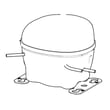
If a compressor replacement is needed for this model, the compatible part is the Samsung refrigerator compressor MKV190CL2BASH.
Why it matters
Cooling and airflow problems can quickly lead to food spoilage, excessive frost, and longer run times that stress components like the compressor and fans. Catching a blocked vent, incorrect mode, or filter restriction early can prevent bigger repairs.
Last updated: January 2026