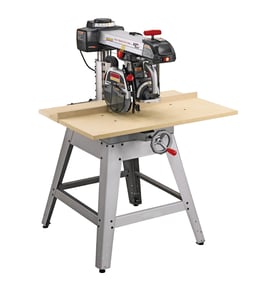

When did Craftsman stop making radial arm saws?
Craftsman radial arm saws were largely phased out in the early 1990s; most Craftsman-branded radial arm saws stopped being sold new through Sears around 1992, with a few smaller models continuing into the mid-1990s. For parts and model lookups tied to your specific saw, we recommend searching by the exact model number on Sears PartsDirect.
Radial arm saw production and retail availability varied by size and supplier, but this is the practical cutoff most owners use when dating Craftsman units.
- Most Craftsman radial arm saws were no longer sold new through Sears by about 1992.
- Some 8-inch versions continued a bit longer (commonly cited into 1995).
- Many saws still in use today were built earlier and stayed in service for decades.
- The shift in the market favored compound miter saws and table saws for many common cuts.
The most reliable way to pin down the era is to use the identification information on the saw itself.
- Find the model number and serial number on the ID plate (often on the arm, column, or base).
- If the model begins with a 3-digit prefix (for example, 113.xxxxx), that prefix often indicates the original manufacturer.
- Compare the guard style, switch style, and motor tag details to the parts breakdown for your model.
| What you have | What it usually means |
|---|---|
| Craftsman radial arm saw sold new through Sears | Commonly pre-1992 |
| Smaller 8-inch Craftsman radial arm saw | Sometimes mid-1990s |
| No clear ID plate | Use motor tag, switch style, and guard design to narrow the era |
Knowing the approximate build era helps us match the correct dust collection cover, blade guard components, table hardware, and electrical parts (switches, cords, and wiring) so fit and safety features line up with your exact configuration.
Last updated: February 2026
What is the best radial arm saw?
The best radial arm saw is the one that matches your work: accurate crosscuts, safe guarding, solid fence alignment, and enough motor power for your typical stock. For Craftsman accessories like model 16997-DUST, we focus on keeping your saw set up safely and dust-controlled so it performs at its best.
- Cut capacity: crosscut width and depth you actually need (common for framing lumber vs. trim).
- Motor power: most homeowner saws are in the 10 to 15 amp range; higher power helps with thicker hardwood.
- Arm and carriage rigidity: less flex means straighter cuts and less chatter.
- Fence and table system: easy-to-square fence, flat table, and repeatable stops.
- Guarding and dust control: a complete guard and a working dust cover reduce mess and improve visibility.
- Parts availability: being able to replace wear items keeps an older saw usable.
| Your main job | What “best” means | Features to prioritize |
|---|---|---|
| Repetitive crosscuts | Speed and repeatability | Solid fence, stops, stable table |
| Trim and finish work | Clean, accurate cuts | Low play in carriage, sharp blade, good alignment |
| Occasional DIY | Easy setup and safety | Clear guarding, simple adjustments, dust collection |
| Shop versatility | Handles varied stock | Power, rigidity, accessory support |
If you are deciding whether your current saw is “good enough,” we use these checks:
- Blade tracks square to the fence at 90 degrees.
- Carriage rolls smoothly with no binding.
- Arm locks hold position without drifting.
- Guarding is complete and secure.
- Dust cover and collection path are intact and not clogged.
A radial arm saw can be extremely capable, but accuracy and safety depend on alignment, guarding, and dust control. A well-maintained saw with the right accessories often outperforms a “bigger” saw that is out of square or missing guards.
For parts and accessories, start with the model listing you are using now, or search by your full model number on Sears PartsDirect.
Last updated: February 2026
What has replaced the radial arm saw?
For most home shops, the radial arm saw has largely been replaced by a compound miter saw for crosscuts and angle cuts, plus a table saw (or track saw) for rip cuts. For Craftsman model 16997-DUST accessories, the best “replacement” depends on the cuts you need and your dust collection setup.
- Crosscuts (90°): 10-inch or 12-inch compound miter saw
- Miter cuts (left/right angles): compound miter saw
- Bevel cuts (tilting blade): dual-bevel compound miter saw
- Rip cuts (with the grain): table saw (or track saw with a guide)
- Wide panels and sheet goods: track saw or table saw with outfeed support
| Tool | Best at | Typical limitation vs. a radial arm saw |
|---|---|---|
| Compound miter saw | Fast, accurate crosscuts and miters | Not designed for rip cuts |
| Table saw | Rip cuts and repeatable sizing | Crosscuts need a miter gauge or sled |
| Track saw | Breaking down sheet goods cleanly | Slower for repetitive small parts |
Radial arm saws were popular because one tool could handle many operations, but modern shops usually split those jobs between specialized tools. That approach improves accuracy and dust control, and it reduces setup changes between crosscutting and ripping.
- Match the hose size to the tool port (common sizes are 1-1/4 inch, 2-1/2 inch, and 4 inch).
- Use a hood or shroud behind a miter saw to capture the rear spray.
- Add a shop vacuum with a fine filter for miter saws and track saws.
- Use a dust collector for table saws when you have a 4-inch port.
- Keep airflow up by minimizing long, kinked hoses.
We recommend searching by the exact model number (16997-DUST) and the tool type you are using now (miter saw, table saw, or dust collector accessory). You can also search for additional parts and accessories by model number on Sears PartsDirect.
Last updated: February 2026
Are radial arm saws worth anything?
Yes. Radial arm saws can still be worth owning and worth money, especially for accurate, repeatable crosscuts and dado work on wide stock; value depends on brand, condition, completeness (guards, table, fence), and how well the saw can be tuned and used safely. For Craftsman model 16997-DUST accessories, we focus on keeping the setup complete and functional using the correct model-specific parts list, then sourcing anything else by model number on Sears PartsDirect.
- Condition and wear: smooth arm travel, tight column lock, minimal play in the carriage
- Completeness: blade guard, anti-kickback parts (if equipped), dust cover, table boards, fence hardware
- Accuracy potential: ability to square the arm and keep it square after locking
- Motor health: starts cleanly, no burning smell, no excessive sparking at brushes
- Safety features present: intact guards and a stable table reduce risk and increase buyer confidence
Most used radial arm saws sell for less than many people expect because they are heavy and take space, but clean, complete saws still move quickly.
| Condition | What you typically see | Typical value range (USD) |
|---|---|---|
| As-is / needs work | Missing guard, rough bearings, table damaged | $25 to $75 |
| Working, average | Cuts OK, normal wear, basic accessories | $75 to $200 |
| Clean, complete, tuned | Smooth travel, accurate setup, full guarding | $200 to $500 |
| Collector-grade / industrial | Heavy cast-iron builds, excellent restoration | $500+ |
A radial arm saw earns its keep when you need capacity and repeatability.
- Crosscutting wide boards that exceed many miter saw capacities
- Cutting dados and half-laps with a dado stack (when the saw is rated and set up correctly)
- Repetitive cut lengths using a stop block on a solid fence
- Shop workflows where the saw can stay set up and aligned
Radial arm saw value is tied to safe, predictable performance. A complete guarding setup, a flat table, and a square fence reduce kickback risk and improve cut quality, which directly affects resale value and day-to-day usefulness.
- Unplug the saw; verify the arm lock and column lock hold firmly
- Check for side-to-side play in the carriage and motor yoke
- Inspect the cord and switch housing for damage
- Confirm the table is flat and securely fastened
- Use the correct blade direction and a sharp blade suited for crosscutting
Last updated: February 2026