Can you use an 8 inch blade on a 10 inch table saw?
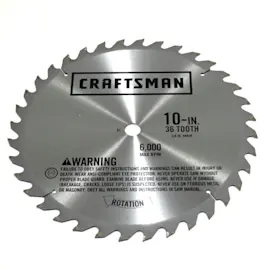
Yes. On a Craftsman 113298840 10 inch table saw, you can use an 8 inch blade as long as the blade’s arbor hole matches your saw’s arbor and the blade is rated for the saw’s RPM. The main tradeoff is reduced maximum cutting depth.
Using a smaller diameter blade is usually straightforward, but it affects how the saw performs.
- Less cut depth: an 8 inch blade cuts shallower than a 10 inch blade.
- Guard and splitter/riving knife fit: the blade guard and anti-kickback setup may not align correctly with a smaller blade.
- Dado use is different: many dado sets are 8 inch diameter and are commonly used on 10 inch saws for non-through cuts.
- Fence and miter gauge use stays the same: your rip fence and miter gauge setup does not change.
- Safety margin matters more: smaller blades can tempt users to remove guards; keep safety devices installed whenever they fit correctly.
Before installing any blade on the Craftsman 113298840, we check these items:
- Arbor hole size matches the saw arbor (commonly 5/8 inch on many 10 inch table saws).
- Blade type matches the job (rip, crosscut, combination, or dado).
- RPM rating on the blade is at least the saw’s no-load RPM.
- Kerf thickness works with your splitter/riving knife (if equipped).
- Blade clears the throat plate and raises/tilts without rubbing.
| Feature | 10 inch blade | 8 inch blade |
|---|---|---|
| Max cutting depth | Deeper | Shallower |
| Common use | General ripping/crosscutting | Specialty cuts, some dado setups |
| Guard alignment | Designed for it | May not align |
| Motor load | Baseline | Often slightly less |
Blade diameter affects both capacity (how thick a board you can cut) and safety setup (whether the guard and anti-kickback parts sit where they should). If the guard or splitter cannot be used correctly with an 8 inch blade, we treat that as a reason to switch back to a 10 inch blade for through-cuts.
For the Craftsman 113298840, we use the model’s parts diagrams to confirm the correct guard, arbor hardware, and throat plate style before changing blade types. If you need to look up components by model number, start with the parts list for this model, or search by model on Sears PartsDirect.
Last updated: February 2026
How to get rid of an old table saw?
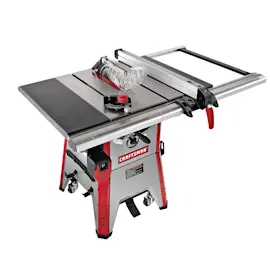
If you are getting rid of a Craftsman 113298840 10" table saw, the best options are to sell or donate it if it still runs, or recycle it as scrap metal and e-waste if it does not. Before it leaves your shop, remove the blade and secure the cord so it cannot be started accidentally.
- Sell it as-is (working or repairable): include photos of the fence, miter gauge, guard, and motor plate.
- Donate it (working and reasonably complete): many community shops and reuse programs accept tools.
- Recycle it: most of the saw is steel and aluminum; the motor and switch are typically handled as e-waste.
- Scrap it: a metal recycler can take the cabinet/stand and table; ask if they want the motor separated.
- Haul-away service: useful when the saw is heavy, missing parts, or unsafe to transport.
- Unplug the saw and remove the blade.
- Lower the arbor fully and lock the tilt/bevel if your saw has that feature.
- Remove loose accessories (throat plate, fence, miter gauge) and bag the hardware.
- Tape or tie the power cord to the frame so it cannot snag.
- If the saw has a capacitor housing on the motor, do not open it; leave the motor intact for recycling.
Saw blades are sharp and can damage bags, bins, and hands. Wrap the blade in heavy cardboard, tape it securely, and take it to a scrap metal recycler if they accept blades.
| Item | Typical handling | Why |
|---|---|---|
| Steel/aluminum table and stand | Scrap metal recycling | Keeps bulky metal out of landfill |
| Motor, switch, wiring | E-waste or recycler drop-off | Contains electrical components |
| Blade | Scrap metal (wrapped) | Sharp edges need safe containment |
Old table saws are heavy, have exposed sharp parts, and include electrical components that are better recycled than trashed. Proper prep prevents injuries during loading and helps recyclers process the saw quickly.
If you need to identify the exact version of your saw before listing it or searching diagrams, use our guide: how to find your appliance model number (and what it means for parts). For parts lookups by model number, start with the parts list for Craftsman 113298840, or search by model on Sears PartsDirect.
Last updated: February 2026
Are craftsman table saws any good?
Yes. Craftsman table saws are a solid choice for many DIYers and hobbyists because they’re typically durable, reasonably powerful for common rip cuts and crosscuts, and cost-effective; for the Craftsman 113298840 10" table saw in particular, overall results depend most on fence alignment, blade quality, and setup.
Most owners judge a table saw on a few practical factors:
- Cut accuracy: fence stays parallel to the blade and locks consistently
- Power and smoothness: motor starts cleanly and holds speed in thicker stock
- Safety and control: guard, splitter/riving-knife style protection (if equipped), and stable stance
- Parts support: ability to keep the saw running with replacement parts over time
Craftsman saws like the 113298840 are commonly a good fit when you need reliable basics:
- Weekend projects, home improvement, and general woodworking
- Repetitive cuts after careful fence calibration
- Use with a quality 10-inch blade matched to the material (plywood, hardwood, framing lumber)
If you’re chasing furniture-grade precision all day, the fence and miter setup matter as much as the motor.
- Fence drift or flex: verify parallel-to-blade alignment and locking pressure
- Miter gauge play: tune the bar fit; consider a sled for repeatable crosscuts
- Vibration: check arbor/blade condition, belt condition (if belt-driven), and stand stability
- Dust control: use a shop vacuum and keep the cabinet/base clear
| Check | What you want | What to adjust |
|---|---|---|
| Fence to blade | Parallel | Fence alignment/lock |
| Blade to miter slot | Parallel | Trunnion/table alignment |
| Blade condition | Flat, sharp | Replace blade |
A “good” table saw is one that cuts straight and predictably. On the 113298840, careful setup and routine checks usually make a bigger difference than the brand name on the badge.
We recommend using the model number 113298840 to match the correct diagrams and replacement parts; you can also search by model on Sears PartsDirect.
Last updated: February 2026
How much is a craftsman professional table saw 113298840?
Pricing for a Craftsman 113298840 10-inch table saw depends on whether you mean the complete saw (usually bought used) or replacement parts (priced individually). We focus on parts for model 113298840; for complete-saw pricing, use recent local used listings as your benchmark.
These ranges are for the full saw, not parts; condition and included accessories drive the number.
- Non-running or incomplete (missing fence/guard, motor or arbor issues): $25 to $150
- Running, average wear (basic fence, some rust, limited accessories): $150 to $350
- Clean and complete (good fence, guard/splitter, miter gauge, stand): $300 to $600
- Fence quality and alignment (locks parallel, doesn’t drift)
- Arbor/bearing condition (low vibration, no rumble on coast-down)
- Motor and switch health (starts quickly, no burning smell)
- Completeness (blade guard, splitter/riving setup, miter gauge, stand)
- Tabletop condition (flat surface, minimal pitting, manageable rust)
| What you’re pricing | Where the price comes from | Best use case |
|---|---|---|
| Complete saw | Local used market, condition, accessories | Buying or selling the whole unit |
| Replacement parts | Individual component pricing by model | Repairing what you already own |
A table saw’s resale value is driven by cut accuracy and safety readiness. A straight, reliable fence and complete guarding often add more value than cosmetic condition.
If you’re repairing your 113298840, you can look up diagrams and order replacement components through Sears PartsDirect.
Last updated: February 2026