 Owner’s manual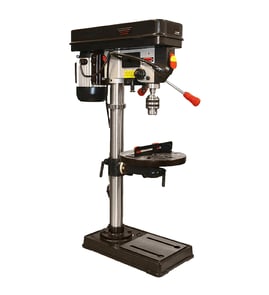

What are the three types of drill presses?
The three most common drill press types are benchtop, floor-standing, and radial-arm drill presses. Your Craftsman 113213150 is a traditional drill press design; the best “type” for you depends on the size of your workpieces, the throat/reach you need, and how much power and stability you want.
The 3 drill press types (quick definitions)
- Benchtop drill press: Smaller, mounts on a bench; best for light to medium drilling and limited shop space.
- Floor-standing drill press: Taller, heavier base; better stability and capacity for larger stock and bigger bits.
- Radial-arm drill press: Head moves on an arm for extra reach; useful for drilling larger panels without repositioning the work.
How to choose the right type for your work
- Choose benchtop if you drill smaller parts and want portability.
- Choose floor-standing if you need more leverage, stability, and capacity.
- Choose radial-arm if you frequently drill wide workpieces and need extra reach.
- Match the drill press to your workholding plan (vise, clamps, fixtures).
- Plan for safe operation: secure the workpiece and avoid freehand drilling.
Comparison table
| Type | Best for | Typical tradeoff |
|---|---|---|
| Benchtop | Small parts, tight spaces | Less capacity and mass |
| Floor-standing | Larger stock, frequent drilling | Needs floor space |
| Radial-arm | Wide panels, reach and positioning | More complex setup |
Why it matters
The “type” affects accuracy and safety. A heavier, more stable drill press helps reduce vibration and bit wander, and the right reach makes it easier to position the work correctly. For safe results, we recommend following the workholding and operating guidance in the 113213150 owner's manual, including clamping the workpiece and using proper spindle speed.
For parts lookup and model-based searching, use the parts list for Craftsman 113213150 or search by model on Sears PartsDirect.
Last updated: February 2026
What is a good horsepower for a drill press?
A good horsepower for a drill press depends on the bit size, material, and how often you drill. For most home shop drilling in wood and light metal, 1/2 to 3/4 HP is a strong all-around range; step up to 1 to 1-1/2 HP for frequent larger holes and tougher steel.
How to choose the right horsepower
Use these practical rules so the motor does not bog down and the bit does not overheat.
- Small bits (1/16 to 3/8 in.) in wood or aluminum: 1/3 to 1/2 HP is typically plenty.
- General-purpose shop work (up to about 1/2 in.): 1/2 to 3/4 HP is the sweet spot.
- Larger holes (5/8 in. and up), hole saws, or frequent steel drilling: 1 to 1-1/2 HP helps maintain torque.
- If you often use Forstner bits or large spade bits in hardwood, prioritize torque and low speed over raw HP.
- If you plan to run accessories, use only accessories designed for the drill press and follow the speed guidance in the owner's manual.
What matters as much as horsepower (especially on model 113213150)
On the Craftsman 113213150 drill press, correct spindle speed and safe setup do as much for performance as horsepower.
- This drill press uses a belt-and-pulley speed system with 12 speeds (from 250 RPM up to 3100 RPM).
- Lower speeds increase torque at the spindle and reduce burning in metal.
- The manual calls out limits for certain accessories (for example, hole saws must never be run above 400 RPM).
Quick guide: horsepower vs. typical use
| Typical use | Practical HP range | Notes |
|---|---|---|
| Wood drilling, occasional metal | 1/2 HP | Good for most home projects |
| Mixed materials, frequent use | 3/4 HP | Better reserve power |
| Larger holes, frequent steel work | 1 to 1-1/2 HP | Helps prevent stalling |
Why it matters
Choosing enough horsepower helps you keep a steady feed rate without stalling, reduces bit chatter, and supports safer drilling. Just as important, matching RPM to the bit and material helps prevent overheating and accessory failures.
Parts and documentation
For model-specific operating and speed guidance, use the owner's manual. For replacement parts and diagrams for Craftsman 113213150, start with the model parts list or search by model on Sears PartsDirect.
Last updated: February 2026
What is the 4 inch rule for drill press?
On a drill press, the 4-inch rule means we keep our hands at least 4 inches away from the rotating drill bit and any moving parts. On the Craftsman 113213150 drill press, this works with the manual’s core safety guidance: never place fingers where they could contact the cutting tool if the workpiece shifts.
How to follow the 4-inch rule (practical steps)
- Clamp the workpiece to the table whenever possible; do not “hand-hold” small parts.
- Use a drill press vise, V-block, or a simple wood jig to keep fingers away from the bit.
- Keep the table clear; do not do layout, assembly, or setup work while the tool is rotating.
- Remove the switch key and turn the switch off before changing bits or adjusting the table.
- Tie back long hair and avoid gloves, jewelry, loose clothing, or anything that can pull you into the spindle.
Quick guide: safer ways to hold different workpieces
| Workpiece type | Safer holding method | Why it helps with the 4-inch rule |
|---|---|---|
| Small flat stock | Drill press vise | Keeps hands away from the bit |
| Round stock (dowel, pipe) | V-block plus clamp | Prevents spinning and grabbing |
| Thin wood | Backup material under the workpiece | Reduces tear-out and sudden grab |
| Awkward shapes | Jig or fixture screwed to a board | Moves your hands farther from the bit |
Why it matters
The biggest drill press injuries happen when a workpiece catches and spins or when hands drift too close during setup. Keeping a 4-inch buffer gives you reaction time and space if the bit grabs, the workpiece shifts, or chips kick back.
Model-specific safety reminders for the Craftsman 113213150
We follow the safety panel and operating guidance in the 113213150 owner's manual, including avoiding setup work on the table while the cutting tool is rotating and using only accessories designed for this drill press.
Parts and diagrams
If you are replacing worn safety-related items (like guards, switches, or cords), we use the model number 113213150 to match the correct diagrams and parts list; you can also search by model on Sears PartsDirect.
Last updated: February 2026
Where can I buy Craftsman replacement parts?
You can buy replacement parts for your Craftsman drill press model 113213150 from the model-specific parts list and diagrams, then order by the exact part number to ensure fit. For broader Craftsman parts searches by model number, we also offer lookup and ordering through Sears PartsDirect.
How to make sure you get the right part
We recommend matching parts by model number and part number, not by appearance. The manual notes the model and serial tag is typically on a plate at the rear of the drill press head.
- Confirm the model number is 113213150 (rear of the head plate)
- Use the repair parts list to identify the exact part number
- Order by part number, not key number (as the parts list instructs)
- If you are replacing a wear item, inspect related hardware (nuts, washers, bearings)
- Keep your serial number handy in case there were production changes
Common parts customers look up for this model
The 113213150 owner's manual includes a repair parts section with part numbers for common drill press components. Here are examples of part types you can identify there:
| Part type (example) | What it affects | Typical symptom when worn |
|---|---|---|
| Chuck and arbor | Bit holding and runout | Bit slips, wobble, poor hole accuracy |
| Spindle and quill parts | Smooth drilling travel | Sticking quill, excessive play |
| Table and elevation parts | Work support and height adjustment | Table won’t raise, drifts, or won’t lock |
| Bearings and washers | Rotation smoothness | Noise, vibration, heat |
Why it matters
A drill press is a precision tool; using the correct Craftsman 113213150 part number helps maintain alignment, safe operation, and smooth quill travel. Ordering by part number also reduces returns caused by look-alike parts that do not match the shaft size or mounting style.
Quick ordering checklist
- Model number: 113213150
- Identify the part in the repair parts list
- Write down the part number and description
- Verify electrical parts match your setup (the manual notes 110-120V, 60 Hz operation)
Last updated: February 2026
How much does a Craftsman 150 drill press weigh?
The Craftsman drill press model 113213150 is commonly listed at about 200 lb (approximate shipping weight). For the most accurate number for your exact setup (with or without accessories), confirm in the 113213150 owner's manual or weigh the assembled unit.
What weight to use (moving vs. planning)
Use the weight that matches what you are doing:
- Moving or freight: use about 200 lb (shipping weight)
- Lifting into a shop: plan for extra margin if you have a vise, light, or aftermarket table
- Bolting down: weight helps, but anchoring and a level base matter more than a few pounds
| Use case | Best weight to use | Why |
|---|---|---|
| Shipping or pickup planning | ~200 lb | Matches typical shipping listings for this model |
| Carrying down stairs | ~200 lb plus accessories | Real-world load includes add-ons |
| Anchoring to floor | Not weight alone | Stability depends on anchors and level base |
How to confirm the exact weight safely
If you need a precise number for rigging or transport:
- Check the specifications section in the 113213150 owner's manual
- Weigh the drill press on a platform scale (best option)
- If needed, weigh in sections (head, table/arm, column, base) and add totals
- Use lifting help; cast-iron bases and columns are awkward and top-heavy
Why it matters
Knowing the weight helps prevent tip-over and back injuries, and it helps you choose the right dolly, mobile base, and anchors. For repair part lookups by model number, you can also search by model on Sears PartsDirect.
Last updated: February 2026