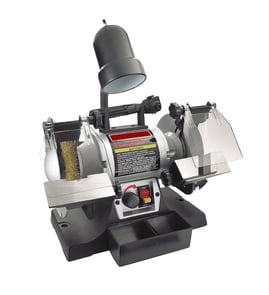

What is a Craftsman bench grinder?
A Craftsman bench grinder (including model 152211160) is a stationary power tool with one or two abrasive wheels that we use to sharpen tools, shape metal, remove rust or burrs, and do light polishing. It mounts to a workbench for stability and control during grinding.
What it’s used for
A bench grinder is a go-to shop tool because it handles many common metalworking and maintenance tasks.
- Sharpening chisels, lawn mower blades, and other edged tools
- Deburring cut metal (removing sharp edges)
- Cleaning up welds and smoothing rough metal
- Removing light rust or paint with a wire wheel (if equipped)
- Shaping small parts and hardware
Key parts and how they work together
Most Craftsman bench grinders share the same basic layout. Knowing the components helps you troubleshoot vibration, poor grinding, or slow startup.
| Component | What it does | Common issue it affects |
|---|---|---|
| Grinding wheel(s) | Removes material by abrasion | Poor finish, slow grinding, wheel glazing |
| Tool rest | Supports the workpiece at a steady angle | Bad sharpening angle, chatter |
| Eye shield/spark guard | Helps deflect debris and sparks | Safety risk if missing/misaligned |
| Motor and shaft/arbor | Spins the wheel at operating speed | Humming, slow start, overheating |
| Wheel flanges/nut | Clamps the wheel centered on the arbor | Vibration, wheel wobble |
Safety basics that matter
Bench grinders throw sparks and grit; safe setup prevents injuries and wheel damage.
- Wear eye protection and keep shields in place
- Keep the tool rest close to the wheel (a small gap) to prevent the workpiece from catching
- Let the wheel reach full speed before grinding
- Use light pressure; forcing the tool overheats the metal and can damage the wheel
- Stop using the grinder if the wheel is cracked, badly chipped, or wobbling
Why it matters
Using the right wheel, correct tool-rest position, and light grinding pressure gives cleaner results, keeps the motor from overheating, and reduces vibration that can damage the arbor and wheel mounts over time.
If you need replacement parts for Craftsman 152211160, start with the parts list for this model, or search by model number on Sears PartsDirect.
Last updated: February 2026
What are the 4 important rules for a bench grinder?
For a Craftsman bench grinder like model 152211160, the 4 most important rules are: wear proper eye and face protection, keep guards and tool rests correctly adjusted, use only wheels rated for the grinder’s RPM, and keep hands, clothing, and hair safely clear of the wheel. You can also use Sears PartsDirect to look up model-specific parts and diagrams.
The 4 rules (with the “do this every time” details)
- Protect your eyes and face: Wear safety glasses plus a face shield; grinding throws sparks and grit.
- Set the grinder up safely before starting: Keep the tool rest close to the wheel (commonly about 1/8 inch) and keep the spark guard close (commonly about 1/4 inch). Make adjustments with the grinder unplugged.
- Match wheel speed to grinder speed: Only install a grinding wheel with an RPM rating equal to or higher than the grinder’s no-load RPM.
- Control what can get pulled in: No loose sleeves, gloves near rotating wheels, jewelry, or dangling cords; tie back long hair and keep a stable stance.
Quick safety checklist before you grind
- Unplug the grinder before changing wheels or adjusting guards
- Inspect the wheel for chips or cracks; replace damaged wheels
- Start the grinder and let it reach full speed before contacting the wheel
- Grind on the face of the wheel (not the side) unless the wheel is specifically rated for side grinding
- Use light pressure; forcing the work can overheat the wheel and the metal
Common setup targets (typical bench grinder guidance)
| Item to check | Typical target | Why it matters |
|---|---|---|
| Tool rest gap | ~1/8 in. | Prevents the workpiece from getting wedged |
| Spark guard gap | ~1/4 in. | Helps contain sparks and debris |
| Wheel RPM rating | ≥ grinder RPM | Reduces risk of wheel failure |
Why it matters
Bench grinders remove metal fast; a poorly adjusted tool rest, the wrong wheel RPM rating, or loose clothing can turn a routine sharpening job into a loss-of-control situation in seconds.
Last updated: February 2026
What is the best speed for a bench grinder?
For a Craftsman bench grinder like model 152211160, the best speed depends on the job: high-speed grinders (about 3,450 to 3,600 RPM) remove material faster, while slow-speed grinders (about 1,725 to 1,800 RPM) give more control and reduce heat buildup on the workpiece.
Choosing the right RPM for the job
Use this as a practical rule of thumb:
- 3,450 to 3,600 RPM: fast stock removal, shaping, rough grinding
- 1,725 to 1,800 RPM: sharpening and edge work where heat control matters
- If you see bluing on steel: you are overheating the edge; slow down your pressure and cool the part
- If the wheel loads up or burns: dress the wheel and use lighter passes
- If the tool chatters: check wheel condition, tool rest gap, and mounting stability
Quick comparison
| Speed range (RPM) | Best for | Tradeoff |
|---|---|---|
| 3,450 to 3,600 | Grinding, shaping, faster material removal | More heat, easier to over-grind an edge |
| 1,725 to 1,800 | Sharpening, precision work, heat-sensitive edges | Slower material removal |
Setup tips that matter as much as RPM
Even the “right” speed performs poorly if the grinder is not set up safely and accurately.
- Keep the tool rest close to the wheel (a small gap helps prevent the workpiece from catching)
- Use light pressure and let the abrasive do the work
- Quench/cool the workpiece often when sharpening steel
- Dress the wheel if it is glazed, out-of-round, or clogged
- Wear eye protection and keep guards and shields in place
Why it matters
RPM directly affects heat, control, and finish quality. Higher speed is efficient for bulk removal, but slow speed is better when you need to protect a cutting edge, avoid temper loss, and produce a cleaner, more controlled grind.
Parts and help for your model
If you are looking up replacement components for your Craftsman 152211160 bench grinder (such as guards, tool rests, switches, or hardware), start with the model parts list, or search by model number on Sears PartsDirect.
Last updated: February 2026
Can I use a bench grinder as a polisher?
Yes. You can use your Craftsman 152211160 bench grinder as a polisher by swapping the grinding wheel for a buffing wheel and using the right compound; it works well for light polishing and buffing when you control speed, pressure, and heat.
What you need to do it safely
- Unplug the grinder before changing wheels or adjusting guards.
- Use a buffing wheel rated for the grinder’s RPM (never exceed the wheel’s max speed).
- Use the correct arbor size and flanges so the wheel mounts flat and runs true.
- Keep the tool rest and spark guards adjusted close to the wheel (about 1/8 inch is typical).
- Wear eye protection and avoid loose sleeves, gloves, jewelry, and long hair near the spinning wheel.
Setup tips that improve results
A bench grinder polishes best when you treat it like a light-duty buffer.
- Use a spiral-sewn cotton wheel for cutting and a loose cotton wheel for final shine.
- Apply compound lightly; too much loads the wheel and smears.
- Keep the work moving to prevent heat buildup and waves.
- Polish on the lower front quadrant of the wheel so the part is pushed down toward the rest.
- For small parts, use locking pliers or a small holding jig to reduce grab risk.
Choose the right wheel and compound
| Task | Wheel type | Typical compound |
|---|---|---|
| Remove light oxidation | Firm/spiral-sewn cotton | Tripoli (brown) |
| Brighten and refine | Medium cotton | White rouge |
| Final shine | Loose cotton/flannel | Jeweler’s rouge (red) |
Why it matters
Using the wrong wheel, compound, or technique can overheat metal, round over edges, or let the wheel grab and throw the part. A correct buffing setup gives you a cleaner finish with less risk and less rework.
Parts and accessories
For replacement parts for your Craftsman 152211160 bench grinder (guards, tool rests, switches, hardware) and to search accessories by model number, start with the model’s parts list and then use Sears PartsDirect.
Last updated: February 2026
How to restore a bench grinder?
Restoring a Craftsman bench grinder like model 152211160 means fully cleaning and inspecting it, correcting any electrical or bearing issues, and then reassembling and tuning it so the wheels run true and the guards and tool rests are set safely. We focus on safety checks first, then cosmetics.
Safety first (before you touch anything)
- Unplug the grinder and remove the wheels before deep disassembly.
- Wear eye protection and a dust mask; old grinding dust and paint debris get airborne.
- If the power cord is cracked, stiff, or taped, replace it before testing.
- Never run the grinder without guards, eye shields, and properly adjusted tool rests.
Step-by-step restoration workflow
- Document and disassemble: Take photos as you remove guards, tool rests, spark deflectors, and wheels.
- Clean and de-rust: Degrease the housing; wire-brush rust on guards and brackets.
- Inspect the wheels: Replace wheels that are chipped, oil-soaked, or out-of-round.
- Check bearings and shaft: Spin the shaft by hand; roughness, wobble, or grinding noise points to bearing replacement.
- Inspect electrical parts: Check the switch action, cord strain relief, and internal wiring for heat damage.
- Repaint (optional): Strip loose paint, prime bare metal, then paint.
- Reassemble and tune: Install wheels, set tool rests, then dress the wheels so they run smoothly.
What to inspect and what it usually means
| Symptom | Most common cause | What we do |
|---|---|---|
| Loud rumble or growl | Worn bearings | Replace bearings, verify shaft alignment |
| Heavy vibration | Wheel damage or imbalance | Replace wheel, dress wheel, check flanges |
| Won’t start | Bad switch, cord, or wiring | Test continuity, repair/replace damaged wiring |
| Sparks hitting guard | Tool rest/spark deflector misadjusted | Reset clearances and tighten hardware |
Key setup specs (typical targets)
These are standard bench-grinder setup targets that apply well during restoration:
- Tool rest gap to wheel: 1/16 inch or less
- Spark deflector gap to wheel: 1/8 inch or less
- Wheel condition: no cracks; ring-test vitrified wheels before mounting
Why it matters
A restored grinder is only “restored” when it is safe and stable. Correct clearances, sound wheels, and solid wiring prevent wheel breakage, kickback, and electrical shock while sharpening tools.
For replacement parts and diagrams for model 152211160, start with the parts list for this model, or search by model number on Sears PartsDirect. You can also use our DIY guidance on electrical testing, such as how to use a multimeter to test electrical parts video.
Last updated: February 2026