Installation guide
 Owner’s manual
 Error Codes
What is the most common problem with Whirlpool washers?
The most common Whirlpool washer problem we see is a no-start or mid-cycle stop caused by a lid not locking, an unbalanced load, or a power and fill issue. On the Whirlpool WTW8900BC0, start by confirming the lid closes and locks, then check power, water supply, and loading. See the WTW8900BC0 owner's manual.
- Confirm the lid is fully closed; the washer will not run with the lid open.
- Plug the power cord into a grounded 3-prong outlet; avoid extension cords.
- Reset a tripped breaker or replace a blown fuse.
- Make sure both hot and cold water valves are fully open.
- Check inlet hose screens for clogs and hoses for kinks.
| Symptom | Likely cause | What we recommend |
|---|---|---|
| Lights on, won’t start | Lid not locking | Inspect/replace the washer lid lock WPW10619844 |
| Stops or “walks” during spin | Unbalanced load or leveling issue | Load items evenly around the washplate; level and lock the feet |
| Won’t fill or fills slowly | Clogged inlet screens or kinked hoses | Clean screens; straighten hoses |
| Won’t drain or clothes still wet | Drain hose issue or excess suds | Verify drain hose setup; run Rinse/Drain & Spin with no detergent |
A lid-lock, leveling, or water-supply problem can look like a “bad control,” but these basics are faster to confirm and often prevent repeat shutdowns, vibration, and wet loads.
Using non-HE detergent or too much HE detergent can create suds that slow or stop draining and spinning. Measure detergent carefully and use the cycle options recommended in the WTW8900BC0 owner's manual.
Last updated: February 2026
Is 4.8 cubic feet a large capacity washer?
Yes. A 4.8 cu. ft. washer is considered large capacity, and it is sized to handle bulky loads like comforters, towels, and mixed family laundry with fewer cycles. For the best results on your Whirlpool WTW8900BC0, follow the load and cycle guidance in the WTW8900BC0 owner's manual.
Most washers at 4.5 cu. ft. and above are treated as large capacity. With 4.8 cu. ft., you can typically wash:
- A king or queen comforter (depending on fill and fabric)
- A large towel load (bath towels plus hand towels)
- A full mixed load of everyday clothing
- Bulky items like hoodies, jeans, and blankets (balanced around the basket)
Capacity helps, but loading technique matters just as much for cleaning and spin performance.
- Load items loosely; do not pack them down
- Keep the load evenly distributed around the washplate
- Mix large and small items to reduce out-of-balance spinning
- Use HE detergent and measure carefully to prevent oversudsing
- If the display shows oL (overloaded), remove items and restart the cycle
| Washer capacity | Common label | Best for |
|---|---|---|
| 3.5 to 4.4 cu. ft. | Standard | Regular weekly loads |
| 4.5 to 5.0 cu. ft. | Large capacity | Bulky items, fewer loads |
| 5.0+ cu. ft. | Extra-large | Very large households, frequent bulky loads |
A large-capacity basket like 4.8 cu. ft. reduces the number of loads you run, but overloading can still cause poor cleaning, longer drain times, and unbalanced spinning. Using the right cycle, proper loading, and correct detergent amount protects performance and helps prevent error conditions.
Last updated: February 2026
What is the life expectancy of a Whirlpool Cabrio washer?
A Whirlpool Cabrio washer like model WTW8900BC0 typically lasts about 11 years with average household use and routine maintenance. Heavy weekly loads, frequent overloading, and skipped cleaning shorten lifespan; good leveling, correct detergent, and prompt repairs help it reach or exceed that average.
Most lifespan estimates assume normal residential use and basic care. For WTW8900BC0, we recommend following the cleaning and operating guidance in the WTW8900BC0 owner's manual.
- About 6 to 8 loads per week
- Proper HE detergent use (correct amount)
- Washer is level and not walking during spin
- Hoses are not kinked and inlet screens stay clear
- Small issues (noise, leaks, drain problems) are fixed early
| Factor | Shortens life | Extends life |
|---|---|---|
| Load size | Overloading, tightly packed loads | Loosely loaded, balanced loads |
| Detergent | Too much, non-HE in an HE washer | Correct HE type and dose |
| Vibration | Unlevel cabinet, worn suspension | Leveling and timely suspension repair |
| Water/drain | Clogged screens, restricted drain | Clear flow, no kinks, good standpipe |
These steps reduce strain on the drive system, tub, and drain components.
- Run the washer’s cleaning cycle as directed; keep the lid open between loads to dry
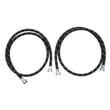
- Check fill hoses yearly for bulges or cracking; replace as needed (example: washer fill hose, 2-pack 8212487RP)
- If the washer bangs or goes out of balance often, inspect the suspension (example: suspension W10440786)
- If loads stay wet or it will not drain, check for drain restrictions and pump issues (example: washer water pump WPW10403803)
Knowing the expected lifespan helps you decide whether to maintain, repair, or plan a replacement. On a Cabrio-style high-efficiency top-load washer, preventing chronic unbalance and drainage problems is one of the best ways to avoid expensive drive and tub wear.
Last updated: February 2026
Is it worth repairing a Whirlpool washer?
Yes, it’s worth repairing a Whirlpool washer like model WTW8900BC0 when the fix is a common wear item or a single failed part and the total repair cost stays well below the price of a comparable new washer. It’s usually not worth it when multiple major drive or tub components are failing at the same time.
- If the washer is less than about 10 years old, repairs typically make sense.
- If the problem is isolated (won’t drain, won’t lock, won’t spin), repair is usually the better value.
- If the estimate is more than about half the cost of a new washer, replacement is usually the better choice.
- If the washer has repeated breakdowns in a short period, replacement is usually the better long-term move.
- If you’re still within the 1-year limited warranty period, start with the warranty and troubleshooting steps in the WTW8900BC0 owner’s manual.
These are typical “single-part” repairs that can restore normal operation without rebuilding the whole washer:
- Lid won’t lock or cycle won’t start: washer lid lock WPW10619844
- Won’t drain or leaves water in the tub: washer water pump WPW10403803 or washer drain hose WPW10363893
- Loud banging, walking, or out-of-balance issues: suspension W10440786
- Agitation issues or slipping symptoms: hub W10820039
Major drive and tub repairs can add up quickly, especially if more than one is needed:
| Repair type | What it usually affects | Typical value call |
|---|---|---|
| Drive system (stator/rotor/sensor) | Spin and agitation performance | Worth it if it’s one part and the washer is otherwise solid |
| Tub/basket related issues | Leaks, severe noise, chronic imbalance | Replace more often if multiple tub components are involved |
| Electrical/control problems | Random stopping, no power, error behavior | Worth it if diagnosis is clear and it’s a single component |
A targeted repair keeps a good Whirlpool top-load washer running for a fraction of replacement cost, but stacking multiple high-cost repairs can exceed the washer’s remaining useful life. Using the troubleshooting and warranty guidance in the WTW8900BC0 owner’s manual helps you avoid replacing parts that are not actually causing the symptom.
Last updated: February 2026
Are Whirlpool washer parts interchangeable?
Whirlpool washer parts are only interchangeable when the replacement part is listed as compatible with your exact washer model. For Whirlpool model WTW8900BC0, we recommend using Factory Specified Replacement Parts (FSP) or the exact Sears PartsDirect part shown for your model to ensure proper fit and operation.
Parts can look similar across Whirlpool, Maytag, and Kenmore-built platforms, but small differences (mounting points, wiring connectors, software calibration, or material revisions) can cause leaks, noise, error codes, or no-start conditions.
Use these checks before ordering:
- Match the model number WTW8900BC0 on the rating label, not just the series name.
- Confirm the part is shown for your model in the parts list or diagram.
- Compare connector style and wire count for electrical parts.
- Replace mounting hardware or clamps if specified.
- Follow the installation steps and diagnostics in the WTW8900BC0 owner's manual.
Here are common parts where “close enough” often causes problems:
| Part type | Why exact match matters | Example part for this model |
|---|---|---|
| Lid lock | Connector and switch logic must match control expectations | Washer lid lock WPW10619844 |
| Drive system | Rotor, stator, and sensor must be compatible as a set | Rotor position sensor (model-matched) |
| Suspension | Rod length and damping affect out-of-balance control | Suspension rod kit W10440786 |
Using the correct Whirlpool-specified part helps the washer run, fill, drain, and spin as designed, and it reduces repeat failures caused by mismatched electrical signals or mechanical tolerances.
- Safe to swap only if listed for WTW8900BC0: lid lock, pump, harness, rotor/stator, washplate
- Usually not interchangeable without model match: control boards, sensors, wiring harnesses
- Always verify in documentation: torque specs, wiring routing, and test steps in the WTW8900BC0 installation guide
Last updated: February 2026
What size is the WTW8900BC0?
The Whirlpool WTW8900BC0 is a full-size, 27-inch-class top-load washer. For the exact cabinet width, depth, height, and the clearance and ventilation space you need (especially for a closet install), use the measurements in the WTW8900BC0 installation guide.
Measure your space first, then compare to the installation requirements.
- Width: confirm the cabinet width and side clearances
- Depth: include space for water inlet hoses and the drain hose bend
- Height: confirm cabinet height and any overhead shelving clearance
- Closet door ventilation: required openings at the top and bottom of the door
- Drain location: standpipe or laundry tub placement affects hose routing
The WTW8900BC0 installation instructions include these key requirements:
- Tested side clearance: the guide shows tested spacing of 0 in. (0 mm) clearance on sides; additional spacing is recommended for service access and noise reduction.
- Standpipe drain: minimum 2 in. (51 mm) standpipe diameter.
- Standpipe height: top of standpipe must be at least 39 in. (990 mm) high and installed no higher than 96 in. (2.4 m) from the bottom of the washer.
| Measurement or requirement | Value for WTW8900BC0 | Where it’s used |
|---|---|---|
| Side clearance (tested) | 0 in. | Alcove/closet fit planning |
| Standpipe diameter (minimum) | 2 in. (51 mm) | Prevents slow drain and overflow |
| Standpipe height range | 39 to 96 in. | Prevents siphoning and drain problems |
Getting the size and clearances right prevents common install problems like a washer that vibrates against walls, a closet door that restricts airflow, or a drain setup that causes slow draining and spin issues.
Last updated: February 2026