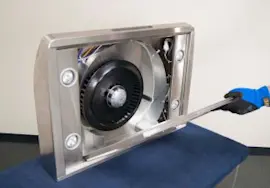
How much oil is in a hydro gear transaxle?
Hydro-Gear transaxles are typically filled to a measured oil level, not a fixed “quarts” amount. For your Hydro-Gear 311-3500 transaxle, we recommend setting the fluid so it matches the correct level specification for the exact transaxle family and housing style, then rechecking after purging air.
How to check the oil level correctly
Use a clean, repeatable method so you do not overfill (foaming) or underfill (pump cavitation).
- Park on a flat surface and let the unit cool
- Clean around the fill/vent area before opening it
- Remove the fill plug or vent cap and use a clean dipstick or depth gauge
- Measure from the top of the housing down to the oil surface (the common service method)
- Reinstall the plug, run the drive briefly, then recheck and top off if needed
Typical oil level targets (common Hydro-Gear service spec)
Many Hydro-Gear integrated hydrostatic transaxles use a “distance from the top of the housing” oil level spec. A common reference range used on similar Hydro-Gear units is:
| Transaxle family example | Typical oil level from top of housing |
|---|---|
| 310-0500 style | 1.25 to 2.00 in (31.75 to 50.8 mm) |
| 310-0750 style | 1.00 to 1.75 in (25.4 to 44.45 mm) |
Why it matters
Correct oil level protects the hydrostatic pump and motor from aeration and overheating, keeps the charge circuit stable, and helps maintain consistent forward and reverse drive performance.
Parts that often get replaced during a service
If you are servicing leaks or resealing the case, these parts on our list are commonly involved:
- Lawn tractor transaxle sealant 178322 for resealing case halves
- Seal.1" (507 583000201 when replacing a worn lip seal
- Filter 51315 if your transaxle uses a serviceable filter
Last updated: February 2026
How do I find the model number on my 311-3500?
The model number for your Hydro-Gear transaxle is usually on an ID tag or stamped plate attached to the transaxle housing; on many riding mowers it is easiest to see from the rear of the machine near the axle area. Confirm the exact number before ordering parts like the filter 51315.
Where to look on a Hydro-Gear transaxle
Check these common locations first:
- On top of the transaxle case, near the fan or input pulley
- On the rear face of the case, near the axle shafts
- On the side of the case near the brake arm or linkage
- Stamped into the housing near a mounting boss (may be faint under dirt)
What the tag typically shows
Most Hydro-Gear tags include more than one identifier. Use the full model number when searching parts.
| Label item | What it means | What to record |
|---|---|---|
| Model | The transaxle model (example: 311-3500) | Record exactly as printed |
| Serial | Unique unit identifier | Helpful for service history |
| Spec/Build code | Production variation | Useful if parts differ by build |
Tips to read the tag accurately
- Clean the area with a rag and mild degreaser; avoid scraping off printed ink.
- Take a clear photo, then zoom in to confirm every digit.
- Match characters carefully (for example, 0 vs O, 1 vs I).
- If the mower has a separate tractor model number, do not use that in place of the transaxle model.
Why it matters
Hydro-Gear transaxles can look similar across mower brands, but seals, filters, and internal drivetrain parts vary by model and build. Using the correct model number helps ensure the parts diagram and items you order fit your exact unit.
Last updated: March 2026
What is the average lifespan of 311-3500?
A Hydro-Gear 311-3500 transaxle typically lasts 7 to 10 years in normal residential mowing use when the drive system is kept clean, the cooling fan stays intact, and leaks are addressed quickly with the correct sealing materials such as lawn tractor transaxle sealant 178322.
What most affects transaxle life
- Heat buildup from grass and debris packed around the case and fan
- Low or contaminated oil from leaks or water intrusion
- Worn drive belt or idlers that cause slipping and excess heat
- Overloading (towing heavy loads, steep hills, constant high-speed starts)
- Long storage without use, leading to seal drying and corrosion
Signs the transaxle is nearing end of life
- Loss of drive when hot, then partial recovery after cooling
- Whining or grinding noises that increase with speed
- Jerky acceleration or inconsistent ground speed
- Visible oil seepage around axle seals or case halves
- Brake linkage issues that do not improve after adjustment
Maintenance that extends lifespan
| Task | How often | Why it helps |
|---|---|---|
| Clear debris from fan and case | Every mow | Reduces heat stress |
| Inspect for leaks | Monthly | Prevents low oil damage |
| Check belt condition and tension | Seasonally | Prevents slip and overheating |
| Keep linkage moving freely | Seasonally | Reduces strain on internal components |
Why it matters
The transaxle is the core of the mower drivetrain; when it overheats or runs low on oil, internal wear accelerates quickly. Catching leaks and cooling issues early is the difference between a long service life and a premature failure.
Last updated: March 2026