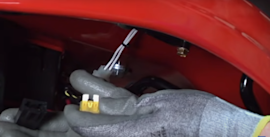
Installation guide
 Owner’s manual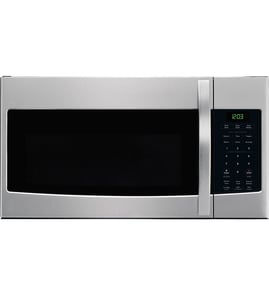



How to hard reset a KitchenAid microwave?
To hard reset your KitchenAid KMHC319ESS0 microwave/hood combo, unplug the power cord (or switch the circuit breaker OFF) for 5 minutes, then restore power and test heating a cup of water for 1 minute. This clears many control glitches and lockups.
- Unplug the microwave from the grounded 3-prong outlet.
- Wait 5 minutes (this lets the control fully power down).
- Plug it back in (or turn the breaker back ON).
- Set the clock if prompted.
- Test operation: heat 1 cup of water for 1 minute at 100% power.
- Test the vent fan and cooktop light to confirm normal operation.
A reset will not fix a power supply problem or a door-safety (interlock) problem. Check these common causes next:
- Household power: confirm the breaker is not tripped and the outlet has power.
- Door closure: close the door firmly; if a “door” message appears, open and close the door, then start.
- Control settings: make sure Control Lock is off and the controls are set correctly.
- Interlock system: a failed door switch can prevent the microwave from starting.
| Symptom after reset | Most likely area to check | Example part for this model |
|---|---|---|
| No display, totally dead | Power supply, fuse circuit | (See troubleshooting in the manual) |
| Runs but does not heat | High-voltage circuit | Diode W11256462 |
| Won’t start, door-related behavior | Door switches and latch | Microwave door interlock switch W10269458 |
The microwave’s control board can “hang” after a power interruption or keypad glitch. A hard reset restores normal startup logic; if the problem returns immediately, the issue is usually power, door interlocks, or a heating-circuit component.
For model-specific operating checks and troubleshooting steps, use the KMHC319ESS0 owner’s manual.
Last updated: February 2026
What is the disadvantage of a convection microwave oven?
A convection microwave like the KitchenAid KMHC319ESS0 can bake and roast using a convection element and fan, but the main disadvantages are higher cost and complexity than a basic microwave, smaller usable capacity than a full-size oven, and more cleanup because convection cooking can create more splatter and grease in a microwave cavity.
- Smaller cooking space than a standard oven; large casseroles, multiple sheet pans, and tall roasts may not fit.
- More steps and settings (microwave, convection, combination, grill, rack use), so it takes longer to learn.
- More frequent cleaning; grease and food soil build up faster, especially in an over-the-range setup.
- Cookware limitations; metal is only appropriate in specific convection bake situations, not in microwave or combination modes.
- Not a perfect oven replacement for big meals; you may still prefer a full oven for volume and even browning.
The KMHC319ESS0 uses a convection element and fan embedded behind a metal screen in the cavity. It also uses racks for certain cooking modes, and those supports need regular cleaning to prevent soil buildup.
| Cooking mode | Typical advantage | Typical disadvantage |
|---|---|---|
| Microwave | Fast reheating | Limited browning/crisping |
| Convection (bake/roast) | Better browning than microwave | More splatter and longer cleanup |
| Combination | Faster than full convection | More rules for cookware and placement |
- Do not use paper products when operating in convection, combination, grill, or “pan brown” modes.
- Do not use metal scouring pads; they can shed and create an electric shock risk.
- Keep the vent hood and filters clean; grease should not be allowed to accumulate.
For the exact cookware guidance and rack usage for your model, follow the KMHC319ESS0 owner's manual.
Most “convection microwave disappointment” comes from expecting full-size oven capacity and simplicity. If you plan for smaller batches, use the correct rack and cookware, and keep up with cleaning, convection microwaves are very versatile.
Last updated: February 2026
What are the specs of the KMHC319ESS0?
The KitchenAid KMHC319ESS0 is a 30-inch over-the-range microwave/hood combo designed to install above electric or gas cooking surfaces up to 36 inches wide. For exact dimensions, electrical requirements, and venting options for your installation, use the KMHC319ESS0 installation guide.
These are the most-requested specs for the KMHC319ESS0; we recommend confirming the exact values in the documentation before ordering cabinets, ducting, or trim.
- Installation type: Over-the-range microwave/hood combination
- Cooktop compatibility: Above electric or gas cooking products up to 36 in. wide
- Fit in wider openings: Filler panel kits are available for 36 in. or 42 in. openings (each panel is 3 in. wide)
- Critical install specs to verify: Product dimensions, electrical requirements, and venting design
The installation instructions for this model family include a dedicated section for Product dimensions and Electrical requirements. Use those pages to confirm:
- Overall width, height, and depth
- Required cabinet opening and mounting plate placement
- Power supply requirements (voltage, circuit, grounding)
- Venting configuration (recirculating vs. ducted, and duct direction)
| Spec item | What we can confirm for KMHC319ESS0 | Where to verify the exact number |
|---|---|---|
| Cooktop width it can be installed over | Up to 36 in. | KMHC319ESS0 installation guide |
| Product dimensions | Listed in the guide | KMHC319ESS0 installation guide |
| Electrical requirements | Listed in the guide | KMHC319ESS0 installation guide |
| Venting design specs | Listed in the guide | KMHC319ESS0 installation guide |
Microwave/hood combos are sensitive to cabinet cutouts, mounting plate location, and venting path. Verifying the KMHC319ESS0 dimensions and electrical requirements first helps prevent rework, cabinet damage, and poor ventilation performance.
Last updated: February 2026
Are KitchenAid appliances high end?
KitchenAid is widely considered a premium, upper-mid-range brand. For your KitchenAid KMHC319ESS0 microwave/hood combo, that typically means solid build quality, strong performance, and a more refined design than entry-level models, without being positioned as ultra-luxury.
KitchenAid generally sits in the premium tier because it commonly offers:
- Better fit and finish (controls, door feel, trim, lighting)
- More feature depth than basic models (sensor cooking, vent options, presets)
- Strong parts support for repairs and maintenance
- A price point above value brands, but below luxury lines
For model-specific features, operating tips, and care guidance, use the KMHC319ESS0 owner’s manual.
Premium and luxury can overlap, but they are not the same. Here is a practical way to compare:
| Tier | Typical focus | What you’ll notice most |
|---|---|---|
| Value | Basic heating and venting | Fewer presets, simpler controls |
| Premium (KitchenAid) | Performance + design | Smoother controls, better finish, more options |
| Luxury | Pro-style integration | Highest prices, niche features, design ecosystems |
“Premium” usually means it is worth repairing when a common wear item fails, especially on an over-the-range unit where replacement involves uninstalling and re-mounting.
Common repair categories we see on microwave/hood combos include:
- Door safety switching and latching issues (no-start symptoms)
- Interior light or cooktop light problems
- Heating circuit failures (no-heat symptoms)
- Vent fan performance issues
If you are troubleshooting a no-heat complaint, our DIY article why is my microwave not heating walks through the most common causes and what to check first.
When a premium unit is maintained, it typically stays in service longer. If you are diagnosing a symptom, these model-matched parts are examples of what is commonly replaced:
- Microwave door interlock switch W10269458
- Diode W11256462
- Microwave high-voltage capacitor W10561770
Microwave high-voltage components can retain a dangerous charge even when unplugged. We recommend using the procedures in the KMHC319ESS0 owner’s manual and having a qualified technician handle high-voltage testing.
Last updated: February 2026