Owner’s manual
 Error Codes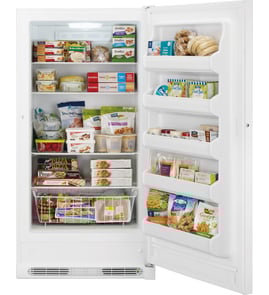


What is the life expectancy of a Frigidaire upright freezer?
A Frigidaire upright freezer like model LFFU1765DW3 typically lasts 10 to 15 years. With steady maintenance (good airflow, correct loading, and periodic cleaning/defrosting), many units reach the upper end of that range.
- Ventilation and heat: Keep airflow around the cabinet; most upright freezers need about 3 inches of space on all sides for circulation.
- Proper loading: Avoid overloading with unfrozen food; a common guideline is freezing about 3 pounds of fresh food per cubic foot at one time.
- Defrost and cleaning habits: Defrost and clean when frost buildup reaches about 1/4 to 1/2 inch (for models that require manual defrosting).
- Door sealing: A weak door seal makes the freezer run longer and wear faster.
- Stable temperature control: Make small adjustments and allow time for temperatures to stabilize.
- Leave proper air space around the freezer for cooling system airflow.
- Keep the door closed as much as possible and avoid holding it open while loading.
- Defrost safely by unplugging the unit first (turning the control to OFF does not disconnect power).
- Use only a plastic scraper for frost; avoid sharp metal tools that can damage cooling surfaces.
- Keep shelves and air paths clear so cold air can circulate.
| What you notice | What it usually means | What to do first |
|---|---|---|
| Runs longer than it used to | Door leaks, warm room, heavy loading | Check door seal, improve airflow, reduce warm-food loading |
| Frost builds up quickly | Moist air entering, door not sealing | Inspect gasket and door alignment |
| Temperature swings | Control setting changes, airflow blocked | Reorganize contents, adjust control and wait several hours |
A freezer that runs continuously due to poor airflow, heavy warm-food loading, or air leaks puts extra hours on the compressor and defrost system. Keeping the cabinet ventilated and the door sealing well is the simplest way to protect long-term reliability.
For model-specific operating and care details, follow the LFFU1765DW3 owner's manual.
Last updated: January 2026
How do I reset my Frigidaire upright freezer?
To reset your Frigidaire upright freezer model LFFU1765DW3, we recommend doing a simple power reset: unplug the freezer for about 1 minute, then plug it back in and allow several hours for temperatures to stabilize. Use the LFFU1765DW3 owner's manual for control and alarm details.
- Turn the temperature control to OFF (if your control has an OFF position).
- Unplug the freezer from the wall outlet.
- Wait 60 seconds.
- Plug the freezer back in.
- Set the temperature control back to your normal setting.
- Let the freezer run at least 4 hours before judging temperature or turning on alarms.
- Temp alarm behavior: On many models, the temp alarm indicator can blink when first plugged in and stops once a safe temperature is reached.
- Door seal and closing: A door that does not close freely can cause warm air leaks, frost, and temperature alarms.
- Leveling: The freezer should be level so the door seals properly.
- Airflow clearance: Leave about 3 inches of space on all sides for good air circulation.
| Situation | What to do | What it fixes |
|---|---|---|
| Controls acting odd after a power flicker | Power reset (unplug 60 seconds) | Clears minor control glitches |
| Heavy frost buildup (about 1/4 to 1/2 inch) | Manual defrost and clean | Restores airflow and cooling efficiency |
| Temp alarm sounding | Check door seal, leveling, and cooling | Addresses warm temps and air leaks |
A power reset is the fastest safe way to clear minor electronic or control issues without changing parts. If the freezer is not level or the door gasket is leaking, the freezer can warm up and trigger alarms even after a reset.
Last updated: January 2026
Why is my Frigidaire upright freezer not freezing?
If your Frigidaire LFFU1765DW3 upright freezer isn’t freezing, the most common causes are an incorrect temperature setting, poor airflow around the cabinet, a door that isn’t sealing, or a failed defrost or fan component that prevents cold air from circulating. Use the steps below to pinpoint the issue.
- Confirm the freezer had enough time to cool: allow 4 hours for a full cool-down after startup or a warm load.
- Set the temperature control colder and wait several hours between adjustments (the control is adjustable and needs time to stabilize).
- Make sure the room temperature is not above 110°F (43°C).
- Verify airflow around the cabinet: leave about 3 inches of space on all sides.
- Check the door closes easily and seals all the way around; leveling affects door alignment and sealing.
For model-specific operating and setup details, follow the LFFU1765DW3 owner's manual.
| What you notice | Most likely area | What it usually means |
|---|---|---|
| Runs a lot but still warm | Air leaks or airflow restriction | Warm air entering or cold air not moving |
| Frost or ice buildup inside | Defrost system issue | Ice can block airflow and reduce cooling |
| Quiet inside, little or no airflow | Evaporator fan issue | Cold air is not circulating |
| Clicking, then stops | Start components | Compressor may not be starting reliably |
If basic checks do not help, these model-matched parts are common suspects:
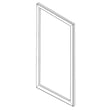
- Freezer door gasket 5304507200 if the seal is torn, warped, or leaking air
- Defrost timer 5304518034 if the unit is stuck in defrost or not defrosting properly
- Freezer defrost heater 216730700 if frost buildup is heavy and persistent
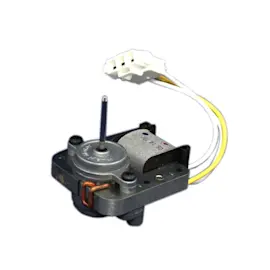
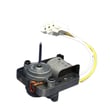
- Motor 297309000 (evaporator fan motor) if the fan is not running
- Upright freezer start relay 5304491585 if you hear repeated clicking and the compressor will not stay running
A freezer that is not freezing can be caused by simple setup issues (temperature setting, leveling, airflow clearance) or by a cooling-system problem (defrost, fan, start relay). Catching the cause early helps prevent food loss and avoids running the compressor harder than necessary.
Last updated: January 2026