 Owner’s manual
 Error Codes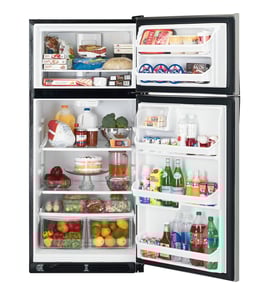




What is the upper part of a fridge called?
On the Kenmore 79579433219 top-mount refrigerator, the upper section is the freezer compartment (often just called the freezer). It’s the insulated area designed to hold frozen foods and maintain temperatures below freezing.
What you’ll typically find in the upper (freezer) section
- Freezer door and door gasket (helps seal in cold air)
- Shelves or bins for frozen food storage
- Evaporator area behind an interior cover (moves cold air)
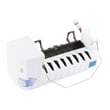
- Ice maker (if your model is equipped)
- Temperature control or airflow controls (varies by design)
Freezer vs. refrigerator compartment (quick comparison)
| Compartment | Typical temperature | Main purpose |
|---|---|---|
| Freezer (upper on a top-mount) | 0°F | Long-term frozen storage, ice production |
| Fresh food section (lower) | 37°F to 40°F | Short-term refrigerated storage |
Why it matters
Knowing the correct name helps when you’re ordering parts, following repair steps, or reading instructions. For example, the 79579433219 owner's manual uses “freezer door,” “upper hinge,” and “middle hinge bracket” terminology when describing door removal and reattachment.
Related parts and terms you may see
If you’re troubleshooting door sealing, alignment, or ice production, these terms come up often:
- Door gasket (air leaks cause frost and temperature swings)
- Door hinge bushing (helps the door pivot smoothly)
- Ice maker assembly (if installed)
Last updated: January 2026
How to tell cubic feet of Kenmore refrigerator by model number?
For Kenmore model 79579433219, the most reliable way to get the refrigerator’s cubic feet is to look up the capacity in the specifications section of the 79579433219 owner's manual. If you need a quick estimate, you can calculate interior volume from measurements.
Best way (recommended): use the manual specs
The model number itself usually does not directly encode cubic feet in a consistent way across Kenmore lines. For this refrigerator, use the manual to confirm the official capacity and features.
- Find the model and serial label inside the fresh food section (often on a side wall or near the crisper area)
- Match the full model number exactly: 79579433219
- Check the specifications or “parts and features” sections in the 79579433219 owner's manual
Quick estimate method (when you cannot access specs)
You can estimate cubic feet by measuring the usable interior space (not the outside cabinet).
- Empty the compartment so you can measure accurately
- Measure width x depth x height in inches for the refrigerator section
- Repeat for the freezer section
- Add the two volumes together
- Convert to cubic feet by dividing by 1,728 (12 x 12 x 12)
Conversion table
| What you have | What to do | Result |
|---|---|---|
| Interior volume in cubic inches | Divide by 1,728 | Cubic feet (approx.) |
| Separate fridge and freezer volumes | Add them first | Total capacity estimate |
Why it matters
Cubic feet helps you compare storage capacity, choose the right replacement shelves and bins, and set realistic expectations for food storage. It is also useful when comparing similar Kenmore and LG-built top-mount refrigerators.
Last updated: January 2026
Are there any 32 inch wide refrigerators?
Yes. 32-inch wide refrigerators are common, especially in top-freezer and some bottom-freezer or counter-depth French door designs, and they are a practical choice when you have a tight cabinet opening. For exact fit planning around your Kenmore 79579433219, use the clearance guidance in the 79579433219 owner's manual.
What to measure before you buy
Even when the cabinet opening is 32 inches, the refrigerator still needs clearance for doors, airflow, and hookups.
- Measure the cabinet opening width at the front and back (walls are often not perfectly square).
- Confirm door swing clearance; many installations need about 24 inches of space in front to open doors comfortably.
- Check depth limits (standard-depth vs counter-depth) and handle clearance.
- Plan for water line access if you want an automatic ice maker; verify your home water pressure is in the typical refrigerator range.
- Leave space behind and above for ventilation per the manual.
Typical 32-inch refrigerator options (quick comparison)
| Style | Why people choose it | Fit notes |
|---|---|---|
| Top-freezer | Best value, simple layout | Often available in 32-inch widths |
| Bottom-freezer | Easier access to fresh food | Some models are 32 inches; depth varies |
| Counter-depth French door | Built-in look, wide shelves | 32-inch options exist but are less common |
Why it matters
A refrigerator that is exactly 32 inches wide on paper can still be a poor fit if the doors cannot open fully or if the unit cannot breathe properly. Correct clearances help prevent higher energy use and weak cooling performance.
Related installation tip for this Kenmore model
If you are planning to connect water for an ice maker, the manual calls out water pressure requirements and recommends choosing a location where a water supply can be easily connected. For step-by-step guidance, follow the water line section in the 79579433219 owner's manual.
Last updated: January 2026





