

Can you use a jointer without a planer?
Yes. You can use the jointer function on your Craftsman model 149236280 without using the planer function; a jointer flattens one face and squares one edge, but it does not make the opposite face parallel or bring the board to a consistent thickness the way a planer does.
- Jointer: creates one flat reference face and one straight, square edge.
- Planer: makes the opposite face parallel to the reference face and brings stock to uniform thickness.
- Jointer only: great for straightening and flattening, but boards can still vary in thickness.
- Planer only: makes boards uniformly thick, but it will not reliably flatten a twisted or cupped board without a sled.
- Both together: the standard workflow for milling rough lumber accurately.
| Goal | Best approach | Typical steps |
|---|---|---|
| Flatten and square rough lumber | Jointer + planer | Joint face, joint edge, plane to thickness |
| Straighten an edge for glue-up | Jointer only | Joint one edge, then rip to width |
| Thickness already-flat stock | Planer only | Plane in light passes to final thickness |
- Start with shorter boards that are easier to control.
- Take light passes to reduce tear-out.
- Use push blocks and keep hands away from the cutterhead area.
- Confirm the fence is set square before edge-jointing.
- Stop and correct snipe, chatter, or burning by reducing depth of cut and feed pressure.
A jointer gives you a true reference surface. Without a planer, you can still build projects, but you will spend more time selecting flatter stock, hand-planing, sanding, or designing joinery that tolerates thickness variation.
For general DIY safety practices before servicing or adjusting a power tool, we recommend reviewing are diy appliance repairs safe.
Last updated: February 2026
Is there a jointer planer combo?
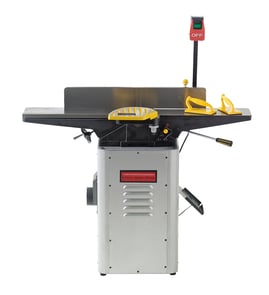
Yes. A jointer planer combo is a single woodworking machine that functions as both a jointer (to flatten and square an edge/face) and a thickness planer (to make boards a consistent thickness). Your Craftsman model 149236280 is a 6-1/8 inch jointer/planer, which is exactly this type of combo tool.
A combo unit gives you two core milling steps in one footprint:
- Jointing: flattens one face and squares one edge to that face
- Planing: makes the opposite face parallel and brings stock to final thickness
- Space savings: one machine instead of two separate tools
- Shared cutterhead/motor: one cutting system used in both modes
Use these quick checks when comparing models:
| Feature | Jointer only | Planer only | Jointer/planer combo |
|---|---|---|---|
| Infeed/outfeed tables | Yes | No | Yes |
| Thickness bed with height adjustment | No | Yes | Yes |
| Fence for edge jointing | Yes | No | Yes |
| Mode change (table lift/flip, dust hood move, etc.) | No | No | Yes |
If you need both flat, square reference surfaces and consistent thickness, a combo tool streamlines the workflow and reduces setup space. The tradeoff is that you typically switch modes (jointer to planer) rather than running both operations at the same time.
When you are shopping for replacement parts or confirming compatibility, match the full model number exactly (for this tool: 149236280). Our guide on how to find your appliance model number (and what it means for parts) helps you locate and verify the model tag so you order the right items.
Last updated: February 2026
How does the position of a cutterhead on a planer compare to its position on a jointer?
On a jointer, the cutterhead sits below the workpiece and cuts the bottom face as the board passes over the infeed and outfeed tables. On a planer, the cutterhead sits above the workpiece and cuts the top face as the board feeds through.
- Jointer: cutterhead is under the board; you reference the tables to flatten one face.
- Planer: cutterhead is over the board; you reference the bed to make the opposite face parallel.
- Jointer goal: create one flat face and a straight, square edge.
- Planer goal: bring stock to consistent thickness and make faces parallel.
- Feed behavior: jointer is typically hand-fed; planer uses powered feed rollers.
| Tool | Cutterhead position | What it cuts | What it references | Typical result |
|---|---|---|---|---|
| Jointer | Below the board | Bottom face | Infeed/outfeed tables | One flat face (and a straight edge with fence) |
| Planer | Above the board | Top face | Bed/table | Uniform thickness; faces parallel |
Because the cutterhead is below the board on a jointer, the outfeed table becomes the “new reference surface” after the knives remove material. Because the cutterhead is above the board on a planer, the bed is the reference, so the planer follows whatever shape the bottom face already has.
- Joint one face first before planing; it prevents “copying” a cup or twist into the finished thickness.
- Use light passes; heavy cuts increase tear-out and can overload the cutterhead.
- Keep knives sharp and set evenly; uneven knife height causes ridges.
- Support long boards with infeed/outfeed stands to reduce snipe and taper.
- Unplug the tool before checking knife height, belt condition, or wiring.
For general DIY safety and best practices when working on power tool wiring, see are diy appliance repairs safe.
Last updated: February 2026
What is the best jointer planer?
The “best” jointer/planer depends on your shop space, budget, and how wide your lumber is. For most DIY woodworkers, an 8-inch jointer/planer combo with a helical cutterhead is the best all-around choice because it balances capacity, surface finish, and noise. Use your Craftsman model 149236280 needs (6-1/8 inch capacity) as your baseline when comparing upgrades.
- Width capacity: 6-inch machines (like the Craftsman 149236280) handle common boards; 8-inch is the most popular step-up.
- Cutterhead type: Helical (spiral) heads cut quieter and reduce tear-out; straight knives cost less.
- Bed length and fence rigidity: Longer tables and a solid fence improve jointing accuracy.
- Dust collection: A good hood and strong airflow keep the planer from clogging.
- Power and feed rate: More power and consistent feed reduce snipe and stalling.
| If you are… | Best fit | Why it’s best |
|---|---|---|
| Tight on space | Jointer/planer combo | One footprint, shared motor and cutterhead |
| Chasing best finish | Helical cutterhead model | Less tear-out, smoother surface, quieter cut |
| On a strict budget | Straight-knife model | Lower upfront cost, simple maintenance |
| Working wider stock often | 8-inch or 12-inch capacity | Fewer glue-ups, less pre-ripping |
- Measure your typical stock width (rough lumber is often wider than finished parts).
- Confirm electrical needs (many larger combos require 240V).
- Plan for knives or inserts (ongoing cost and availability matters).
- Look at adjustment access (infeed/outfeed table and fence adjustments should be straightforward).
A jointer/planer that matches your real lumber sizes and tolerance for setup time saves hours of rework. The right cutterhead and table stability also reduce tear-out, snipe, and alignment frustration, which is what most people mean when they say a machine is “the best.”
For help confirming you have the correct model number before comparing parts or specs, use how to find your appliance model number (and what it means for parts).
Last updated: February 2026