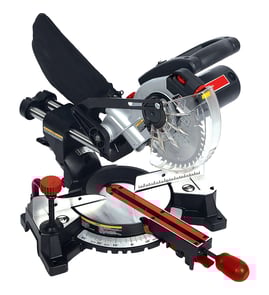

What should you never cut with a miter saw?
For a Craftsman miter saw like model 137285870, we never use it to cut materials it is not designed to control safely, especially items that can bind, shatter, or grab the blade. Avoid ferrous metals, masonry, and any cut that forces your hands close to the blade path.
Materials you should never cut
- Ferrous metals (steel, iron, rebar): they can overheat the blade and throw sparks and fragments.
- Masonry products (brick, concrete, tile): abrasive dust and binding can damage the saw and create dangerous kickback.
- Very small pieces that cannot be clamped securely: they can shift and get pulled into the blade.
- Warped, twisted, or round stock that cannot sit flat against the fence and table: it can roll or pinch the blade.
- Anything thicker or wider than the saw’s cutting capacity: it increases binding and loss of control.
Cuts you should never attempt
- Freehand cuts (not against the fence, not supported): the workpiece can move into the blade.
- Ripping boards (cutting with the grain like a table saw): miter saws are built for crosscuts and miters, not rip cuts.
- Cutting without securing the work: if you cannot hold it firmly against the fence and table, clamp it or do not cut it.
Quick “safe vs. not safe” guide
| Task or material | Use a miter saw? | Why |
|---|---|---|
| Crosscutting dimensional lumber | Yes | Work is supported and controlled against fence/table |
| Cutting tiny offcuts without a clamp | No | Piece can shift and be launched |
| Cutting steel angle iron | No | Sparks, overheating, blade damage, loss of control |
| Cutting brick or tile | No | Abrasive dust, binding, kickback risk |
Why it matters
Most miter saw injuries happen when the material moves unexpectedly or the blade binds. Using the right material, keeping the work flat to the fence, and clamping small pieces prevents kickback and keeps hands out of the blade path.
Parts and help for your saw
If your saw is vibrating, not cutting straight, or the guard is sticking, worn components (blade, arbor hardware, pivot points, fence alignment) are common causes. Use the model number 137285870 to find the correct diagrams and replacement parts on the model page, or search by model at Sears PartsDirect.
Last updated: February 2026
Why is 31.6 on a miter saw?
The 31.6° mark on your Craftsman miter saw model 137285870 is there to simplify common crown molding cuts. It is a preset miter angle used for “compound” crown cuts (miter plus bevel) so you can build accurate inside and outside corners with less trial-and-error.
What 31.6° is used for
Most miter saws include 31.6° because it pairs with a common bevel setting (often 33.9°) to create a tight corner joint when crown molding has a standard spring angle.
Typical use cases:
- Cutting crown molding laid flat on the saw table (not nested against the fence)
- Making inside corners and outside corners with repeatable settings
- Speeding up trim work when you are doing multiple rooms
- Reducing the need for test cuts when the molding spring angle matches common profiles
Quick settings guide (typical)
These are the common “cheat sheet” angles many saws reference for crown molding. Always confirm with scrap first because crown profiles vary.
| Crown spring angle (common) | Typical miter setting | Typical bevel setting |
|---|---|---|
| 38° (common) | 31.6° | 33.9° |
| 45° (less common) | about 35.3° | about 30.0° |
How to use the 31.6° mark successfully
- Verify the molding’s spring angle (often printed on the packaging or measured).
- Set the miter to 31.6° and the bevel to the matching preset (commonly 33.9°).
- Keep the crown oriented consistently (ceiling edge vs wall edge) for every cut.
- Make a test corner using short scrap pieces before cutting full-length trim.
- Use a sharp blade and steady feed to prevent tear-out on the face of the molding.
Why it matters
Crown molding corners are unforgiving; a small angle error creates visible gaps. The 31.6° detent is a built-in shortcut that helps you get clean, repeatable compound cuts without doing trigonometry on the job.
If you need replacement parts for your Craftsman 137285870 miter saw, we recommend starting with the model’s parts list, or searching by model number on Sears PartsDirect.
Last updated: February 2026
Can I cut a 4x4 with a 10-inch miter saw?
Yes, you can cut a 4x4 with a 10-inch miter saw, but whether it’s a one-pass cut depends on the saw’s max cut capacity. With a Craftsman miter saw like model 137285870, many 4x4 cuts require flipping the board or making a two-step cut, especially on non-sliding saws.
What to expect when cutting a 4x4
A “4x4” is typically 3-1/2 in. x 3-1/2 in. actual size. A 10-inch blade often has enough depth for some 90° cuts, but miter and bevel angles reduce capacity.
- Sliding 10-inch miter saws usually handle 4x4s more easily than non-sliders.
- Non-sliding 10-inch miter saws commonly need a flip cut (cut halfway, rotate the 4x4, finish the cut).
- Bevel cuts (tilting the head) reduce max cut depth.
- Miter cuts (turning the table) can also reduce capacity.
- Knots and wet lumber can bind the blade; feed steadily and let the blade do the work.
Safe, clean method: the flip-cut technique
Use this approach when the blade will not reach through in one pass.
- Mark your cut line on all four faces of the 4x4.
- Cut as deep as you can on the first face.
- Rotate the 4x4 180° (keep the same reference face against the fence if possible).
- Align the blade with the cut line and finish the cut.
Quick setup checklist
- Clamp the workpiece (or hold it firmly against the fence and table).
- Keep the 4x4 fully supported; use extension wings or a stand.
- Start the saw, let it reach full speed, then lower smoothly.
- Wait for the blade to stop before lifting it back up.
Capacity guide (typical, not model-specific)
| Saw type | Typical 4x4 at 90° | Notes |
|---|---|---|
| 10-inch non-sliding | Sometimes, often flip cut | Capacity varies by design |
| 10-inch sliding | Often yes | Wider crosscut and better reach |
| 12-inch (sliding or not) | Usually yes | More depth, less flipping |
Why it matters
Trying to force a one-pass cut when your saw cannot reach through can cause binding, tear-out, and inaccurate cuts. Using the flip-cut method keeps the cut square and reduces strain on the motor and blade.
Parts and help for your saw
If your saw struggles (slow start, weak power, excessive sparking, or rough pivoting), worn electrical components, brushes, switches, or mechanical wear can be involved. We list replacement parts by model, and you can also search by model number on Sears PartsDirect.
Last updated: February 2026
What are the parts of a miter saw?
A Craftsman miter saw like model 137285870 is built around a motor-driven blade, a pivoting saw head, and adjustable angle controls so we can make accurate crosscuts, miters, and bevels. Most models share the same core components, even if the exact layout varies.
Main parts you’ll see on most miter saws
- Blade: The cutting disc (commonly 10-inch or 12-inch on many saws).
- Blade guard: Covers the blade when the head is raised; retracts during the cut.
- Motor and drive: Spins the blade; may use direct drive or a belt/gear system.
- Handle and trigger (power switch): Starts and stops the saw.
- Saw head and pivot arm: The upper assembly that lowers into the work.
- Fence: Vertical back support that keeps the workpiece square.
- Table (base): Flat surface the work rests on.
Angle and adjustment controls (the accuracy parts)
These are the parts we use to set cut angles:
- Miter scale and pointer: Shows the left/right table rotation angle.
- Miter lock (knob/lever): Locks the table at the chosen miter angle.
- Detent plate and detent latch: “Click stops” at common angles (like 0°, 15°, 22.5°, 45°).
- Bevel scale and bevel lock: Sets and locks the tilt of the saw head for bevel cuts.
| Adjustment | What it changes | Typical use |
|---|---|---|
| Miter | Table rotates left/right | Picture frames, trim corners |
| Bevel | Blade tilts left/right | Crown molding, compound cuts |
| Depth stop (if equipped) | Limits how deep the blade drops | Dados, lap joints |
Other common components you may have
- Slide rails (sliding miter saws): Increase crosscut capacity.
- Work clamp: Holds material against the fence.
- Dust port and dust bag: Captures sawdust (often works best with a shop vacuum).
- Arbor and arbor bolt: The shaft and fastener that secure the blade.
Why it matters
Knowing the names of the miter scale, bevel lock, fence, and guard helps us troubleshoot accuracy issues (out-of-square cuts, drifting angles) and identify the right replacement components when something is worn or broken.
For replacement parts and diagrams for Craftsman 137285870, start with the parts list for your model, or search by model number on Sears PartsDirect.
Last updated: February 2026
What size is the miter slot on a Craftsman table saw?
Craftsman model 137285870 is a miter saw, and miter saws do not use a table-saw-style miter slot. If you are asking about a Craftsman table saw, most use the standard 3/4 inch wide x 3/8 inch deep miter gauge slot, but you should measure your saw’s slot to confirm before buying accessories from Sears PartsDirect.
What to know for a Craftsman miter saw vs. table saw
A miter slot question usually applies to a table saw because the miter gauge rides in a machined slot.
- Miter saw (like 137285870): uses a pivoting miter table with detents and a fence; no miter gauge slot
- Table saw: uses one or two miter slots to guide a miter gauge, sled, or runner
- Accessories are not interchangeable unless the interface matches (slot size, bar profile, anti-lift tabs)
How we recommend measuring a table saw miter slot
Use a caliper or accurate rule; measure in multiple spots.
- Unplug the saw
- Measure inside width at the tabletop surface
- Measure depth from tabletop down to the slot bottom
- Check the slot at the front and back of the blade area
- Note whether it is a T-slot (undercut) or a straight slot
Common miter slot sizes you’ll see
| Slot width | Slot depth | Where it’s common |
|---|---|---|
| 3/4 in | 3/8 in | Most U.S. table saws, including many Craftsman models |
| 5/8 in | 3/8 in | Some compact/benchtop saws |
| 3/4 in | varies | Depth differences affect anti-lift tabs and sled runners |
Why it matters
A loose bar causes wobble and inaccurate crosscuts; a tight bar can bind and create unsafe kickback conditions. Confirming width, depth, and slot style ensures your miter gauge or sled runner fits correctly.
Last updated: February 2026