Owner’s manual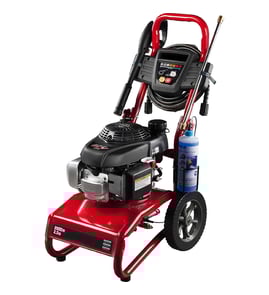





Is it worth repairing a pressure washer?
Yes, repairing a Craftsman pressure washer model 580752501 is usually worth it when the problem is a wear item (hose, nozzle, injector hose) and the total repair cost stays well below the price of a comparable new gas pressure washer. It is less worth it when the pump or engine has major internal damage.
- Compare the repair total (parts plus labor) to the cost of a similar new unit.
- Repair is the better value when the fix is simple and the frame, pump, and engine are in good shape.
- Replace is the better value when multiple systems are failing (pump plus engine plus hoses).
- If you only need better cleaning performance, start with the spray tip and nozzle selection.
- Use the maintenance schedule and specs in the 580752501 owner’s manual to avoid repeat failures.
These are typically straightforward and often restore performance quickly:
- Replace a cracked or leaking high-pressure hose: pressure washer hose 84006753
- Replace a worn or clogged spray tip/nozzle: pressure washer spray nozzle 195983XGS
- Fix chemical pickup issues by replacing the injector line: pressure washer chemical injector hose 705076
- Replace missing retaining hardware that causes leaks or loose connections
| Repair type | Typical complexity | Typical value outcome |
|---|---|---|
| Nozzle, hose, injector hose | Low | Usually worth repairing |
| Unloader valve or check valve service | Medium | Often worth repairing |
| Pump replacement | Medium to high | Depends on overall condition |
| Engine internal repair | High | Often better to replace |
A pressure washer can “feel” worn out when the real issue is flow restriction or a worn spray nozzle. Starting with the simplest water-path parts (spray nozzle, hose, chemical injector hose) often restores pressure and prevents unnecessary pump or engine work.
- Solving pressure washer problems
- Choosing the correct spray tip for a pressure washer
- How to replace a pressure washer unloader valve
Last updated: January 2026
What kind of gas goes in a Craftsman 3000 PSI pressure washer?
For the Craftsman pressure washer model 580752501, we use clean, fresh unleaded gasoline (87 octane/87 AKI minimum). Avoid old fuel and don’t mix oil into the gas (this is a 4-cycle engine setup on most gas pressure washers).
Use this checklist before you fill the tank:
- Use unleaded gasoline
- Use 87 octane (87 AKI) or higher
- Use fresh fuel (ideally less than 30 days old)
- Avoid stale fuel that smells sour or looks dark
- Avoid E85 or other high-ethanol blends
- Don’t use 2-cycle mix (no oil mixed into the gas)
For model-specific operating notes (fuel, oil checks, starting steps), follow the 580752501 owner’s manual.
Most small engines run best on low-ethanol fuel. Here’s a practical comparison:
| Fuel at the pump | Typical ethanol | Recommended for small engines | Notes |
|---|---|---|---|
| Regular unleaded | Up to 10% (E10) | Yes | Most common option; use fresh fuel |
| Ethanol-free | 0% | Best | Helps reduce storage and carb issues |
| E15 | 15% | No | Can cause hard starting and fuel system problems |
| E85 | 51% to 83% | No | Not compatible with small-engine fuel systems |
Using the right gasoline helps prevent hard starting, surging, and loss of pressure caused by fuel-system varnish and carburetor clogging. Fresh fuel also protects seals and reduces downtime during peak cleaning season.
If the engine cranks but won’t run, these steps usually help:
- Drain old fuel and refill with fresh 87+ octane unleaded
- Check the oil level (low-oil shutdown can prevent starting)
- Confirm water supply is on and the spray gun is triggered while starting
- Try a different spray tip if the pump is loading the engine (a clogged tip can bog it)
- Review our pressure washer won’t start troubleshooting steps
Last updated: January 2026
What PSI should my pressure washer be?
For a Craftsman gas pressure washer like model 580752501, the “right” PSI depends on what you’re cleaning: most homeowners get the best results in the 1,300 to 2,800 PSI range for cars, decks, patios, fences, and general outdoor cleanup. For the exact rated PSI for your unit, check the 580752501 owner's manual.
- 1,300 to 1,900 PSI: cars, patio furniture, grills, light siding rinse
- 2,000 to 2,800 PSI: decks, fences, most concrete and driveway cleaning
- 2,900+ PSI: heavy-duty concrete, paint prep (higher risk of surface damage)
- Use a wider spray pattern first; increase pressure only as needed
- Keep the wand moving to avoid etching wood or concrete
Even with the same pump pressure, the spray nozzle (tip angle and orifice) changes cleaning power and risk of damage.
| Tip color (common) | Typical angle | Best for | Risk level |
|---|---|---|---|
| Red | 0° | spot cleaning only | Highest |
| Yellow | 15° | heavy grime on hard surfaces | High |
| Green | 25° | general cleaning | Medium |
| White | 40° | rinsing, delicate surfaces | Low |
| Black | soap | detergent application | Low |
If your spray pattern is uneven, weak, or “pulsing,” a worn or clogged tip can make the washer feel underpowered. Replacing the nozzle is often the fastest fix; see pressure washer spray nozzle 195983XGS.
Using too much PSI (or too narrow a tip) can gouge wood, strip paint, and etch concrete. Using too little PSI wastes time and can lead to overuse of chemicals. Matching PSI and nozzle angle gives faster cleaning with less surface damage.
- Verify full garden-hose flow to the pump (no kinks, clean inlet screen)
- Purge air from the system (trigger on, steady water flow before starting)
- Inspect for leaks at the hose and fittings; replace if damaged (example: pressure washer hose 84006753)
- Try a different spray nozzle before adjusting or replacing pump components
Last updated: January 2026