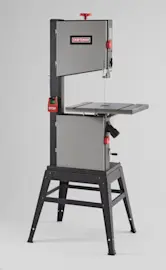
Owner’s manual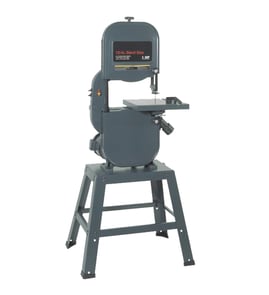

How do I know the size of my bandsaw blade?
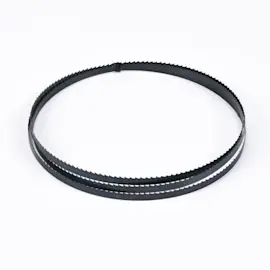
For Craftsman model 113244512, the blade size is defined by length and width; this saw uses 1/4-inch wide blades that are 56-7/8 inches long. You can confirm the spec and see blade installation details in the owner's manual.
Blade size for Craftsman 113244512
This model is designed to use only the blade size below:
| Spec | What it means | 113244512 requirement |
|---|---|---|
| Blade length | Total loop length of the blade | 56-7/8 in. |
| Blade width | Tooth tip to back edge | 1/4 in. |
How to measure your blade (if it is off the saw)
We recommend measuring only when the saw is unplugged and the blade is safely handled.
- Wear safety goggles and gloves before uncoiling a blade
- Lay the blade loop on the floor and carefully uncoil it at arm’s length
- Mark a starting point (often the weld)
- Follow the blade around with a tape measure until you return to the mark
- Measure blade width from the tooth tip to the back of the blade
- Count teeth per inch (TPI) by counting teeth across 1 inch
Why the correct blade size matters
Using the correct 56-7/8 in. length helps the blade tension and tracking adjustments work properly; the correct 1/4 in. width helps the blade guides support the blade and reduces twisting during cuts.
Quick safety and setup reminders
- Unplug the band saw before changing or measuring the blade
- Install the blade with the teeth pointing downward toward the table
- Center the blade on the rubber tires before tensioning
- Set tension so the blade moves only slightly with moderate thumb pressure
For replacement parts and diagrams for your Craftsman 113244512 band saw, start with the parts list for this model, or search by model number on Sears PartsDirect.
Last updated: February 2026
What are the specs of the Craftsman 113244512 10" direct-drive band saw?
The Craftsman 113244512 is a 10-inch direct-drive band saw. For model-accurate specifications (setup, adjustments, and the complete parts breakdown), we use the 113244512 owner's manual; it’s the best source for the exact configuration and service details for this saw.
Key specs you can count on for this model
These are the core, model-specific identifiers and what they mean in practical terms:
- Brand/model: Craftsman 113244512
- Type: 10-inch direct-drive band saw (motorized)
- Category: Power tool parts
- Identification plate location: right-hand side of the frame (helpful for matching parts)
- Documentation included: assembly, operating, and repair parts information
What “10-inch” and “direct-drive” mean
On a 10-inch direct-drive band saw like the Craftsman 113244512:
- 10-inch typically refers to the saw’s size class (commonly tied to wheel diameter and overall capacity class).
- Direct-drive means the motor drives the lower wheel directly (no belt and pulleys), which reduces belt-related maintenance and simplifies troubleshooting.
- You will still need correct blade tracking, blade tension, and guide alignment for clean cuts.
Typical measurements and capabilities (use as a planning range)
Exact capacities vary by configuration and setup, but most 10-inch benchtop band saws are commonly in these ranges:
| Spec area | Typical range for 10-inch band saws | What to check in the manual |
|---|---|---|
| Throat depth | About 9 to 10 inches | Capacity and cutting envelope |
| Max cut height | About 3-1/2 to 6 inches | Guide post travel and setup |
| Table tilt | Often 0 to 45 degrees | Trunnion/tilt adjustment procedure |
Why it matters
Using the correct specs helps you choose the right blade width and tooth count, set proper guide spacing, and avoid drift, burning, or premature wear on wear items like tires and bearings. For ordering parts by the correct model number, start with the model parts list, then search by model on Sears PartsDirect.
Last updated: February 2026
What is the 3-tooth rule for bandsaws?
The 3-tooth rule means you choose a band saw blade tooth pitch (TPI) so at least 3 teeth are in the cut at all times. On your Craftsman 113244512 10-inch direct-drive band saw, this helps prevent tooth breakage on thicker stock and reduces grabbing or rough cuts on thinner stock; see the owner's manual for safe setup and operation basics.
How to use the 3-tooth rule (quick method)
- Measure the workpiece thickness where the blade enters the cut.
- Pick a blade TPI that keeps 3 or more teeth engaged.
- If you are between choices, go finer TPI for thin material and coarser TPI for thick material.
Simple TPI guide by thickness
- 1/8 inch stock: typically 18 to 24 TPI
- 1/4 inch stock: typically 10 to 14 TPI
- 1/2 inch stock: typically 6 to 10 TPI
- 1 inch stock: typically 3 to 6 TPI
- 2 inches and thicker: typically 2 to 4 TPI (wood blades)
Why the rule matters
If too few teeth are engaged (TPI too coarse for thin stock), the blade can snag and strip teeth. If too many teeth are engaged (TPI too fine for thick stock), the gullets cannot clear sawdust well, which increases heat, slows the cut, and shortens blade life.
What to watch for while cutting
- Chattering, grabbing, or tooth loss: switch to a finer TPI
- Burning, slow feed, or packed sawdust: switch to a coarser TPI
- Wandering cuts: check blade tension and blade guides adjustment
- Excessive vibration: confirm the saw is bolted securely to the bench
Setup reminders for the Craftsman 113244512
These steps support cleaner cuts regardless of TPI:
- Install the blade with the teeth pointing downward toward the table.
- Set blade tension so the blade deflects only slightly with moderate thumb pressure.
- Adjust the upper blade guide assembly to just clear the workpiece before turning the saw on.
| If you are cutting | Best blade choice | What you gain |
|---|---|---|
| Thin stock, veneers, small parts | Higher TPI | Smoother cut, less snagging |
| Thick stock, resawing | Lower TPI | Better chip clearance, faster feed |
| Tight curves | Narrower blade (often higher TPI) | Smaller turning radius |
Ordering parts and blades
We list model-specific parts by diagram when available; you can also search by model number on Sears PartsDirect to find compatible replacement items.
Last updated: February 2026
What is the 4 inch rule for bandsaw?
The 4-inch rule for a band saw means we keep our hands and fingers at least 4 inches away from the moving blade at all times. On a Craftsman 113244512 10" direct-drive band saw, that usually means using a push stick, push block, or a holding jig anytime the cut brings your hands close to the blade.
How to apply the 4-inch rule on the Craftsman 113244512
Use these habits on every cut:
- Set the upper guide assembly to just clear the workpiece before you start feeding the cut.
- Keep both hands on the workpiece, but outside the 4-inch zone; reposition your hands before they get close.
- Use gentle, steady feed pressure; do not force the work into the blade.
- For small parts, narrow rips, or short offcuts, use a push stick or push block instead of your fingers.
- Never reach across the blade path; stop the saw and wait for the blade to fully stop before clearing scraps.
For model-specific operating and setup details (including guide adjustment and safe feeding technique), follow the 113244512 owner's manual.
Quick safety checklist (before every cut)
- Blade tracking and tension are set correctly.
- Blade teeth point downward toward the table.
- Guides are set close to the blade and adjusted correctly.
- Workpiece is supported flat on the table.
- Push device is within reach for small stock.
When the 4-inch rule is hardest to follow
Small work and tight curves are where hands drift too close. The manual notes that a 1/4-inch blade can cut a minimum circle of about 1-1/2 inches; tighter work often needs relief cuts so you are not twisting the blade or crowding your hands.
| Cutting situation | Best way to keep 4 inches away |
|---|---|
| Narrow rip or thin strip | Push stick or push block |
| Short piece near the blade | Holding jig or clamp-style fixture |
| Tight curve | Relief cuts, slow feed, frequent hand repositioning |
Why it matters
The band saw blade is continuously moving and exposed at the cut line. Keeping a 4-inch buffer gives you reaction time if the workpiece shifts, binds, or the blade grabs, and it helps you maintain control without putting fingers in the danger zone.
If you need to look up diagrams or replacement parts by model number, start with the parts list for Craftsman 113244512, or search by model on Sears PartsDirect.
Last updated: February 2026