Owner’s manual
 Error Codes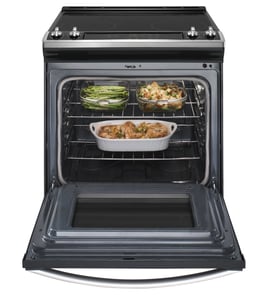



What are the disadvantages of electric ovens?
Electric ovens like the one in our Amana AER6303MFS3 range are typically very consistent once they stabilize, but they can feel slower to respond than gas when you change settings; they also stop heating during a power outage. For model-specific operating tips, use the AER6303MFS3 user manual.
Common disadvantages you may notice
- Slower temperature changes: electric elements cycle on and off, so quick adjustments can take longer to show up in the oven.
- Preheat can take longer: especially when you are moving to higher temperatures.
- Power-outage dependency: if household power is out, the oven will not heat.
- Residual heat: the cavity and elements stay hot after you turn the oven off, which can overcook delicate foods if you do not account for carryover heat.
- More noticeable cycling: some foods can brown differently as the bake element cycles to maintain temperature.
What we recommend for better results on AER6303MFS3
- Preheat fully and wait for the preheat tone before baking.
- Use the rack positions recommended for the food type (cookies, casseroles, roasts).
- Avoid frequent door openings; heat loss can extend cook time.
- Do not line the oven bottom with foil or liners; it can affect airflow and baking performance.
- If baking seems consistently too hot or too cool, use the oven temperature adjustment feature described in the manual.
Quick comparison: electric vs. gas ovens
| Feature | Electric oven | Gas oven |
|---|---|---|
| Temperature stability | Usually steadier | Can fluctuate more |
| Response to setting changes | Slower | Faster |
| Moisture in oven | Drier heat | More humid heat |
| Works during power outage | No | Sometimes (varies by design) |
Why it matters
Knowing these tradeoffs helps you choose the right bakeware, rack position, and preheat habits so you get predictable baking and roasting results without chasing the temperature.
Last updated: January 2026
How much does it cost to run an electric oven for 3 hours?
For the Amana AER6303MFS3 electric range, the 3-hour cost depends on your electricity rate and the oven’s actual power draw while baking. The use & care manual focuses on operation, not electrical wattage; use the rating label on your range for the most accurate estimate (see the AER6303MFS3 user manual).
How to calculate your 3-hour cost (most accurate method)
Use the wattage from the range’s rating label (often listed as kW at 240 V) and your utility rate.
- Find your electric rate on your bill (in $/kWh)
- Find the oven/range kW or watts on the rating label
- Use: Cost = (Watts ÷ 1000) × Hours × Rate
- Remember: ovens cycle on and off after preheat, so average draw is usually lower than the maximum rating
3-hour cost examples (plug in your numbers)
These examples show the math; replace the wattage with your AER6303MFS3 rating-label value.
| If your average draw is | Energy used in 3 hours | Cost at $0.15/kWh | Cost at $0.20/kWh |
|---|---|---|---|
| 2,000 W | 6.0 kWh | $0.90 | $1.20 |
| 3,000 W | 9.0 kWh | $1.35 | $1.80 |
| 4,000 W | 12.0 kWh | $1.80 | $2.40 |
What changes the real-world cost on AER6303MFS3
- Preheat time (highest, most continuous energy use)
- Set temperature (higher temps usually increase element on-time)
- Door openings (heat loss forces longer recovery)
- Cookware and load (heavy pans and multiple racks can extend recovery)
- Temperature accuracy (if the oven struggles to regulate temperature, check the range oven temperature sensor WPW10181986)
Why it matters
A cost estimate helps you plan long bakes and compare strategies like cooking multiple dishes in one session versus running the oven multiple times.
Last updated: January 2026
What is a common problem of the electric oven?
A common problem we see on the Amana AER6303MFS3 electric range is the oven not heating correctly or baking unevenly. On this model, the most likely causes are a failed bake or broil heating element, an out-of-range oven temperature sensor, or an electronic control issue.
Common symptoms you may notice
- Oven will not heat in Bake, or it heats very slowly
- Broil does not heat, or only heats intermittently
- Long preheat times
- Food consistently underbakes or overbakes
- Temperature swings that do not match the set temperature
Quick checks we recommend first (no parts)
Use the AER6303MFS3 user instructions manual to confirm the correct keypad steps, then check these basics:
- Verify the range has power; reset the breaker if needed
- Make sure the control is not in Demo mode (display works but elements do not heat)
- Press OFF/CANCEL to clear a flashing display after a power interruption
- Confirm you are starting the cycle correctly; Start must be pressed within the allowed time
- Avoid lining the oven bottom with foil or a liner; it can disrupt airflow and heating
Parts that commonly fix heating and temperature problems
If the quick checks do not help, these model-compatible parts are common suspects:
| Symptom | What usually failed | Model-compatible part |
|---|---|---|
| Oven temperature inaccurate | Oven temperature sensor | Range oven temperature sensor WPW10181986 |
| No or weak heat on Bake | Bake element | Bake element W11182108 |
| No or weak heat on Broil | Broil element | Range broil element W10856603 |
| Erratic operation or no response | Electronic control | Control, electronic (lcx) (black) W11747105 |
Why it matters
When the oven cannot regulate heat, cooking results suffer and food may not reach safe internal temperatures. Fixing the root cause also helps prevent longer run times that can stress other components.
Last updated: January 2026