 Owner’s manual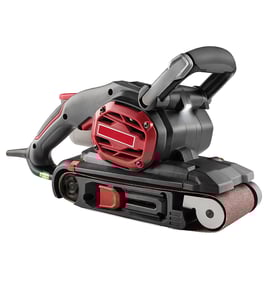


What is the procedure to replace the belt on the belt sander?
To replace the sanding belt on your Craftsman 113225831 belt and disc sander, we power the tool off, release belt tension, remove the old belt, install the new belt in the correct direction, then re-tension and track the belt so it runs centered.
- Unplug the sander before touching the belt, rollers, or guards
- Let the belt stop completely before servicing
- Wear eye protection and avoid loose sleeves or gloves near moving parts
- Keep fingers clear of pinch points at the rollers
- Vacuum dust from the belt area before reassembly
- Disconnect power: Unplug the sander.
- Open access: If your unit has a belt cover or guard, remove it (usually a few screws or a latch).
- Release tension: Move the belt tension lever or loosen the tension knob (model designs vary).
- Remove the old belt: Slide the belt off the front and rear rollers.
- Install the new belt:
- Align the belt on both rollers.
- Match the belt’s arrow (if printed) to the normal belt travel direction.
- Re-tension: Return the tension lever to the locked position (or re-tighten the tension knob).
- Set belt tracking: Plug in and briefly run the sander; adjust the tracking knob so the belt stays centered on the rollers.
| What you see | What to do |
|---|---|
| Belt walks toward the left edge | Turn the tracking knob slightly to move it back toward center |
| Belt walks toward the right edge | Turn the tracking knob slightly the opposite direction |
| Belt flutters or slips | Increase tension and re-check belt size and seating |
Correct tension and tracking prevent the belt from shredding, reduce vibration, and protect roller bearings and the platen from uneven wear.
Control locations (tension lever, tracking knob, and any guards) can vary by production run; we use the diagrams and instructions in the 113225831 owner's manual to match your exact configuration.
Last updated: February 2026
What is better than a belt sander?
A belt sander is the fastest choice for heavy stock removal, so nothing is strictly “better” for that job. For smoother finishing, tighter control, or less aggressive sanding than your Craftsman 113225831 belt & disc sander, a random orbital sander or finishing sander is usually the better pick.
| Task | Better choice than a belt sander | Why |
|---|---|---|
| Fine finish on flat surfaces | Random orbital sander | Leaves fewer straight-line scratches |
| Light sanding between coats | Finishing (pad) sander | Gentle, easy to control |
| Tight corners and edges | Detail sander or sanding block | Fits where belts cannot |
| Removing paint in small areas | Oscillating multi-tool with sanding pad | More precise, less gouging |
- Use a belt sander when you need rapid material removal (leveling, flattening, shaping).
- Switch to a random orbital sander for final smoothing before stain, paint, or clear coat.
- Use a finishing sander for light touch-ups and between-coat sanding.
- Use a detail sander for corners, inside edges, and small profiles.
- Match grit to the goal: coarse (40 to 80) for removal, medium (100 to 150) for smoothing, fine (180 to 220+) for finishing.
Using a belt sander when you really need a finishing tool can leave deep scratches, rounded edges, and swirl-free but visibly “striped” sanding marks that take extra time to remove. Choosing the right sander first usually saves abrasives and rework.
- Confirm belt tracking and disc alignment before precision sanding.
- Use light pressure; let the abrasive do the work to avoid gouging.
- Follow the setup, adjustment, and safety steps in the 113225831 owner's manual.
Last updated: February 2026
Is a 4x36 belt sander good for knife making?
Yes; a 4x36 belt sander can work for knife making, especially for rough shaping and handle work, but it is slower and less versatile than a 2x72 grinder for profiling, bevel grinding, and fast stock removal. For your Craftsman 113225831 belt and disc sander, use it as a solid starter tool and plan your process around its limits.
A 4x36 belt sander is most effective when you treat it like a shaping and finishing station, not a high-powered grinder.
- Rough profiling on mild steel or annealed blade blanks
- Flattening and truing handle scales (wood, G10, Micarta)
- Cleaning up forge scale before finer grinding
- Light bevel work with patience and fresh belts
- Deburring and edge-breaking
It struggles most with:
- Fast bevel grinding on hardened steel
- Keeping plunge lines consistent without a platen designed for knife work
- Heat control (thin edges heat quickly)
Most 4x36 sanders run at a moderate surface speed; that is fine for control, but it increases time on steel. You get the biggest performance gain from belt choice and technique.
| Task | Recommended belt type | Typical grit range |
|---|---|---|
| Profiling/stock removal | Ceramic or zirconia | 36 to 60 |
| Bevel shaping | Ceramic | 60 to 120 |
| Pre-finish | Aluminum oxide | 120 to 220 |
| Handle shaping | Aluminum oxide | 80 to 220 |
- Use a fresh, quality belt; dull belts create heat and slow grinding.
- Keep the platen flat and the belt tracking centered.
- Grind in short passes and quench often to protect temper.
- Use a simple angle jig or tool rest to keep bevel angles consistent.
- Dress or replace the disc if it is glazed or out of flat.
Knife grinding is a balance of speed, control, and heat management. A 4x36 belt sander like the Craftsman 113225831 gives good control and can produce excellent knives, but it demands better abrasives and more time to avoid overheating and uneven bevels.
For model-specific adjustments, alignment, and safe operation details, follow the 113225831 owner's manual.
Last updated: February 2026