 Owner’s manual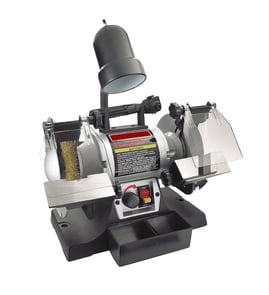


What is the work rest gap for a bench grinder?
For the Craftsman bench grinder model 152211620, we set the tool (work) rest so the inside edge is 1/16 inch from the grinding wheel. This tight gap helps prevent the workpiece from getting pulled between the wheel and the rest; confirm the adjustment procedure in the owner's manual.
Recommended work rest gap (quick reference)
- Target gap for this model: 1/16 inch
- Recheck the gap after: wheel changes, wheel dressing, or any hard bump to the rest
- Keep the rest rigid and locked down after adjustment
- Adjust with the grinder unplugged and the switch OFF
| Setup item | What to set | Why it matters |
|---|---|---|
| Tool rest to wheel gap | 1/16 in. | Reduces chance of the workpiece wedging and kicking back |
| Tool rest position | Flat and stable | Helps you control sharpening and grinding |
| After wheel dressing | Re-adjust to 1/16 in. | Dressing changes wheel diameter slightly |
How we adjust the tool rest on model 152211620
- Unplug the bench grinder.
- Loosen the tool rest adjustment knob(s).
- Slide the tool rest in until the inside edge is 1/16 inch from the wheel.
- Tighten the fasteners firmly so the rest cannot shift.
- Spin the wheel by hand to confirm it clears the rest before powering on.
Why it matters
A properly set work rest gap improves control during sharpening, deburring, and stock removal, and it helps keep small parts from being pulled into the wheel area.
Last updated: February 2026
What are the 4 important rules for a bench grinder?
For the Craftsman 152211620 bench grinder, the 4 most important rules are: wear proper eye protection, keep guards and rests correctly adjusted, use only wheels rated above the grinder’s RPM, and start and grind safely (stand to the side at startup and grind only on the wheel face). See the owner's manual for the model-specific safety steps.
The 4 rules (with the settings that matter)
- Protect your eyes and face: Use the eye shields and wear safety glasses (a face shield is a smart upgrade for heavy grinding).
- Keep guards, tool rests, and spark arrestors adjusted: As wheels wear down, re-adjust so the gap stays tight (the manual calls out about 1/16 inch from the wheel).
- Match wheel RPM to the grinder: Only install a grinding wheel with an RPM rating higher than the bench grinder’s maximum RPM.
- Operate safely every time: Stand to one side when turning it on, let it run up to speed for at least one minute, then grind on the front face of the wheel (never the side).
Quick safety checklist before you switch it on
- Unplug the grinder before adjustments, wheel changes, or maintenance.
- Inspect the grinding wheel for cracks and handle it carefully.
- Keep flammables away; grinding produces sparks and debris.
- Do not force the workpiece, especially on a cold wheel; apply light pressure and let the wheel cut.
- Keep the work area clean and frequently remove grinding dust.
Key limits and targets (easy reference)
| Item | What to do | Why it matters |
|---|---|---|
| Tool rest and spark arrestor gap | Keep near 1/16 inch from the wheel | Reduces snagging and kickback risk |
| Startup position | Stand to the side; run 1 minute | Protects you if a damaged wheel sheds debris |
| Grinding surface | Use the wheel face only | Side loading can crack wheels |
| Wheel selection | Wheel RPM rating must exceed grinder max RPM | Prevents overspeed wheel failure |
Why it matters
A bench grinder can eject debris at high speed, and a damaged or misused wheel can break. Tight clearances, correct wheel selection, and safe startup habits reduce the biggest risks while improving control and grind quality.
Last updated: February 2026
Can you use a bench grinder to sharpen tools?
Yes. The Craftsman 152211620 bench grinder is designed for hand-held grinding and sharpening, so you can sharpen many tools as long as you use the correct wheel, set the tool rest to the right angle, and avoid overheating the edge. See the owner's manual for safe sharpening setup and operation details.
Best practices for sharpening on a bench grinder
- Wear safety goggles and keep the eye shields and wheel guards in place.
- Use light pressure and make short passes; let the wheel do the work.
- Keep the tool rest close to the wheel (without touching) and set it to match your bevel angle.
- Cool the tool often (dip in water) to prevent drawing the temper, especially on knives and chisels.
- Stand to the side when starting the grinder, then move into position once it runs smoothly.
Which side and speed to use
The manual describes sharpening as a right-side grinding-wheel task, and it includes a speed chart showing low speed (about 1725 RPM) runs cooler for light-duty work like sharpening.
| Task | Typical setup | Why it helps |
|---|---|---|
| Sharpening | Grinding wheel (right side), lighter pressure | Better control of the edge |
| Heavy stock removal | Higher speed, heavier pressure (as needed) | Faster material removal |
| Cleaning metal | Wire wheel (left side) | Removes rust/paint without grinding an edge |
Safety checks before you sharpen
- Inspect the grinding wheel for cracks or damage; replace a damaged wheel immediately.
- Tighten the spindle nut just enough to hold the wheel firmly; do not over-tighten.
- Make sure the grinder is securely mounted to a solid work surface so it cannot tip or move.
- Use proper circuit protection (120V, 15-amp branch circuit with a time-delay fuse or breaker).
Why it matters
Sharpening creates hot sparks and can overheat thin cutting edges quickly. Using the guards, correct speed, and a stable tool rest helps you get a sharper edge with less risk of wheel damage, kickback, or eye injury.
Last updated: February 2026
What is a Craftsman bench grinder?
A Craftsman bench grinder is a stationary power tool you mount to a solid work surface; it spins a grinding wheel (and often a wire wheel) to sharpen, grind, deburr, and clean metal. For Craftsman model 152211620, operating and safety details are covered in the 152211620 owner's manual.
What you can do with a bench grinder
Typical workshop uses include:
- Sharpening hand tools (chisels, punches, mower blades)
- Light grinding and shaping metal
- Deburring cut edges
- Rust and paint removal (commonly with a wire wheel)
- Cleaning metal surfaces before finishing
Key specs and setup points for model 152211620
These model-specific details help you choose accessories and set up safely.
| Item | Model 152211620 detail |
|---|---|
| Power | 1/2 continuous duty HP (1/5 maximum developed HP) |
| Electrical | 120V, 60 Hz; connect to a 120V, 15-amp branch circuit with a 15-amp time-delay fuse or circuit breaker |
| No-load speed | 1725 RPM to 3450 RPM (as listed in the manual) |
| Grinding wheel size | 8 in. x 1 in. x 5/8 in. |
| Grinding wheel grit | 60 grit |
| Work light bulb | 120V, 40W or less, Type R20, medium base or equivalent (not included) |
Safety essentials we recommend
Bench grinders throw sparks and debris; safe setup matters as much as the tool.
- Wear ANSI Z87.1-rated eye protection; everyday glasses are not enough
- Secure the grinder to a solid bench so it cannot tip or move
- Keep spark arrestors adjusted close to the wheel (about 1/16 in.)
- Use a properly grounded outlet and correct circuit protection
- Use indoors only; avoid damp locations
Why it matters
Correct wheel size, proper mounting, and the right electrical circuit reduce vibration, improve sharpening results, and help prevent wheel damage and injury.
Last updated: February 2026