
Which mitre saw is the most accurate?
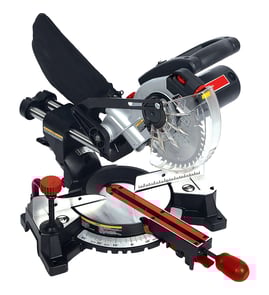
The most accurate miter saw is the one that holds its settings and cuts square after you tune it. For a 10-inch compound miter saw like the Craftsman 113235330, accuracy comes from a rigid fence and pivot, minimal blade wobble, and a properly aligned miter and bevel scale.
Accuracy is usually a mix of repeatability (it returns to the same angle every time) and cut quality (the blade tracks straight without deflection).
- Repeatability: miter detent plate, miter lock, and bevel lock do not slip
- Squareness: fence is straight and 90 degrees to the table
- Blade tracking: arbor and bearings run true (low runout)
- Deflection control: sharp blade, steady feed rate, and solid work support
- Calibration: miter and bevel pointers match the actual cut angle
- Unplug the saw.
- Check fence straightness and tighten fence hardware.
- Verify 90 degrees at miter 0 and bevel 0 using a reliable square.
- Make a test cut on a wide board; flip one piece and check for gaps.
- If cuts drift, inspect blade condition and arbor play.
| Feature | Why it matters | What to look for |
|---|---|---|
| Rigid fence and table | Keeps stock from shifting | No flex, solid mounting |
| Tight pivots and locks | Prevents angle creep | Locks that clamp firmly |
| Quality blade and arbor | Reduces wander and tearout | Minimal wobble, sharp teeth |
| Stable work support | Prevents twisting | Extension wings or stands |
Even a premium saw cuts inaccurately if the fence is out of square or the blade is dull. A well-tuned saw (including the Craftsman 113235330) produces cleaner miters, tighter joints, and less rework on trim and framing.
If you are troubleshooting electrical issues that can affect performance (intermittent power, weak start, sparking), use how to use a multimeter to test electrical parts video to test switches, cords, and connections safely.
Last updated: February 2026
How much is a miter saw worth?
A miter saw’s value depends on brand, size, and condition. For a Craftsman 113235330 10-inch compound miter saw, most used-market prices land in the low hundreds when it runs smoothly, cuts accurately, and includes key accessories; new saws typically cost more.
- Used, working, average wear: about $75 to $200
- Used, excellent condition (tight pivots, accurate bevel/miter, clean motor): about $150 to $300
- Needs repair or missing parts (guard, fence, switch, cord): about $20 to $100
- New 10-inch compound miter saws (varies by features): about $99 to $1,099
- Blade guard returns smoothly and fully covers the blade
- Miter and bevel locks hold firmly with no slipping
- Fence is straight and the table is not cracked or warped
- Motor starts quickly, runs without heavy sparking, and does not bog down
- Cord and plug are intact (no cuts, no taped repairs)
- Includes extras (blade, dust bag, hold-down clamp, stand)
| Step | What to do | Why it matters |
|---|---|---|
| 1 | Confirm the model number is 113235330 | Correct ID improves pricing accuracy and parts matching |
| 2 | Test cut a 2x4 at 90° and 45° | Accuracy and smooth travel drive buyer confidence |
| 3 | Note missing or damaged items | Missing safety parts and hardware reduce value quickly |
A miter saw that is accurate and safe (guarding, solid locks, good wiring) sells for more because it is ready to use immediately. If it needs electrical or alignment work, buyers price in repair time and parts.
For help confirming the model tag location before you price or shop parts, use how to find your appliance model number (and what it means for parts).
Last updated: February 2026
What should you never cut with a miter saw?
You should never use a Craftsman 113235330 10-inch compound miter saw to rip-cut boards (cutting with the grain), cut tiny pieces held close to the blade, or cut materials the saw is not designed for (such as masonry or most steel). These cuts raise the risk of binding, kickback, and loss of control.
- Rip cuts (with the grain): use a table saw or circular saw setup instead.
- Very small workpieces that put your fingers within the “danger zone” near the blade.
- Freehand cuts (no fence support, no clamp, no stable work surface).
- Warped, twisted, or bowed lumber that cannot sit flat on the table and tight to the fence.
- Masonry products (brick, tile, concrete): abrasive dust and incorrect blade type.
- Ferrous metals (iron, most steel): only cut metal if the saw and blade are specifically rated for it.
| If you need to cut... | Use this instead | Why it is safer |
|---|---|---|
| Long boards with the grain | Table saw or circular saw with a guide | Miter saws are built for crosscuts, not ripping |
| Tiny trim blocks | Stop block plus clamp, or a hand saw | Keeps hands away from the blade |
| Metal | A dedicated metal-cutting saw | Correct speed, guarding, and blade type |
| Tile/brick | Wet saw or masonry saw | Controls dust and uses the right abrasive system |
- Keep the workpiece flat on the table and tight to the fence before starting the cut.
- Clamp whenever the piece is short, narrow, or wants to roll.
- Let the blade reach full speed, then cut smoothly; do not force the cut.
- Wait for the blade to stop completely before lifting the saw head.
- Use the correct blade for the material and confirm the blade is sharp and undamaged.
A miter saw is optimized for controlled crosscuts and miters against a fence. When the material can shift, bind, or requires a different blade and speed, the blade can grab the work and pull it, which is when injuries and damaged parts happen.
For general DIY safety best practices before any repair or adjustment, review are diy appliance repairs safe.
Last updated: February 2026
Why is 31.6 on a miter saw?
The 31.6° mark on your Craftsman 113235330 10-inch compound miter saw is a built-in shortcut for cutting crown molding using a compound cut. It pairs with a common bevel setting (often 33.9°) to produce tight 90° corner joints when the crown has a standard spring angle.
Most compound miter saws include “crown molding” reference angles because crown corners are tricky to calculate. The 31.6° miter setting is commonly used when you cut crown:
- As a compound miter (miter plus bevel), not a simple miter
- For inside corners and outside corners (the direction changes, but the angle is the same)
- With crown that has a typical spring angle (commonly 38° or 52°)
- To reduce measuring errors and speed up repeat cuts
Use this as a starting point, then make test cuts on scrap to match your exact crown profile.
- Set the miter to 31.6° (left or right depending on the corner)
- Set the bevel to 33.9° (left or right depending on your saw’s bevel direction)
- Keep the crown oriented consistently (same face up each time)
- Cut two test pieces and check the joint before cutting finish material
These are the typical “shortcut” angles many saws reference for standard crown.
| Crown spring angle | Miter setting | Bevel setting |
|---|---|---|
| 38° (common) | 31.6° | 33.9° |
| 45° (less common) | 35.3° | 30.0° |
Crown molding corners are a geometry problem; the 31.6° detent helps you get repeatable results without doing trigonometry every time. It also reduces gaps caused by small layout errors, especially on long runs.
If you are troubleshooting power, switches, or wiring while setting up your saw, we recommend starting with how to use a multimeter to test electrical parts video.
Last updated: February 2026
What are the parts of a miter saw?
A Craftsman 113235330 10-inch compound miter saw is built around a motor-driven blade on a pivoting arm, plus angle-setting controls that let us make accurate crosscuts and miters. Most models share the same core parts even when the exact shapes and names vary.
- Blade and arbor: The blade mounts to the arbor; the arbor nut/bolt clamps it in place.
- Blade guard (upper and lower): Covers the blade; the lower guard retracts as we lower the handle.
- Motor and drive: Powers the blade (direct drive or belt drive depending on design).
- Handle and trigger/power switch: Starts the saw and gives us control while cutting.
- Base and table: The work surface; supports the workpiece and the fence.
- Fence: Keeps the board square to the blade for repeatable cuts.
- Miter scale and miter lock: Sets left/right angle (commonly 0 to 45 degrees each way).
- Bevel scale and bevel lock: Tilts the saw head for bevel cuts (commonly 0 to 45 degrees).
- Positive stops (detents): Click-stops at common angles (for example 0, 15, 22.5, 31.6, 45).
- Depth stop: Limits how far the blade lowers for trenching or controlled depth cuts.
- Spindle lock: Holds the arbor still so we can change the blade.
- Dust port and dust bag (or vacuum adapter): Captures sawdust at the guard.
- Clamp (work hold-down): Secures the workpiece to reduce movement.
| Area | Parts you’ll see | What you use it for |
|---|---|---|
| Front of base | Miter scale, miter lock/handle | Setting left/right angles |
| Side/rear of pivot | Bevel scale, bevel lock | Tilting the head |
| Around blade | Guard, arbor, spindle lock | Safety and blade changes |
| Back of saw | Dust port | Dust collection |
Knowing the names of the fence, miter lock, bevel lock, and guard helps us diagnose problems faster (for example, a saw that will not hold angle, a guard that sticks, or a switch that will not start).
If you’re trying to identify a specific component on your Craftsman 113235330, use the exploded-view diagrams and parts list for the model, or search by model number on Sears PartsDirect.
Last updated: February 2026