
Can you replace the chuck on a Drill Press?
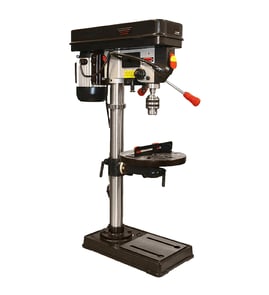
Yes. On the Craftsman 113213720 8 inch bench model drill press, you can replace the chuck by removing the existing chuck from its taper (usually a Jacobs taper on the chuck and a Morse taper in the spindle), then cleaning and reseating the new chuck and arbor so it runs true.
Safety first
- Unplug the drill press before touching the chuck, belts, or spindle.
- Remove the bit and lower the table for clearance.
- Wear eye protection; tap-out operations can release parts suddenly.
- Support the chuck with a block of wood so it does not drop.
- Avoid striking the chuck jaws directly; it can ruin accuracy.
How chuck removal usually works (common drill press design)
Most bench drill presses remove the chuck in one of these ways:
| What you see | Likely setup | Typical removal method |
|---|---|---|
| Slot in the quill/spindle | Tapered arbor seated in spindle | Insert a drift key (wedge) and tap to pop the arbor/chuck out |
| No slot, but a retaining screw inside chuck | Threaded mount | Open jaws fully, remove screw (often reverse thread), then unthread chuck |
Tapered arbor method (most common)
- Lower the quill to expose the slot.
- Insert the correct drift key into the slot.
- Tap the drift key firmly to release the arbor and chuck.
Installing the new chuck (so it stays tight)
- Clean the spindle taper and arbor with solvent; remove oil and dust.
- Inspect for burrs or dents; lightly dress with fine abrasive if needed.
- Seat the arbor into the spindle taper.
- Press the chuck onto the arbor by raising the table and pulling the quill down firmly (no hammering).
- Test runout with a straight bit or rod; re-seat if wobble is obvious.
Why it matters
A worn or poorly seated chuck causes wobble, oversized holes, and bit slippage. A properly installed chuck improves accuracy and reduces vibration, which also helps protect the spindle bearings and belts.
Related DIY help: how to use a multimeter to test electrical parts video
Last updated: February 2026
How to repair a Drill Press spindle?
On the Craftsman 113213720 8 inch bench model drill press, spindle repair usually means removing the quill assembly, inspecting the spindle and bearings, then replacing worn bearings or the spindle and reassembling with correct retention and runout checks. This restores smooth rotation and accurate drilling.
Before you start (safety and setup)
- Unplug the drill press; lock out power so it cannot be switched on.
- Remove the bit, chuck key, and any workpiece; lower the table for clearance.
- Mark the depth stop and quill return spring position so reassembly is easier.
- Take photos as you go; small washers and clips must return to the same order.
- Plan to clean and lightly oil sliding surfaces during reassembly.
Spindle and quill repair steps (typical process)
- Remove the belt cover and release belt tension; slip the belt off the pulleys.
- Remove the chuck (and arbor if used) from the spindle taper.
- Support the quill; remove the quill retaining hardware (often a retaining ring or collar).
- Slide the quill assembly out of the head.
- Separate the spindle from the quill; press or drive the spindle out carefully.
- Remove and replace spindle bearings if rough, noisy, loose, or seized.
- Reinstall bearings on the spindle, reinstall the spindle into the quill, then reinstall the quill.
- Re-tension the belt, verify smooth quill travel, and check runout at the chuck.
What to inspect while it is apart
| Item | What you are looking for | What it causes |
|---|---|---|
| Spindle bearings | Grinding, play, heat discoloration | Wobble, noise, poor hole accuracy |
| Spindle taper | Rust, scoring, dents | Chuck falls off, runout |
| Quill bore | Galling, debris, wear | Sticky feed, uneven return |
| Return spring | Weak tension, binding | Quill will not retract |
Why it matters
A worn spindle or bearing set is one of the most common reasons a drill press drills oversized holes, chatters, or throws the chuck. Fixing the spindle assembly improves accuracy, reduces vibration, and protects the motor and pulleys.
Helpful DIY reference
If you need a quick refresher on electrical checks while troubleshooting vibration or intermittent power, use how to use a multimeter to test electrical parts video.
Last updated: February 2026
Where is the model number on a Craftsman Drill Press?
On the Craftsman drill press model 113213720, the model number is on the identification label at the rear of the head (the motor and pulley housing). Use 113213720 when ordering parts so we match the correct diagrams and components.
Where to look on model 113213720
- Stand behind the drill press and look at the back side of the head
- Check for a metal nameplate or printed decal on the head casting
- Wipe off dust and oil; the printing is often easier to read after cleaning
- If the label is missing, look for small rivet holes or a clean rectangle where it was mounted
What information you should write down
Most Craftsman drill press ID labels include:
- Model number (used for parts lookup)
- Serial number (helps identify the production run)
- Electrical ratings (volts, amps, phase)
| Label item | Why it matters for parts and service | Example for this drill press |
|---|---|---|
| Model number | Matches the correct parts list and diagrams | 113213720 |
| Serial number | Helps narrow variations across production | Varies |
| Electrical ratings | Confirms correct switch, cord, and motor specs | Varies |
Why it matters
Craftsman drill presses can look similar across model series, but parts like the switch, belts, pulleys, and quill components vary by model. Using the exact model number prevents ordering the wrong part.
For a quick guide to finding and using model numbers, see how to find your appliance model number (and what it means for parts).
Last updated: February 2026
Who made Craftsman drill presses?
Craftsman drill presses were built for Sears by several different manufacturers over the years, so there is no single company that made them all. For Craftsman model 113213720, the most accurate way to identify the original maker is to use the data plate and any manufacturer codes on the drill press and motor.
Common makers you may see on older Craftsman drill presses
Depending on the era, Craftsman drill presses are commonly associated with manufacturers such as:
- King-Seeley
- Emerson Electric
- Atlas Press Company
- Walker-Turner
- Other later suppliers (varies by production run and year)
How to identify the maker on model 113213720
Use the physical identification tags first; they are more reliable than assumptions based on the model prefix.
- Check the data plate on the head, column, or base for a listed company name
- Look for an EIA code, date code, or manufacturer code on the plate (if present)
- Check the motor nameplate for the motor manufacturer (this can differ from the drill press maker)
- Note any casting marks inside the pulley cover or on the head casting
- When buying replacement parts, always match by model 113213720 to ensure fit
Quick reference: what different tags tell you
| Where you look | What it identifies | Why it matters |
|---|---|---|
| Drill press data plate | Tool maker or Sears production info | Best clue to who built the machine |
| Motor nameplate | Motor manufacturer | Helps when replacing motor or electrical components |
| Casting marks | Foundry or casting run | Useful for confirming families of designs |
Why it matters
Knowing the actual maker helps you match the correct quill/spindle parts, belts and pulleys, switches, and bearings because similar-looking Craftsman bench drill presses can use different shaft sizes and mounting patterns.
For help confirming the exact model and tag locations, use how to find your appliance model number (and what it means for parts).
Last updated: February 2026