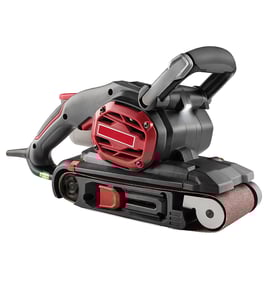

Why does my belt sander keep ripping belts?
On a Craftsman 31522420 3" belt sander, belts usually rip when the belt is the wrong type or installed backward, tracking is off so the belt rubs the housing/platen, tension is incorrect, or heat and heavy pressure weaken the belt seam. Fixing tracking, belt direction, and sanding technique typically stops repeat failures.
- Belt installed backward: Many sanding belts have an arrow; running it the wrong way can stress the seam.
- Tracking misalignment: If the belt rides hard against one side, it can fray and tear quickly.
- Worn or damaged platen/plate: A nick, burr, or rough spot can cut the belt backing.
- Bad rollers: A seized, out-of-round, or dirty roller can overheat the belt and shred edges.
- Too much pressure or too slow feed: Overloading builds heat and can pop the seam.
- Wrong belt construction: Paper-backed belts tear easier; cloth-backed belts usually last longer on belt sanders.
- Unplug the sander and remove the belt.
- Inspect the belt path for sharp edges, packed dust, pitch, or a screw head rubbing.
- Check the rollers: spin by hand; they should turn smoothly without wobble.
- Install a fresh belt in the correct direction (follow any arrow on the inside of the belt).
- Set tracking so the belt runs centered and does not touch the side guards.
- Sand with light, steady pressure; let the abrasive do the work and pause to cool if the belt feels hot.
| What you see | Most likely cause | Best next move |
|---|---|---|
| Belt tears at the seam | Heat, backward belt, over-tension | Verify arrow direction; reduce pressure; check tension |
| One edge frays fast | Tracking off, roller wear | Re-center tracking; inspect rollers |
| Random cuts/tears | Burr on platen/guard, debris | Smooth burrs; clean belt path |
A ripping belt is usually a sign of mis-tracking or friction. That extra heat and drag can also wear rollers and internal components faster, so correcting the root cause protects the tool and improves sanding results.
For help confirming you have the correct model number before ordering belts or repair parts, use how to find your appliance model number (and what it means for parts).
Last updated: February 2026
Which sanding belt lasts the longest?
Ceramic abrasive sanding belts typically last the longest on a Craftsman 31522420 3 inch belt sander because the grain stays sharp longer and handles heat better during heavy stock removal. Zirconia is a strong second choice for aggressive sanding, while aluminum oxide is best for lighter, lower-cost work.
- Longest life (hard use): ceramic belts
- Best durability for woodworking: zirconia belts
- Best value for light sanding: aluminum oxide belts
- Best for paint removal: zirconia or ceramic (coarser grits)
- Best for finish sanding: aluminum oxide (finer grits)
Belt life is mostly about heat, pressure, and keeping the abrasive cutting instead of rubbing.
- Use moderate pressure; pushing hard overheats the belt and glaze-loads the grit
- Keep the belt tracking correctly so it does not chew the edges
- Match grit to the job; too fine too soon burns and clogs faster
- Clean the belt when sanding wood or paint (a belt cleaning stick helps)
- Replace worn platen/cork pad surfaces if the belt is bouncing or slipping
| Abrasive type | Typical lifespan | Best use cases | Tradeoff |
|---|---|---|---|
| Ceramic | Longest | Heavy sanding, hardwoods, tough coatings, some metals | Higher cost per belt |
| Zirconia | Long | Fast stock removal on wood, leveling, stripping | Can run hotter than ceramic |
| Aluminum oxide | Medium | General sanding, finish prep, lighter duty | Wears faster under heavy pressure |
A longer-lasting belt cuts cooler and faster, which helps protect the sander’s motor, reduces burn marks on wood, and saves time on belt changes. Choosing the right abrasive also improves surface quality and reduces gouging.
If you are troubleshooting power loss, intermittent running, or suspect a cord or switch issue, use our guide: how to repair broken or damaged wires video.
Last updated: February 2026
How to install belt on Craftsman belt sander?
To install a sanding belt on your Craftsman 31522420 3" belt sander, release the belt-tension lever, slide the belt off and on with the arrows matching the sander’s belt direction, then re-engage the lever and center the belt using the tracking knob before sanding.
- Unplug the sander.
- Flip the belt-tension lever to the release position (this loosens the front roller).
- Slide the old belt off the rollers.
- Slide the new 3-inch belt on; align the belt’s arrow with the sander’s belt travel direction.
- Flip the lever back to the locked position to tension the belt.
- Lift the sander slightly (belt not touching the work) and briefly run it.
- Turn the tracking knob a little at a time until the belt runs centered on the rollers.
- Belt installed backwards: Reinstall so the belt arrow matches belt travel.
- Tracking needs adjustment: Make small knob turns; wait a second for the belt to respond.
- Worn belt or damaged seam: Replace the belt if it “walks” no matter how you track it.
- Dirty rollers/platen: Clean dust buildup so the belt can ride smoothly.
| Item to verify | What “right” looks like | What happens if it’s wrong |
|---|---|---|
| Power disconnected | Cord unplugged | Accidental start risk |
| Belt direction | Arrow matches travel | Poor tracking, premature wear |
| Tension lever | Fully locked | Belt slips or jumps |
| Tracking | Belt runs centered | Belt rubs housing or walks off |
Correct belt tension and tracking protect the rollers and housing, reduce belt tearing, and help the Craftsman 31522420 sand evenly without gouging the workpiece.
For general DIY safety and prep steps before working on powered equipment, see are diy appliance repairs safe.
Last updated: February 2026
What are the main parts of a belt sander?
On the Craftsman 31522420 3-inch belt sander, the main parts are the abrasive sanding belt, two rollers (drive and idler), the motor and drive system, and the belt-tracking and tension hardware that keeps the belt centered and tight during use.
- Sanding belt: The abrasive belt that does the cutting and smoothing.
- Drive roller (lower roller): Powered by the motor; it pulls the belt.
- Idler roller (upper roller): Free-spinning roller that supports the belt and helps maintain tension.
- Motor: Provides power to turn the drive roller.
- Belt tension lever or knob: Lets you release and re-tension the belt for changes.
- Tracking adjustment: Fine-tunes belt alignment so it runs centered on the rollers.
- Platen (sanding shoe): Flat backing surface behind the belt that helps keep sanding even.
| Part | What it does | Common symptom if it has an issue |
|---|---|---|
| Sanding belt | Removes material | Poor sanding, glazing, burning wood |
| Drive roller | Moves the belt | Belt stalls or slips under load |
| Idler roller | Supports belt and tension | Belt wanders, squeals, uneven wear |
| Tracking adjuster | Centers the belt | Belt runs off the side |
| Platen | Keeps belt flat on the work | Gouging, uneven sanding pattern |
| Dust port/bag (if equipped) | Captures dust | Excess dust, clogging, overheating |
Knowing these parts helps you troubleshoot fast. For example, a belt that keeps walking off usually points to tracking, roller wear, or tension problems, while a belt that slows down under pressure often points to belt condition or drive roller grip.
If you are diagnosing a motor, switch, or wiring issue, use a meter and safe test practices; our guide how to use a multimeter to test electrical parts video walks through the basics.
Last updated: February 2026
Is a 4x36 belt sander good for knife making?
Yes; a 4x36 belt sander is a solid entry-level tool for knife making, especially for profiling, handle shaping, and light bevel work, but it is slower and less precise than a 2x72 grinder for primary bevel grinding. Your Craftsman model 31522420 is a 3-inch belt sander, so its belt size and feel can differ from a true 4x36.
- Profiling a blade blank before heat treat
- Shaping and smoothing handle scales
- Rounding spines, easing sharp edges, deburring
- Light bevel cleanup and blending (with a steady tool rest)
- General shop sanding tasks between knife steps
- Slower stock removal: use fresh, coarse belts and lighter pressure so the abrasive cuts.
- Bevel consistency: keep the platen flat, use a firm tool rest, and make repeatable passes.
- Heat control: quench often; overheating ruins edge performance.
- Belt selection: 4x36 belts are available, but the variety is usually narrower than 2x72.
| Step | Typical grit | Goal |
|---|---|---|
| Shaping | 36 to 60 | Remove material fast, establish profile |
| Refining | 80 to 120 | Clean up scratches, start bevel definition |
| Pre-finish | 220+ | Prep for hand sanding or finishing |
Knife grinding is mostly about belt speed, platen stability, and abrasive quality. A 4x36 can produce a good knife, but it takes more time and technique to keep bevels straight and temperatures under control.
For electrical checks that affect grinder performance (cord, switch, motor), use how to use a multimeter to test electrical parts video.
Last updated: February 2026