Owner’s manual
 View engine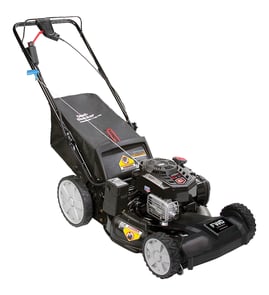
What kind of gas do I put in my push lawn mower?
Use fresh, regular unleaded gasoline in your Craftsman 917388270 push mower; most owners use E10 (up to 10% ethanol). Avoid old or contaminated fuel, and never refuel indoors or while the engine is hot. For safety and handling details, follow the owner's manual.
For this 21 in 5.5 hp rear discharge rotary mower, the goal is clean, stable fuel that will not cause hard starting or loss of power.
- Use fresh regular unleaded gasoline
- E10 is the common choice for most small engines
- Do not use stale fuel (it can cause starting and power problems)
- Do not use fuel contaminated with water or dirt
- Do not store fuel in a rusty gas can (rust and debris cause carburetor issues)
The manual calls out key safety practices when checking and filling the fuel tank.
- Shut the engine off and let it cool for several minutes
- Refuel outdoors, not indoors
- Do not refuel while the engine is running or hot
- Wipe up spilled gasoline before starting
- Keep fuel away from sparks, flames, and smoking materials
If the mower will not start or runs weak, fuel quality is one of the first things we check.
| Symptom | Common fuel cause | What to do |
|---|---|---|
| Will not start | Out of fuel | Fill tank with fresh fuel |
| Hard starting | Stale fuel | Drain and refill with fresh, clean fuel |
| Runs rough or surges | Water in fuel | Drain tank and carburetor; refill with fresh fuel |
| Loss of power | Dirty fuel, clogged air filter | Replace fuel with fresh; clean/replace air filter |
Fresh, clean gasoline helps the carburetor meter fuel correctly, improves starting, and prevents varnish and deposits that lead to poor performance and extra maintenance.
Last updated: February 2026
How much does it cost to repair a hydrostatic transmission on a lawn mower?
A hydrostatic transmission repair is typically a riding mower cost; your Craftsman 917388270 is a 21-inch walk-behind mower and does not use a hydrostatic transmission. For hydrostatic riding mowers, repairs commonly run from a few hundred dollars for service to $1,300 or more for a transmission, with full replacement often reaching $1,500 to $2,500 including labor.
This model’s most common “drive” repairs are for the self-propel system (belt, wheels, brackets) rather than a transmission.
Common cost drivers:
- Worn or stretched drive belt
- Damaged wheel bracket or axle hardware
- Loose fasteners causing slipping or poor engagement
- Blade adapter wear that creates vibration (can mimic drive issues)
Actual pricing varies by shop rates and what failed, but these ranges are typical.
| Repair type | Typical parts cost | Typical labor cost | Notes |
|---|---|---|---|
| Hydrostatic service (riding mower) | $0 to $150 | $100 to $400 | Fluid, purge, linkage adjustments (if applicable) |
| Hydrostatic unit replacement (riding mower) | $800 to $1,300+ | $500 to $1,200 | Often replaced as an assembly |
| Walk-behind self-propel belt replacement | $20 to $40 | $75 to $200 | Most common “won’t drive” fix |
We recommend these basic checks first because they often pinpoint a simple, low-cost fix:
- Confirm the drive control cable engages and returns smoothly
- Inspect the drive belt for glazing, cracking, or slack (replace if worn)
- Check wheels for binding, stripped hubs, or debris wrapped around axles
- Tighten loose hardware on brackets and handle controls
- If vibration is severe, inspect the blade and adapter for damage
If you need diagrams, adjustment steps, and maintenance intervals for your Craftsman 917388270, use the owner's manual.
If your mower is slipping, not self-propelling, or making noise, these parts are frequent fixes:
- Belt, 21-in 532406712 (self-propel drive belt)
- Wheel bracket 532407494 (supports wheel and drive alignment)
- Axle arm assembly 532186575 (wheel/height mechanism support)
- Lawn mower blade adapter 581547901 (reduces vibration and protects crankshaft interface)
Hydrostatic transmission quotes can sound alarming, but they usually do not apply to walk-behind mowers like the Craftsman 917388270. Matching the repair to the correct drive system prevents overpaying and gets you to the right fix faster.
Last updated: February 2026
How do I make my riding mower deck higher?
Craftsman model 917388270 is a 21-inch walk-behind mower, so it does not have a riding mower deck lift. To cut higher, raise the cutting height by moving each wheel height adjuster to a higher-cut setting (all wheels matched). Use the 917388270 owner's manual for the exact adjuster positions.
- Shut the engine off, wait for the blade to stop, and disconnect the spark plug wire.
- Put the mower on a flat, hard surface.
- At one wheel, squeeze the adjuster lever toward the wheel to release the lock.
- Move the wheel to a higher-cut position (the wheel sits lower relative to the deck).
- Repeat for the other wheels; set all four to the same position.
- Adjust wheel height before starting the mower.
- Match all wheel settings to prevent scalping.
- Start at a medium-to-high setting for most lawns.
- In tall grass, raise the cut and slow your walking speed.
- Clean packed grass from under the deck to improve lift and bagging.
These are the most common causes on a walk-behind mower:
| What you notice | Most likely cause | What to do |
|---|---|---|
| Uneven cut | Wheel heights not matched | Re-set all wheels to the same notch/position |
| Scalping on bumps | Cut height too low for terrain | Raise 1 to 2 positions |
| Hard to push | Grass too tall or cut too low | Raise cutting height; mow slower |
| Vibration | Loose hardware at blade area | Check fasteners; replace missing hardware such as a lock nut 532409149 if needed |
A higher cut reduces engine load and helps prevent scalping. For best lawn health, we target removing only the top one-third of the grass blade, especially in thick or overgrown areas.
Last updated: February 2026
Why is my self-propelled lawn mower pulling to one side?
Your Craftsman 917388270 self-propelled mower pulls to one side when one wheel has more rolling resistance than the other or the deck is riding unevenly. The fastest fixes are matching wheel height settings, clearing deck buildup, and checking for a dragging wheel or drive component.
- Set all four wheels to the same cutting height.
- Check tire condition and make sure both rear wheels spin freely.
- Scrape packed grass from the underside of the deck (buildup can drag on one side).
- Look for a bent wheel bracket or loose wheel hardware.
- If you feel vibration, stop and inspect for blade or under-deck damage.
When the drive is engaged, a worn belt or binding axle hardware can load one side more than the other.
- Inspect the drive belt for glazing, cracking, or slack; replace if worn.
- Check the rear axle area for binding, debris, or loose fasteners.
- Inspect the wheel bracket for bending or looseness.
If you find damage, these model-matched parts are common fixes:
- Stop the engine and wait for all moving parts to stop.
- Disconnect the spark plug wire and keep it away from the plug.
- Tip the mower with the air filter and carburetor facing up.
| What you notice | Most likely cause | Best first step |
|---|---|---|
| Pulls on flat ground | Wheel heights uneven | Match wheel height settings |
| Pulls worse in thick grass | Deck dragging from buildup | Clean underside of deck |
| Pulls mainly with self-propel | Belt wear or binding drive side | Inspect belt and axle area |
A mower that pulls is harder to control and usually means extra drag on one side; fixing the cause helps the mower track straight, cut evenly, and reduces wear on the drive system.
For adjustment and maintenance procedures specific to this model, use the owner's manual.
Last updated: February 2026