Installation guide
 Owner’s manual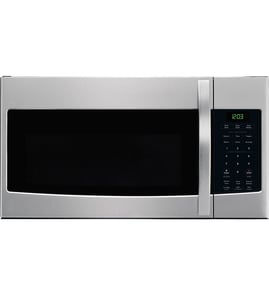





What are the disadvantages of a microwave oven combo?
A microwave/hood combo like the GE JVM1540DM4WW saves space, but the tradeoff is that you are combining two jobs into one appliance; that can mean more complicated installation, more expensive repairs, and ventilation performance that is often weaker than a dedicated range hood.
- If one function fails, the whole unit is impacted: a heating issue, door problem, or vent fan issue can take out your main over-the-range setup.
- Repairs can be more involved: over-the-range units are heavier, mounted above the cooktop, and often require removal for certain repairs.
- Ventilation can be a compromise: combo units may move less air than a high-CFM dedicated hood, and recirculating setups rely on filters.
- More installation constraints: cabinet cutouts, mounting height, duct routing, and electrical requirements must all line up.
- Less flexibility: you cannot easily swap to a countertop microwave or a different hood style without changing the whole configuration.
Microwave/hood combos typically vent in one of two ways: ducted to the outside or recirculating back into the kitchen. Recirculating setups depend heavily on filter condition.
| Setup | What it does well | Main downside |
|---|---|---|
| Ducted (outside vent) | Better smoke and steam removal | Duct routing can be difficult in some kitchens |
| Recirculating (non-ducted) | Easier install when no duct exists | Odors and grease control depend on filter maintenance |
For maintenance items commonly tied to vent performance, see the microwave grease filter WB06X10359 and microwave charcoal filter WB02X33061.
A combo unit sits directly over heat, steam, and grease. Following safe-use guidance in the JVM1540DM4WW owner’s manual helps prevent issues like overheating, arcing, and damage from improper cookware or running the microwave empty.
Last updated: February 2026
What is the average lifespan of a GE microwave?
Most GE microwaves, including over-the-range models like GE JVM1540DM4WW, last about 8 years with typical home use. A realistic range is 5 to 10 years, depending on how often you cook, how well you keep the cavity and venting clean, and whether the door closes and latches correctly.
In real-world use, lifespan usually falls into these buckets:
- 5 to 7 years: heavy daily use, frequent overheating, poor ventilation, or repeated door slams
- 8 years (average): normal household use and basic cleaning
- 9 to 12 years: lighter use, good airflow, and prompt repair of small issues (like a failing light or noisy fan)
| Usage pattern | Common lifespan | What shortens life fastest |
|---|---|---|
| Light (reheat only) | 9 to 12 years | Running empty, blocked vents |
| Typical family use | ~8 years | Grease buildup, door misalignment |
| Heavy daily cooking | 5 to 7 years | Overheating, repeated power surges |
We recommend these habits because they reduce heat stress and prevent common failures:
- Keep the grease filters clean so the hood fan can move air properly.
- Wipe the cavity and waveguide area regularly; grease and food splatter can cause arcing.
- Never run the microwave empty.
- Use microwave-safe containers and avoid metal trim or foil.
- Close the door gently; a damaged latch or misaligned door can stop the unit from running.
- If it goes dead or resets, have the power supply checked and inspect the fuse circuit.
A microwave is usually near end-of-life when you see repeated symptoms such as:
- Runs but does not heat
- Loud buzzing/humming, burning smell, or intermittent operation
- Door won’t latch consistently (unit will not start)
| Symptom | Often involved part |
|---|---|
| Completely dead/no display | Microwave fuse WB27X11099 |
| Door won’t start cycle | Microwave door latch hook WB02X11096 |
| Turntable not working smoothly | Glass tray WB49X10129 |
Knowing the typical lifespan helps you decide whether a repair (like a fuse or door latch issue) is a smart investment, or whether you are approaching the point where multiple age-related failures become more likely.
For model-specific safety, operating, and care guidance, follow the JVM1540DM4WW owner’s manual.
Last updated: February 2026
How do I find the model number on my JVM1540DM4WW?
On the GE JVM1540DM4WW microwave/hood combo, the model number and serial number are printed on a label inside the oven cavity. Open the door and look for the rating plate label on an inside wall of the microwave.
- Open the microwave door fully
- Look along the inside wall of the oven cavity for a label (rating plate)
- Find the lines labeled Model# and Serial#
- Write the numbers down exactly as shown (letters and numbers)
- Use that exact model number when selecting parts and diagrams
| Label name | What it includes | Why you need it |
|---|---|---|
| Rating plate | Model and serial numbers | Ensures the correct GE parts fit |
| Model/serial label | Model# and Serial# fields | Helps match the right diagrams and manuals |
GE microwaves often have multiple versions that look similar; the exact model number on the rating plate is what ensures you get the correct parts (for example, a glass tray WB49X10129 or a microwave fuse WB27X11099) and the right instructions.
For a diagram of key microwave features and the location guidance, use the JVM1540DM4WW owner's manual.
Last updated: March 2026