Installation guide
 Owner’s manual
 Error Codes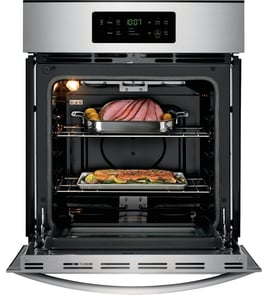



Is a 27 inch wall oven too small?
A 27-inch wall oven is not too small for most homes; it is a common “full-size” option that fits standard cabinetry while saving a little width versus a 30-inch model. For Maytag model MEW6527DDS, the key is matching your cabinet cutout to the required installation dimensions in the MEW6527DDS installation guide.
How to decide if 27 inches is the right size
A 27-inch electric wall oven typically works well for everyday baking and roasting, especially if you rarely need to cook on multiple racks with oversized pans.
- Choose 27-inch if you want more cabinet flexibility or you are replacing an older 27-inch unit.
- Choose 30-inch if you frequently cook for large groups or use extra-wide sheet pans.
- Prioritize cutout fit over the nominal oven width; the cabinet opening dimensions matter most.
- Consider your cookware: large roasters and wide baking sheets can be the deciding factor.
- If you use self-clean often, confirm you have proper door clearance and ventilation space.
MEW6527DDS cutout fit: what the install guide shows
The installation guide for built-in 27-inch and 30-inch electric wall ovens lists minimum cabinet opening requirements and clearances. Use it to confirm your existing cutout before ordering parts or planning a replacement.
| Nominal oven size | Typical use case | What to verify before buying |
|---|---|---|
| 27-inch | Great all-around size; common in many kitchens | Cabinet cutout width and depth; door clearance |
| 30-inch | More interior width; better for large pans | Cabinet cutout width; electrical circuit compatibility |
Why it matters
If the cabinet cutout is even slightly off, the oven may not mount correctly, the door may rub adjacent cabinetry, or airflow can be restricted. A correct cutout also helps the oven sit level, which supports even baking performance.
Last updated: January 2026
What is the disadvantage of a wall oven?
A key disadvantage of a wall oven like the Maytag MEW6527DDS is service access: because it is built into cabinetry, repairs and even basic checks can take more time and often require pulling the oven from the cabinet, which adds labor and complexity.
Common disadvantages (what we see most often)
- Harder to access for repairs: built-in installation can mean removing trim, disconnecting power, and sliding the unit out.
- More installation requirements: cabinet cutout, proper support, and correct electrical connection matter more than with a freestanding range.
- Heat and airflow sensitivity: the vent area can get hot during use; blocking the vent can affect baking results.
- Potentially higher service cost: extra time to remove and reinstall the oven can increase labor.
- Less flexibility to replace: you typically need a unit that fits the existing cutout dimensions.
What to check before assuming you need a repair
If performance is the concern (not just convenience), we recommend these quick checks first:
- Confirm the oven is not in a delayed, hold, or lockout mode.
- Verify the oven is level in the cabinet (uneven baking can be installation-related).
- Make sure pans are not touching each other or the oven wall.
- Do not cover racks or the oven bottom with foil (it can cause poor results and damage).
- Keep the vent opening clear for best baking performance.
Built-in wall oven vs freestanding range (quick comparison)
| Feature | Wall oven (MEW6527DDS type) | Freestanding range |
|---|---|---|
| Repair access | Often requires removal from cabinet | Usually serviced in place |
| Installation | Cabinet cutout and mounting required | Minimal, slides into place |
| Venting/airflow | Vent area can run hot; must stay unblocked | Typically more open airflow |
Why it matters
Most wall oven complaints we hear are not about cooking capability; they are about the practical reality that built-in placement makes troubleshooting, wiring checks, and part replacement more involved. For model-specific operating and safety details (including vent location and fan behavior), use the MEW6527DDS owner’s manual.
Last updated: January 2026
Do electric wall ovens need to be vented?
Electric wall ovens like the Maytag MEW6527DDS do not need a separate duct run to the outdoors; they vent heat through the built-in oven vent and cooling fan system. Keep the vent opening clear, and use room ventilation (window or exhaust fan) during self-clean for best air quality (see the MEW6527DDS owner's manual).
What “vented” means on this wall oven
This model is designed to exhaust heat from the oven cavity and control area through an oven vent located below the control panel.
- The oven vent area can get hot during use.
- Blocking the vent can hurt baking performance.
- The cooling fan may run during broil, cleaning, and some baking cycles, and it can keep running after the oven turns off.
- You should never cover racks or the oven bottom with foil because it can disrupt airflow and overheat components.
When you should ventilate the room
During normal baking and broiling, the built-in vent handles heat exhaust. During self-clean, we recommend ventilating the room.
- Open a nearby window or door during self-clean
- Run a kitchen exhaust fan if available
- Keep pets (especially birds) away from the kitchen area during self-clean
Quick guidance by situation
| Situation | What to do | Why it matters |
|---|---|---|
| Normal bake/broil | Keep the oven vent unobstructed | Helps temperature stability and protects controls |
| Self-clean cycle | Ventilate the room (window/door, exhaust fan) | Reduces odors and airborne byproducts |
| Cabinet installation | Follow clearances in the install instructions | Prevents heat damage and nuisance shutdowns |
Why it matters
Proper airflow protects the control panel area, helps the oven bake evenly, and reduces the chance of overheating issues that can lead to nuisance shutoffs or premature part wear.
Last updated: January 2026
Do I need an electrician to install a wall oven?
If you’re replacing an existing electric wall oven with the same type of connection, you typically do not need an electrician for a Maytag MEW6527DDS. If the circuit, wiring, or junction box needs to be added or changed, we recommend using a competent electrician.
When you can usually DIY the install
You can usually handle the swap if the cabinet cutout is already correct and the oven is connecting to an existing, properly sized 120/240V or 120/208V circuit.
- You are replacing an electric wall oven with another electric wall oven
- The existing wiring is in good condition (no burnt insulation, brittle wires, or loose connections)
- The oven can be secured with the mounting screws and trim as shown in the MEW6527DDS installation guide
- The cabinet cutout is level and straight (important for baking performance)
- The electrical connection is already present and accessible
When we recommend hiring an electrician
The installation instructions specify the unit must be properly circuit protected and wired to local code and the National Electrical Code, and they advise the hookup be done by a competent electrician.
- You need a new 240V circuit run (or the circuit size needs to change)
- You are converting from gas to electric (new circuit and wiring are typically required)
- The junction box location must be moved to meet the oven’s conduit access requirements
- You see heat damage at the connection point (melted wire nuts, discoloration, burnt smell)
- The oven trips the breaker or blows fuses during preheat
Quick decision guide
| Situation | Electrician recommended? | Why |
|---|---|---|
| Replace electric with electric on same circuit | Usually no | Connection already exists |
| New circuit, new junction box, or wire gauge change | Yes | Code compliance and safety |
| Any signs of overheating at the power connection | Yes | Prevents repeat failure and fire risk |
| Unsure of circuit rating or wiring condition | Yes | Confirms correct protection and wiring |
Why it matters
Wall ovens draw high current on 120/240V or 120/208V power. A loose or undersized connection can overheat and damage wiring, the terminal block, or the oven controls. If you find heat damage at the connection point, replacing the terminal block WPW10245259 is often part of the repair, but the wiring and breaker must also be corrected.
Last updated: January 2026