Error Codes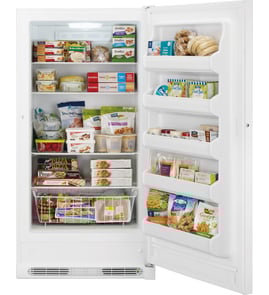



What's the average lifespan of an upright freezer?
Most upright freezers, including the Kenmore 2539264110, typically last 10 to 15 years with normal home use. Good airflow, clean condenser areas, and a tight door seal help the compressor and sealed system run less, which extends overall life.
What affects lifespan the most
- Room conditions: Hot garages and tight enclosures make the freezer work harder.
- Door seal condition: Leaks cause longer run times and frost buildup.
- Condenser cleanliness: Dust and pet hair raise operating temperatures.
- Defrost and airflow: Heavy frost and blocked vents reduce cooling efficiency.
- Power quality: Frequent outages or surges can stress electrical components.
Quick maintenance checklist (5 to 10 minutes)
- Keep 2 to 3 inches of clearance around the cabinet for ventilation.
- Vacuum dust from the back and lower areas a few times per year.
- Confirm the door closes on its own and the gasket seals evenly.
- Avoid overpacking; leave space for air circulation between shelves.
- Set temperature to about 0°F for food storage.
When repair vs. replace usually makes sense
| Situation | What it often points to | Typical next step |
|---|---|---|
| Runs constantly, warm temps | Air leak, dirty condenser, airflow issue | Clean, check gasket, verify vents |
| Loud clicking, won’t start | Start device or compressor issue | Electrical testing, then repair decision |
| Frost wall inside | Defrost or airflow problem | Inspect vents, defrost system components |
Why it matters
A freezer near the end of its lifespan often shows up as longer run times, temperature swings, and heavier frost. Catching airflow and sealing problems early can prevent expensive sealed-system wear.
If you are troubleshooting cooling performance on this model, the freezer condenser coil 5300123788 is one of the components that directly affects heat removal and efficiency.
Last updated: January 2026
Where to find model number on upright freezer?
On a Kenmore upright freezer like model 2539264110, the model number is printed on a rating label (sticker or metal tag) attached to the cabinet. The most common spots are inside the freezer compartment, along the door opening, or behind the lower front grille (kick plate).
Most common places to check
- Inside the freezer on a side wall liner (often near the top front)
- On the ceiling of the freezer compartment
- Along the door frame (cabinet face) where the door gasket seals
- Behind the kick plate or lower front grille
- On the back exterior panel near the power cord
How to find it fast (best order)
- Open the door and scan the cabinet walls and ceiling with a flashlight.
- Check the cabinet face around the door opening (not the door itself first).
- Look behind the kick plate or lower grille (unplug the freezer first).
- If needed, check the back panel for a label.
What the label usually shows
| Label item | What it’s used for | Example you might see |
|---|---|---|
| Model number | Matching parts and diagrams | 2539264110 |
| Serial number | Age and production run | Varies |
| Electrical rating | Outlet and circuit checks | Volts/amps |
Why it matters
We use the model number to match the correct Kenmore parts for your exact upright freezer configuration (shelves, door components, electrical parts, and sealed system items). Even small model number differences can change which parts fit.
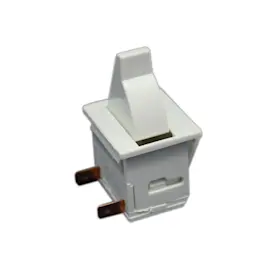
If the label is damaged or missing, use the freezer’s physical layout and parts diagrams to narrow it down, then confirm with a known component such as the refrigerator light switch 5309918806 or another part already installed.
Last updated: January 2026
How many cubic feet is a Kenmore freezer model 2539264110?
We size Kenmore upright freezer model 2539264110 by its rated “cubic feet” capacity, but that exact number is not listed on the parts information for this model. Most freestanding upright freezers in this Kenmore style are commonly sold in the mid-to-high teens; use the steps below to confirm your unit’s capacity.
How to get the exact capacity for your unit
Use one of these reliable methods:
- Check the rating label inside the cabinet (often on a side wall); many list capacity in cu. ft.
- Look for a product data/spec label on the back near the compressor area
- Measure the interior and calculate cubic feet (best when the label does not show capacity)
- If you are comparing similar models, use the full model number 2539264110 (not a partial)
How to calculate cubic feet from interior measurements
- Measure interior width, height, and depth in inches (exclude door bins and obvious air ducts).
- Multiply: width × height × depth = cubic inches.
- Divide by 1,728 to convert to cubic feet.
| What you have | What it tells you |
|---|---|
| Calculated cubic feet | Approximate gross interior volume |
| Shelf/duct space taken up | Why “usable” space feels smaller |
Why it matters
Capacity helps us plan storage, compare similar Kenmore freezers, and confirm the freezer fits your needs without guessing.
Parts that affect usable space (not rated capacity)
Missing shelves or supports reduce organization and usable space even though the rated cubic feet stays the same. For this model, examples include the shelf 297234400 and support 297001500.
Last updated: January 2026