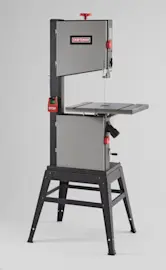
Owner’s manual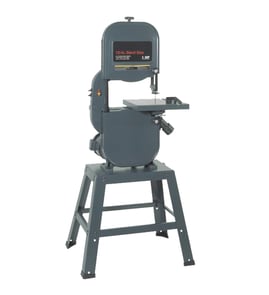

What is the 4 inch rule for bandsaw?
The 4-inch rule means we keep our hands and fingers at least 4 inches away from the moving blade at all times. On the Craftsman 137224140 1.5-hp band saw, that typically means using a push stick, push block, or a jig whenever the cut would bring your hands close to the blade.
Use these habits on every cut to maintain a safe buffer zone:
- Keep both hands on the workpiece, positioned to the sides of the cut line, not in line with the blade.
- Use a push stick or push block for narrow rips, short pieces, and small offcuts.
- Never reach across the blade path to “catch” a cutoff; let it fall or stop the saw first.
- Keep the blade guide assembly set close to the work; our manual calls for about 1/8 inch above the workpiece.
- Feed the stock with light, steady pressure; do not force the workpiece into the blade.
These steps reduce the chance your hands drift too close because the cut feels unstable:
| Setup item | Target | Why it helps |
|---|---|---|
| Blade guide height | About 1/8 inch above workpiece | More control, less exposed blade |
| Feed pressure | Light, steady | Prevents sudden grabs and hand slips |
| Blade choice | Narrower blade for tight curves | Reduces twisting and binding |
| Material | Wood only (no metal) | Prevents blade damage and kickback-like events |
The 4-inch rule is about preventing “reflex” injuries. When a blade binds, a cutoff shifts, or a curve tightens, our hands naturally want to correct the workpiece. Keeping a 4-inch buffer forces us to use safer tools and better technique instead of our fingers.
For the Craftsman 137224140, we follow the operating and safety guidance in the owner's manual, including guide height, feeding technique, and blade selection.
If you need diagrams or want to look up replacement items by model number, we also use the parts resources on this model page or search by model at Sears PartsDirect.
Last updated: February 2026
How do I know the size of my bandsaw blade?
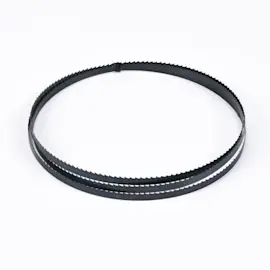
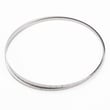
For the Craftsman 137224140 1.5-hp band saw, the blade size is defined by length and width. This model uses blades 91-1/2 inches to 93-1/2 inches long and accepts blade widths 1/8 inch, 1/4 inch, 3/8 inch, or 1/2 inch; we list these specs in the owner's manual.
To fully identify your band saw blade, measure these three items:
- Blade length: Measure the full loop length of the blade (end-to-end around the entire band).
- Blade width: Measure from the tooth tip to the back edge of the blade.
- Teeth per inch (TPI): Count how many teeth are in 1 inch; this helps match the blade to the cut.
- Unplug the saw.
- Remove the blade and coil it carefully.
- Lay it flat and mark a starting point (often the weld).
- Use a tape measure along the blade edge until you return to the mark.
These are the blade ranges and widths specified for this Craftsman band saw:
| Spec | What fits this model | What it affects |
|---|---|---|
| Blade length | 91-1/2 in to 93-1/2 in | Whether the blade can tension and track correctly |
| Blade width | 1/8 in, 1/4 in, 3/8 in, 1/2 in | Curve capability and cut stability |
We match blade width to the type of cut:
- 1/8 inch: tight curves and delicate work
- 1/4 inch: curves and general cutting
- 3/8 inch: straighter cuts with some versatility
- 1/2 inch: best for straighter cuts and stability
Using the correct blade length and width helps the blade tension properly, track on the wheels, and cut without twisting. It also reduces common blade-break causes like forcing a wide blade through a tight radius or running with incorrect guide alignment.
If you are shopping for blades or other replacement items by model number, start with the parts list for Craftsman 137224140, or search by model on Sears PartsDirect.
Last updated: February 2026
What is the 3-tooth rule for bandsaws?
The 3-tooth rule means your Craftsman 137224140 band saw blade should have at least three teeth in the cut at all times. That keeps the blade from snagging and stripping teeth (too few teeth) and helps clear sawdust or chips so the cut stays smoother and the blade lasts longer.
- Measure the material thickness where the blade is cutting.
- Choose a blade TPI (teeth per inch) so 3 or more teeth span that thickness.
- Thin stock needs higher TPI (more teeth per inch).
- Thick stock can use lower TPI (fewer teeth per inch) for faster cutting.
- If the blade chatters or grabs, go to a finer TPI.
- If the cut burns or packs with dust, go to a coarser TPI and reduce feed pressure.
- Keep the guide assembly set close; our manual calls for about 1/8 inch above the workpiece for safer, steadier cutting.
Use this as a practical starting point; then fine-tune based on cut quality.
| Material thickness | Target teeth in cut | Typical blade choice |
|---|---|---|
| 1/8 in | 3+ | 18 to 24 TPI |
| 1/4 in | 3+ | 10 to 14 TPI |
| 1/2 in | 3+ | 6 to 10 TPI |
| 1 in | 3+ | 3 to 6 TPI |
| 2 in+ | 3+ | 2 to 3 TPI |
This model is designed for wood and similar materials and uses common blade widths (up to 1/2 inch). When tooth spacing matches the stock thickness, the blade cuts with lighter pressure, tracks better, and is less likely to twist or break. For blade size guidance and operating tips (including blade width recommendations for curves), use the owner's manual.
For this Craftsman 137224140, match the blade length and width listed in the manual, then pick the TPI using the 3-tooth rule.
- Confirm blade length before ordering
- Pick blade width based on straight cuts vs curves
- Pick TPI based on thickness (3-tooth rule)
You can shop by model number on the parts list for this saw, or search more broadly on Sears PartsDirect.
Last updated: February 2026