
What is the standard size of a Countertop Microwave?
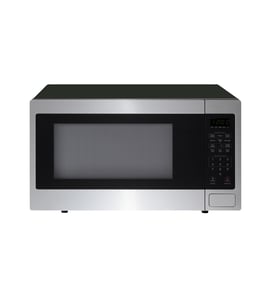
Most countertop microwaves (including the Emerson MW8775W style) are built to fit standard counter depth and outlet spacing; typical exterior dimensions are about 21 to 25 inches wide, 12 to 15 inches tall, and 16 to 20 inches deep, with 1.0 to 2.2 cubic feet of capacity.
Typical countertop microwave size ranges
These are the most common “standard” ranges you will see across brands like Emerson, GE, Whirlpool, and Samsung:
- Width: 21 to 25 inches
- Height: 12 to 15 inches
- Depth: 16 to 20 inches (deeper if the handle protrudes)
- Capacity: 1.0 to 2.2 cu. ft.
- Weight: often 30 to 50 lb.
How we recommend measuring your microwave (so it fits)
Measure the microwave you have now, or the space where the MW8775W will sit.
- Measure width, height, and depth of the cabinet opening or counter space
- Add clearance for door swing and rear airflow
- Include any handle or trim in the depth measurement
- Confirm the unit sits on a flat, level surface
- Make sure the cord reaches the outlet without stretching
Quick fit checklist
| What you are checking | What to allow for | Why it matters |
|---|---|---|
| Side clearance | 1 to 2 inches | Prevents heat buildup and vibration |
| Rear clearance | 2 to 4 inches | Protects airflow and reduces overheating |
| Overhead clearance | 12 inches typical | Keeps vents from being blocked |
Why it matters
Microwaves need breathing room. If a countertop microwave is squeezed into a tight space, it can run hotter, get noisier, and shorten the life of parts like the cooling fan, thermostat, and internal fuse.
Related troubleshooting help
If your microwave fits fine but is not performing normally (for example, it runs but does not heat), use our guide: why is my microwave not heating.
Last updated: February 2026
Do countertop microwaves need space around them?
Yes. Your Emerson MW8775W countertop microwave needs open space around it so the cooling air can flow through the intake and exhaust vents. Without clearance, the microwave can overheat, run poorly, or shut off during cooking.
Recommended clearance (typical countertop setup)
Because we do not have a model-specific clearance spec for MW8775W, use these common minimums for most countertop microwaves:
- Sides: 3 inches or more each side
- Back: 2 inches or more
- Top: 12 inches or more
- Front: keep the door area clear so it can fully open and vent properly
- Bottom: place on a hard, flat surface (not on a towel or soft mat)
Quick placement checklist
Use this checklist to avoid airflow and heat issues:
- Keep the microwave out of a tight cabinet unless it is specifically designed for built-in use.
- Do not block side or rear vents with cookbooks, canisters, or wall décor.
- Keep it away from heat sources (range, toaster oven, space heater).
- Leave room so the power cord is not pinched or bent sharply.
- Wipe dust and grease from vent areas regularly.
Why the space matters
Countertop microwaves pull in cooler room air and push warm air out to protect key components like the magnetron, high-voltage parts, and control board. Restricted airflow raises internal temperatures and can trigger thermal cutoffs or shorten component life.
Clearance guide (at a glance)
| Area around microwave | Minimum space to leave | What it prevents |
|---|---|---|
| Sides | 3 in. | Poor intake airflow |
| Back | 2 in. | Hot exhaust recirculation |
| Top | 12 in. | Heat buildup above unit |
If your microwave is already in a tight spot
- Move it forward so the rear vents are not against the wall.
- Remove items stored beside it.
- Test heating performance after improving airflow; if it still runs but does not heat well, use our guide: why is my microwave not heating.
Last updated: February 2026
Can an over-the-range microwave be a countertop?
No. An over-the-range (OTR) microwave is designed to be mounted to a cabinet and wall with a dedicated mounting bracket and top bolts; it is not intended or safety-listed to sit on a countertop like an Emerson MW8775W countertop microwave.
Why OTR microwaves should not be used on a counter
Using an OTR microwave as a countertop unit creates common safety and performance problems:
- Ventilation is wrong: OTR units rely on specific clearances and airflow paths that a counter setup can block.
- Stability is reduced: the chassis is built to be supported by a bracket and upper cabinet fasteners.
- Cord and outlet routing changes: OTR power routing is planned around an upper cabinet outlet.
- Heat and moisture exposure: OTR models are built to live above a range, not on a shelf with limited airflow.
- Door and hinge stress: countertop placement can change how the unit is supported and flexes during use.
What to do instead
If you want a microwave that sits on a counter, we recommend sticking with a true countertop design (like the Emerson MW8775W) or choosing a model specifically labeled for countertop use.
Here are practical checks before you buy or install:
- Measure the countertop footprint and the space above and behind the microwave for airflow.
- Confirm the microwave is labeled for countertop or built-in use (those are not the same).
- Avoid placing any microwave tight against a wall; leave breathing room for the cooling fan exhaust.
- Use a dedicated, properly grounded outlet; avoid extension cords.
Quick comparison: OTR vs countertop
| Feature | Over-the-range microwave | Countertop microwave (MW8775W type) |
|---|---|---|
| Intended mounting | Wall and upper cabinet | Counter or shelf surface |
| Venting design | Integrated venting system | Self-contained cooling airflow |
| Typical installation hardware | Bracket, bolts, templates | None (set in place) |
| Best use case | Above a cooktop/range | General counter heating/cooking |
Why it matters
Microwaves pull significant power and generate heat internally; using the wrong installation type can restrict airflow and increase the chance of nuisance shutdowns, blown fuses, or premature component wear.
For more microwave safety and placement tips, use our guide: never do these things with a microwave.
Last updated: February 2026
What are the parts of a microwave?
A countertop microwave like the Emerson MW8775W is made up of a heating system (magnetron and high-voltage components), airflow and safety parts (fan and door switches), and cooking-area parts (cavity and turntable). These parts work together to heat food evenly and safely.
Main microwave parts (what they do)
- Magnetron: creates microwave energy that heats food.
- High-voltage system: typically includes a high-voltage transformer or inverter, capacitor, and diode to power the magnetron.
- Waveguide and stirrer (or mode stirrer): directs and distributes microwave energy into the cooking cavity.
- Cooling fan and vents: move air to keep internal components from overheating.
- Door and interlock switches: prevent the microwave from running with the door open.
- Control panel and control board: manage time, power levels, and cooking programs.
- Turntable system: glass tray plus a roller ring and drive coupler to rotate food for more even heating.
Inside vs. outside: quick breakdown
| Area | Common parts you will see | What you notice when it fails |
|---|---|---|
| Inside the cavity | turntable tray, roller ring, coupler, waveguide cover | no rotation, arcing/burn marks, uneven heating |
| Behind the control panel | control board, keypad, display | dead display, buttons not responding |
| Behind the outer cover | magnetron, HV capacitor/diode/transformer, fan, fuses | not heating, loud hum, blowing fuses |
| Door area | latch hooks, interlock switches | won’t start, stops when door moves |
Why it matters
Knowing the major components helps you troubleshoot symptoms correctly. For example, “runs but doesn’t heat” often points to the high-voltage system, while “won’t start” commonly involves the door switches, fuse, or control.
Helpful troubleshooting next steps
- If the microwave runs but does not heat, start with symptom-based checks in why is my microwave not heating.
- If the microwave is completely dead, a blown fuse is common; use how to replace a microwave fuse as a repair overview.
- If you see sparks or burn marks, stop using it and review how to repair arc or burn marks in a microwave video.
Last updated: February 2026
How many watts is the Emerson MW8775W?
The Emerson MW8775W’s exact cooking wattage depends on the rating label for your specific unit. On most countertop microwaves, the advertised number is output (cooking) watts, while the electrical draw from the outlet is higher.
Where to find the correct wattage on MW8775W
Check the model and serial tag (often inside the door opening or on the back panel). Look for “Output” or “Microwave output” in watts.
- Look for Output (cooking power) in W
- Also note Input (electrical draw) in W or A
- Confirm the voltage (typically 120V for U.S. countertop units)
- Match the full model number: MW8775W
- If the label is missing or unreadable, use the model number to search specs and parts on Sears PartsDirect
Output watts vs input watts
Microwave listings and recipes use output watts because that is what changes cook time.
| Spec on label | What it means | What you use it for |
|---|---|---|
| Output (W) | Heating performance | Adjusting cook times |
| Input (W or A) | Power used from outlet | Circuit planning |
Why it matters
If you are converting cook times from another microwave, output watts is the number that keeps results consistent. A lower-output unit needs longer time; a higher-output unit needs less.
If it “runs” but seems low power
Weak heating is usually a component issue, not a settings issue. Use our troubleshooting steps in why is my microwave not heating.
Last updated: February 2026