Error Codes



How do I read my water heater model number?
Your Kenmore gas water heater model number (for example, 153332461) is printed on the rating plate label attached to the tank. Read the model number exactly as shown, including all digits; that exact match is what we use to pull the correct parts list for your heater.
Where to find the model number on the tank
Most Kenmore gas water heaters place the rating plate on the side of the tank, usually:
- On the upper half of the tank jacket
- Near the gas control valve area (but not on the valve itself)
- Behind an access panel or outer door on some installations
- On a label that also lists the serial number and fuel type (gas)
What to copy from the label (and what to ignore)
When you are standing in front of the rating plate, focus on these fields:
- Model number: the key identifier for parts compatibility
- Serial number: helpful for age and production run, but not required to find most parts
- Brand: Kenmore
You can usually ignore these when you are only trying to find parts:
- BTU input and recovery ratings
- Gas type details and pressure specs
- Certification marks and other technical codes
Quick checklist for entering the model number correctly
- Copy the model number character-for-character (no spaces unless the label shows them)
- Use all digits (do not drop leading zeros if present)
- If the label is worn, take a photo and zoom in to confirm each digit
- Match the model number to the parts list before ordering items like a pilot or thermocouple
Common label fields (example)
| Label field | What it means | Do you need it for parts? |
|---|---|---|
| Model number | Identifies the exact water heater design | Yes |
| Serial number | Production identifier | Sometimes |
| BTU input | Heating capacity rating | No |
Why it matters
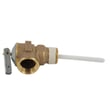
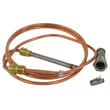
Kenmore water heater parts can look similar across models, but small design differences affect fit and safety. Using the exact model number helps you select the correct replacement parts for your heater, such as the pilot 100109070 or water heater temperature and pressure relief valve 100108279.
Last updated: February 2026
How many years should a gas water heater last?
A Kenmore gas water heater like model 153332461 typically lasts 8 to 12 years. With consistent maintenance (especially flushing sediment and replacing worn safety and combustion parts), many units reach the upper end of that range before performance and reliability drop.
Typical lifespan (what to expect)
Most tank-style gas water heaters fall into these ranges:
| Condition | Typical lifespan | What you’ll notice |
|---|---|---|
| Normal use, average water quality | 8 to 12 years | Slower recovery, more noise, occasional pilot issues |
| Well maintained, low sediment | 10 to 12 years | More stable temperature, fewer service calls |
| Hard water, heavy use, little maintenance | 6 to 10 years | Rumbling, leaks, frequent pilot outages |
What shortens or extends life
These factors make the biggest difference:
- Sediment buildup in the tank (causes rumbling and overheating at the bottom)
- Hard or corrosive water (accelerates tank and fitting wear)
- Anode rod condition (a worn rod speeds up tank corrosion)
- Combustion and pilot health (weak pilot, dirty burner area, poor draft)
- Pressure and temperature stress (high pressure or overheating strains the tank)
Maintenance that adds years
We recommend these practical habits for a gas water heater:
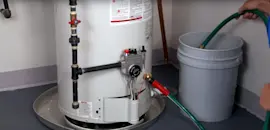
- Flush a few gallons from the drain valve periodically to reduce sediment
- Test the temperature and pressure relief valve for proper operation
- Inspect and replace the anode rod when it’s heavily depleted
- Keep the burner area clean and make sure air openings are not blocked
- Set temperature to a reasonable level (many homes run best around 120°F)
Parts that commonly come up on older units
If your heater is aging and showing symptoms, these model-related parts are often involved:
- Water heater temperature and pressure relief valve 100108279
- Water heater drain valve 100108361
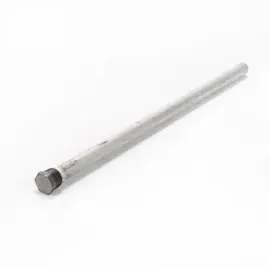
- Annode rod 100108571
- Pilot 100109070
Why it matters
Once a gas water heater gets past its typical service life, small issues (pilot outages, temperature swings, minor leaks at fittings) tend to stack up. Staying ahead with basic maintenance and key replacements helps protect hot water reliability and reduces the chance of sudden failure.
Last updated: February 2026
What is the average cost of a 50 gallon gas water heater?
A 50-gallon gas water heater typically costs $600 to $1,300 for the unit, and $1,000 to $3,100+ installed once you include labor and any venting, gas-line, or code-required updates. For Kenmore model 153332461, the vent type and install complexity drive the total most.
Typical price ranges (what drives the total)
- Standard atmospheric vent units usually land on the lower end.
- Power-vent or higher-efficiency units cost more up front.
- Installation can add cost if venting must be modified or brought up to code.
- Permits/inspection and haul-away fees can add to the final bill.
- Extra materials (shutoff valve, sediment trap, drip pan, connectors) often affect labor time.
Quick cost breakdown (common scenarios)
| Scenario | Unit cost (typical) | Installed total (typical) |
|---|---|---|
| Basic 50-gal atmospheric vent replacement | $600 to $1,000 | $1,000 to $2,200 |
| Higher-efficiency or power-vent 50-gal | $900 to $1,300+ | $1,800 to $3,100+ |
Repair vs. replace: parts that can change the decision
If the tank is sound and you are dealing with an ignition or safety-component issue, a repair can be more cost-effective than replacement. Common examples for Kenmore 153332461 include:
- Water heater temperature and pressure relief valve 100108279 (safety valve that opens if pressure or temperature gets too high)
- Pilot 100109070 (pilot assembly used to ignite the burner)
- Water heater drain valve 100108361 (used for draining the tank during maintenance)
Why it matters
The “average cost” is mostly installation-driven. A straightforward swap can stay near the low end, while venting changes and required safety updates push the total toward the high end.
Last updated: February 2026
What is the most common problem with a gas water heater?
The most common gas water heater problem is loss of ignition, meaning the pilot will not stay lit or the burner will not light; that leads to no hot water. On Kenmore model 153332461, pilot-related issues are often corrected by servicing or replacing the pilot and pilot tube components.
Most common symptoms (and what they usually point to)
- Pilot will not stay lit: dirty pilot, restricted pilot gas flow, or a failing safety/ignition component
- No hot water but pilot is on: burner not lighting, restricted gas flow, or a control issue
- Popping or rumbling noises: sediment buildup in the tank
- Water too hot or not hot enough: temperature setting or control problem
- Water around the heater: loose fittings, leaking drain valve, or tank leak
Quick checks we recommend first
- Confirm the gas shutoff valve is fully open.
- Verify the temperature setting is reasonable (many homes run best around 120°F).
- Look for a steady pilot flame; a weak yellow flame often indicates a dirty pilot or airflow issue.
- If you smell gas or see soot/scorching, stop and use a qualified technician.
- If the pilot will not hold, focus on the pilot assembly and pilot tubing first.
Common parts that fix “pilot keeps going out” on this model
| Symptom | Part to check/replace | What it does |
|---|---|---|
| Pilot will not stay lit or is inconsistent | Pilot 100109070 | Provides the pilot flame to light the burner |
| Pilot problems after service or movement | Water heater pilot tube assembly 100108370 | Delivers gas to the pilot reliably |
| Burner will not light or flame looks wrong | Orifice 100109257 | Meters gas flow into the burner |
Why it matters
A pilot that will not stay lit stops hot water production and can also indicate combustion or gas-delivery problems. Addressing the pilot flame and pilot gas path restores reliable ignition and steady heating.
Last updated: February 2026