 Owner’s manual
 Error Codes




What is the problem with the LG bottom freezer refrigerator?
On the LG LRFCS25D3S bottom-mount refrigerator, the most common “problem” customers notice is cooling performance changing over time: warm fresh-food section, frost buildup, unusual running noises, or reduced ice production. These symptoms usually trace back to airflow restrictions, dirty condenser coils, sensor/fan issues, or sealed-system cooling problems.
Most common issues we see (and what they look like)
- Warm refrigerator, cold freezer: blocked air vents, evaporator fan not moving air, or a temperature sensing issue.
- Frost or ice buildup: door not sealing, frequent door openings, or a defrost/drain issue.
- Not cooling and display shows “OFF”: unit is in Display (Demo) Mode.
- Icemaker slow or no ice: water supply/pressure issue, clogged filter, or icemaker problem.
- Loud or constant running: dirty condenser area, hot room conditions, or the unit trying to recover after door openings.
For model-specific operating checks (including Display Mode steps and temperature settings), use the LRFCS25D3S manual.
Quick checks before you assume a major failure
- Confirm it is actually cooling: set refrigerator to 37°F and freezer to 0°F, then allow up to 24 hours to stabilize.
- Check airflow: make sure packages are not blocking vents between compartments.
- Clean the condenser cover and vents: dust buildup can cause long run times and poor cooling.
- Look for frost patterns: heavy frost on the freezer back wall often points to a defrost/airflow problem.
- Rule out Display Mode: if “OFF” is shown, cooling is disabled until you exit that mode.
Parts that commonly relate to these symptoms (for this model)
If troubleshooting points to a failed component, these are compatible examples for LG LRFCS25D3S:
| Symptom | Likely area | Example compatible part |
|---|---|---|
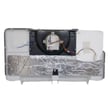
| Warm fridge, freezer OK | Air circulation | Refrigerator evaporator fan motor EAU63923603 |
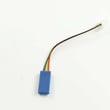
| Temps swing or inaccurate | Temperature sensing | Refrigerator temperature sensor 6500JB2002E |
| No cooling or sealed-system issue | Cooling system | LG refrigerator compressor TCA37071511 |
Why it matters
Catching airflow and maintenance issues early can prevent food spoilage and reduce strain on the compressor and fans. A simple vent check and condenser cleaning often restores normal temperatures without replacing parts.
Last updated: January 2026
Are LG refrigerators expensive to repair?
Repair costs for an LG refrigerator like model LRFCS25D3S can range from relatively affordable (simple maintenance or a fan motor) to expensive (sealed-system or compressor work). The biggest cost driver is whether the repair involves refrigerant work, which typically requires a qualified technician; see the LRFCS25D3S owner's manual for model-specific troubleshooting and maintenance guidance.
What usually makes a repair “expensive”
Some repairs cost more because they involve specialized tools, sealed-system access, or longer labor time.
- Sealed-system issues (refrigerant leak, restriction, internal contamination)
- Compressor-related failures
- Multiple parts replaced in one visit (for example, fan plus control)
- Hard-to-access components that increase labor time
- Service call and diagnostic fees (often separate from parts)
Common repair scenarios for LRFCS25D3S
Here are typical examples of what customers run into on this LG bottom-mount refrigerator.
| Scenario | What you might notice | Typical complexity |
|---|---|---|
| Airflow problem | Warm fridge, freezer OK, unusual fan noise | Medium |
| Icemaker problem | No ice, small cubes, slow production | Medium |
| Cooling system problem | Not cooling well or at all | High |
| Water filter maintenance | Slow water flow, filter light on | Low |
If you suspect an airflow issue, the refrigerator evaporator fan motor EAU63923603 is one of the components that can affect cooling performance.
Ways to keep repair costs down
These steps help prevent repeat service calls and reduce strain on the cooling system.
- Keep condenser areas clear of dust and lint (improves efficiency)
- Confirm doors seal and close fully; misalignment can cause long run times
- Replace the water filter on schedule (about every 6 months per the manual)
- Avoid blocking air vents with food packages
- Use the control panel settings recommended in the manual (37°F fridge, 0°F freezer defaults)
Why it matters
A refrigerator that runs too warm or runs constantly can lead to food spoilage, higher energy use, and added wear on key components like the compressor and fans. Catching symptoms early often keeps the repair simpler and less costly.
Last updated: January 2026
How many cubic feet is a LG LRFCS25D3S?
LG markets the LG LRFCS25D3S as a 25 cu. ft. French door, bottom-freezer refrigerator. The owner’s manual for this model focuses on operation and installation and typically doesn’t list the total cubic-foot capacity; for model-specific features and settings, use the LRFCS25D3S owner's manual.
What we can confirm for LRFCS25D3S
Even when capacity isn’t printed in the manual, we can confirm the model family and configuration from the documentation.
- Brand/model: LG LRFCS25D3S
- Style: French door refrigerator with bottom freezer
- Water system details are specified (water pressure range and filter guidance)
Capacity notes (how to interpret what you see)
Retail listings may show a small decimal (for example, 25.1 or 25.2 cu. ft.) depending on how the “25 cu. ft.” class is rounded. That difference is minor and doesn’t change fit or day-to-day storage in a meaningful way.
| Listing style | What it means | What to use for comparisons |
|---|---|---|
| “25 cu. ft.” | Rounded class capacity | Compare within the same style (French door) |
| “25.1” or “25.2 cu. ft.” | More precise published total | Use the exact number when comparing similar models |
Why it matters
Cubic feet helps you compare overall storage size, but usable space is also affected by shelf layout, door bins, and keeping air vents clear for even cooling.
Tips to maximize usable space
- Keep packages away from interior air vents to maintain airflow.
- Use crispers correctly to reduce moisture loss in produce.
- Avoid overpacking door bins so doors seal fully.
- Set temperatures near the defaults (37°F fresh food, 0°F freezer) and adjust as needed.
Last updated: January 2026





