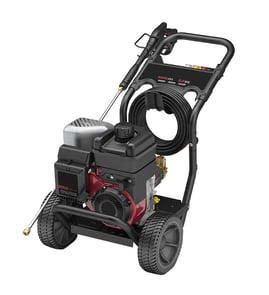

Where to find model number on Craftsman pressure washer?
On a Craftsman pressure washer like model 471446070, the model number is printed on a rating label (sticker or metal tag) attached to the frame. Most often, you will find it on the top of the lower frame near the rear, or on the top or back of the upper frame.
Look for a rectangular label with the model number and other specs (sometimes also a serial number). Check these spots:
- Top of the lower frame, toward the back
- Back side of the lower frame rail
- Top crossbar of the upper frame (near the handle)
- Back of the upper frame (behind the engine/pump area)
- Near the wheel axle bracket or base plate area
Dirt, detergent, and sun fading can hide the print. These steps usually help:
- Wipe the label with a damp cloth and mild soap; dry it fully
- Shine a flashlight across the label at a low angle to highlight embossed print
- Take a close-up photo and zoom in (or increase contrast) to read faded text
- If the label is scratched, look for the model number stamped into nearby metal parts
Having the exact model number (including any extra digits) helps us match the correct parts list and diagrams for your unit.
| You need | Why it matters | Example |
|---|---|---|
| Model number | Identifies the exact pressure washer version | 471446070 |
| Serial number (if present) | Helps narrow production run changes | Varies |
| Engine model (if separate) | Helps match engine-specific parts | Varies |
Pressure washer parts like the pump, unloader/thermal relief components, hose fittings, and spray gun connections can vary by production run. Using the correct model number prevents ordering the wrong replacement.
For more help confirming the right model number format, use how to find your appliance model number (and what it means for parts).
Last updated: February 2026
Does Craftsman have a lifetime warranty on pressure washers?
Craftsman pressure washers (including model 471446070) are not covered by a single, universal lifetime warranty; warranty length varies by the specific pressure washer and by major components (such as the frame, pump, and engine). For the exact coverage on your unit, match the warranty to your model and purchase date.
Warranty terms are typically split by component, so one part of the machine can have longer coverage than another.
Common coverage breakdowns you may see:
- Frame or structural components: often longer coverage than wear items
- Engine (gas models): often a separate term from the rest of the unit
- Pump: may have its own coverage window
- Hose, spray gun, tips, seals: commonly treated as wear items
- Normal wear, misuse, freezing damage: commonly excluded
Use these checks to line up the correct warranty statement with your exact product.
- Locate the model number 471446070 and any type/serial information on the data label
- Find your proof of purchase (date matters for coverage)
- Compare the warranty language for the pressure washer versus the engine (if gas)
- Note any maintenance requirements (oil changes, winterizing, pump protection)
- If you are missing the label or paperwork, use how to find your appliance model number (and what it means for parts) to confirm you are referencing the correct model
| Category | Typically covered | Typically not covered |
|---|---|---|
| Defects in materials/workmanship | Yes (within term) | No (outside term) |
| Wear items (tips, O-rings, seals) | Sometimes | Often |
| Damage from freezing or improper storage | No | No |
| Commercial use | Sometimes reduced | Often excluded |
Pressure washers combine high-pressure water flow with mechanical and (sometimes) engine systems; warranty terms often differ because pumps and engines have different failure patterns and maintenance needs.
Last updated: February 2026
How to replace an O ring on a pressure washer?
On a Craftsman pressure washer model 471446070, replacing an O-ring usually means removing the quick-connect fitting, sliding the old O-ring out of its groove, and pressing a matching new O-ring fully into place so it sits flat and seals.
- Shut the engine off and let it cool.
- Turn off the water supply.
- Squeeze the trigger to relieve pressure in the hose and wand.
- Disconnect the garden hose and high-pressure hose.
- Work over a towel so the small O-ring does not roll away.
- Inspect the fitting: Look inside the female quick-connect coupler (or on the male plug) for a cracked, flattened, or missing O-ring.
- Remove the old O-ring: Use a plastic pick, toothpick, or a small flat tool with taped edges to lift the O-ring out of the groove.
- Clean the groove: Wipe out grit and scale; debris can cause leaks even with a new seal.
- Lubricate lightly: Apply a thin film of silicone plumber’s grease (avoid petroleum grease on many rubber compounds).
- Install the new O-ring: Stretch it just enough to slip into position, then press it evenly into the groove with your fingers until it sits flush.
- Reassemble and test: Reconnect, turn water on first, then run the washer and check for drips at the connection.
O-rings are not one-size-fits-all. Match these details:
- Inside diameter (ID)
- Thickness (cross-section)
- Material (common: Buna-N/NBR; sometimes Viton)
- Location (hose coupler, wand inlet, pump outlet, detergent injector)
| Where it leaks | Most common cause | What to do |
|---|---|---|
| Quick-connect coupler | Nicked or flattened O-ring | Replace O-ring; lubricate |
| Wand to hose connection | Missing O-ring in fitting | Install correct size O-ring |
| Pump outlet fitting | Debris cutting the seal | Clean groove; replace O-ring |
A good O-ring seal prevents air leaks and water leaks that reduce pressure, cause surging, and can damage fittings over time.
For help identifying the correct seal size for your connection style, use how to find your appliance model number (and what it means for parts) and then search by model 471446070 on our site.
Last updated: February 2026
Is it worth repairing a power washer?
Yes, it’s worth repairing a Craftsman 471446070 pressure washer when the problem is a low-cost, high-impact fix (clogged nozzle, leaking hose, worn seals, dirty carburetor). If the pump or engine has major internal damage, replacement usually makes more sense because parts and labor can approach the cost of a new unit.
- Repair if the washer still starts, builds some pressure, and the issue is a wearable item (nozzle, hose, unloader valve symptoms, O-rings).
- Repair if you can do the work yourself and only need basic tools.
- Replace if the pump is cracked, the engine has low compression, or the unit has repeated failures.
- Replace if repair cost is more than 50% of what you would pay for a comparable new pressure washer.
- Replace if you need it for frequent use and downtime costs you time or money.
| Symptom | Most likely cause | Typical fix level |
|---|---|---|
| Low pressure | Clogged nozzle, air leak, worn seals | Easy to moderate |
| Surging pressure | Unloader sticking, nozzle mismatch | Moderate |
| Leaks at connections | Worn O-rings, loose fittings | Easy |
| Won’t start (gas models) | Old fuel, dirty carburetor, fouled plug | Moderate |
- Verify water supply: full flow, no kinks, clean inlet screen.
- Try a different spray tip; a partially clogged tip can mimic pump failure.
- Inspect for suction-side air leaks (loose garden hose fitting, cracked inlet).
- If it’s gas-powered: drain old fuel, check spark plug condition, and confirm the choke works.
- If pressure surges: suspect the unloader valve or a restriction at the nozzle.
Pressure washer repairs are usually economical when they restore performance with minimal parts and labor. Major pump or engine failures often turn into a cost trap, especially on homeowner-grade machines.
For help identifying the correct model and matching parts, use how to find your appliance model number (and what it means for parts).
Last updated: February 2026