 Owner’s manual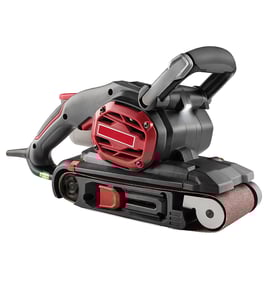

What is the procedure to replace the belt on the belt sander?
To replace the sanding belt on your Craftsman 113226431 belt and disc sander, we unplug the tool, release belt tension with the tension lever, install the new belt in the correct direction, then re-tension and track it so it runs centered on both drums (see the owner's manual).
Step-by-step: replace, tension, and track the sanding belt
- Power down safely
- Turn the switch OFF.
- Remove the switch key (if equipped).
- Unplug the sander.
- Release belt tension
- Slide the tension lever to the right to release tension.
- Remove the old belt
- Slip the belt off the drums.
- Install the new belt in the correct direction
- Find the directional arrow printed on the smooth (inside) side of the belt.
- Place the belt over the drums so it runs in the direction of the arrow.
- Center the belt on both drums before re-tensioning.
- Re-tension the belt
- Move the tension lever back to apply tension.
- Track the belt
- Plug in the sander and run it briefly.
- Use the belt tracking knob to center the belt so it does not walk off either drum.
Safety and fit checks we recommend before you run it
- Unplug the sander before changing the belt or making adjustments.
- Use a belt that is at least 4 inches wide (narrower belts can expose pinch points).
- Inspect for binding, misalignment, broken parts, and cord damage before use.
- Keep fingers away from moving parts; avoid touching plug prongs while plugging in.
- Use only recommended sanding belts for this sander.
Quick troubleshooting after belt replacement
| Symptom | Most common cause | What to do |
|---|---|---|
| Belt walks off drums | Tracking not set | Adjust the tracking knob while the belt is running |
| Belt slips or stalls | Too much pressure on workpiece | Ease up and let the abrasive cut |
| Belt looks like it will separate | Belt installed opposite arrow direction | Reinstall so the belt runs with the arrow direction |
Why it matters
Correct belt direction, tension, and tracking help prevent belt failure, reduce vibration, and keep sanding accurate. A properly centered belt also protects the drums and helps you avoid sudden belt walk-off during use.
You can look up diagrams and replacement items by model number on the parts list for Craftsman 113226431, or search by model on Sears PartsDirect.
Last updated: February 2026
Should I use a belt sander or orbital sander?
A belt sander (like the Craftsman 113226431 belt and disc sander) removes material fast and is best for flattening and shaping; an orbital sander removes material slowly and is best for smoothing and finish prep. Many projects use both: belt sander first, orbital last.
Quick pick guide
- Choose a belt sander when you need to level high spots, remove glue squeeze-out, or change shape quickly.
- Choose an orbital sander when you need to remove light scratches, blend surfaces, or prep for stain, paint, or clear coat.
- Use belt then orbital for tabletops, benches, and panels: flatten first, refine second.
- Avoid using a belt sander for final finish sanding; it can leave deep, straight scratches.
- Avoid using an orbital sander when you need rapid stock removal; it is slower by design.
What each tool is best at
| Tool | Best for | Typical grit range | Common risk |
|---|---|---|---|
| Belt sander (bench belt and disc sander) | Fast leveling, shaping, removing lots of material | 36 to 120 | Gouges, rounding edges, “dip” spots |
| Orbital sander (random orbital or finishing sander) | Smoothing, scratch removal, finish prep | 80 to 220 (sometimes higher) | Swirl marks if grit jumps too fast |
Using your Craftsman 113226431 safely for belt sanding
Our Craftsman 113226431 manual focuses on preventing accidental starts and controlling the workpiece.
- Unplug the sander, switch it OFF, and remove the switch key before changing the belt or making adjustments.
- Inspect the workpiece for nails or foreign objects before sanding.
- Sand one workpiece at a time and keep the table clear.
- If you hear unusual noise or feel heavy vibration, stop, unplug, and correct the problem before restarting.
- Install the sanding belt in the correct direction; follow the belt’s directional arrow.
For the model-specific setup and belt tracking steps, use the owner's manual.
Why it matters
Picking the right sander saves time and improves results. Belt sanding gets you flat and close to size quickly; orbital sanding removes the belt scratches so your finish looks even and professional.
If you need to look up parts or diagrams for your Craftsman belt and disc sander, start with the model parts list and search by model number on Sears PartsDirect.
Last updated: February 2026
Is a 4x36 belt sander good for knife making?
Yes. A 4 x 36 belt sander like the Craftsman 113226431 works well as a starter tool for knife making tasks such as profiling, rough bevels, and handle shaping; it is slower than a 2 x 72 grinder, but it produces good results with the right belts, setup, and safe technique (see the 113226431 owner's manual).
What it does well
- Rough shaping and profiling of blanks
- Handle shaping and scale cleanup
- Flattening small parts on the platen area
- Squaring and refining on the disc sander
Where it falls short vs. a 2 x 72
- Slower stock removal and less torque
- More heat buildup at the edge if you push hard
- Shorter belt life under aggressive grinding
- Fewer knife-specific attachments and tool rests
| Feature | 4 x 36 belt sander | 2 x 72 belt grinder |
|---|---|---|
| Best use | Starter shaping, cleanup | Fast bevel grinding |
| Speed | Moderate | High |
| Heat control | More technique-dependent | Easier with power and belt length |
Setup and technique tips
- Start with coarse ceramic belts, then step through finer grits.
- Keep belt tracking and tension correct; the manual covers belt tensioning and tracking.
- Keep the work support gap tight; the manual calls out avoiding a gap larger than 1/16 inch between the work support and sanding surface.
- Use short passes and cool the blade often to protect the temper.
Safety checks that matter
- Unplug the sander before changing the belt/disc or adjusting anything.
- Inspect for binding, broken parts, and cord damage before each use.
- Keep guards in place and mount the tool securely to the bench.
Why it matters
Knife grinding is about control and heat management. A 4 x 36 gets you started affordably, but belt choice, tracking, and a stable work support determine how cleanly and safely you can grind.
For replacement parts and diagrams for Craftsman 113226431, search by model on Sears PartsDirect.
Last updated: February 2026