Installation guide
 Owner’s manual
 Error Codes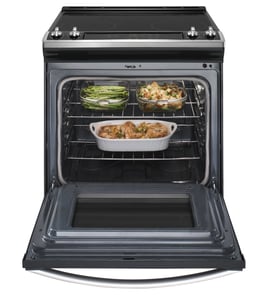





How do I find the model number on my JS645SL6SS?
The model number for your GE electric range is printed on the appliance’s rating label. On the GE JS645SL6SS, the label is typically found around the oven door frame area or on the storage drawer frame; match the full model number exactly when ordering parts.
Where to look on a GE JS645SL6SS
Check these common label locations:
- Open the oven door and look along the door frame (front frame of the oven cavity)
- Check the lower front frame near the storage drawer opening
- Pull out the storage drawer and look on the frame behind it
- Look for a silver or white sticker/plate with model and serial information
What the label should show
You are looking for:
- Model number: JS645SL6SS (letters and numbers)
- Serial number: used for manufacturing date and service history
- Electrical ratings: voltage and amperage (helpful for installation checks)
| Label item | What it’s used for | When you need it |
|---|---|---|
| Model number | Ensures correct part fit | Always, before buying parts |
| Serial number | Identifies production run | When troubleshooting or confirming revisions |
| Electrical rating | Confirms power requirements | During install or electrical checks |
Why it matters
GE ranges can have similar-looking models with different wiring, controls, or surface elements. Using the exact model number helps us match the correct diagrams and parts the first time.
For diagrams and model identification details, use the JS645SL6SS owner’s manual.
Last updated: March 2026
How do I troubleshoot my JS645SL6SS?
To troubleshoot your GE JS645SL6SS electric range, start by identifying whether the issue is cooktop heat, oven heat, or controls, then verify power supply and basic settings. Many problems trace to a failed surface element, a bad control switch, or a heating element.
Step-by-step checks (safe, high-value)
- Confirm the range has the correct power (range breakers fully on, not half-tripped)
- For cooktop issues, test a different burner and a different knob setting
- For oven issues, test Bake and Broil separately to isolate bake vs broil heating
- Check for visible damage: blistered element, burned terminals, melted wiring
- Let the range cool, then retry; overheating can trigger cooling-fan related behavior
Symptom-based troubleshooting
| Problem | What to check first | Likely part area |
|---|---|---|
| One surface burner won’t heat | Swap to another burner setting/knob | Element or switch |
| Burner heats but won’t regulate | Heat stuck high/low | Surface element control switch |
| Oven won’t bake but broils | Bake circuit only | Bake element |
| Oven won’t broil but bakes | Broil circuit only | Broil element |
| Control area gets very hot | Fan operation | Cooling fan/sensor board |
Parts that often fix common failures
If your symptoms match, these model-specific parts are common solutions:
- Range bake element WB44X45494 for no-bake or weak baking
- GE range broil element WB44X45497 for no-broil or weak broiling
- GE range surface element control switch WB24X25013 for burner heat that will not adjust
- Range control panel cooling fan WB26X29468 if the control area overheats
Why it matters
Troubleshooting by symptom prevents unnecessary part swaps and helps you focus on the circuit that actually failed (surface heating vs oven heating vs controls), saving time and avoiding repeat repairs.
For model-specific diagnostics, wiring references, and operating checks, use the JS645SL6SS owner’s manual. If you need installation-related electrical guidance, also review the JS645SL6SS installation guide.
Last updated: March 2026
What is the average lifespan of JS645SL6SS?
The average lifespan of a GE electric range like the JS645SL6SS is 13 to 15 years with normal household use. Keeping the oven and cooktop clean, ensuring proper electrical supply, and replacing wear items promptly helps the range reach that typical service life.
What affects lifespan most
These factors have the biggest impact on how long an electric range lasts:
- Heat stress from frequent high-temperature baking or broiling
- Power quality (loose terminal connections or voltage issues)
- Spillovers that damage switches, elements, or wiring
- Door slams and heavy loads on oven racks
- Cooling airflow around the control area
Parts that commonly drive “end of life” repairs
If performance drops, these are common repair points on electric ranges:
- Surface element control switch (burner won’t regulate heat)
- Radiant surface element (burner won’t heat)
- Bake or broil element (uneven baking, no heat)
- Oven control board (display issues, temperature control problems)
- Cooling fan (overheating control area)
| Symptom | Common cause | Typical fix |
|---|---|---|
| Burner stuck on high/low | Failed infinite switch | Replace switch |
| Oven not heating | Failed bake element | Replace element |
| Display dead or erratic | Control board issue | Replace control |
Why it matters
Knowing the typical 13 to 15 year lifespan helps you decide whether to repair (often cost-effective) or plan for replacement, especially if multiple heating or control components are failing.
For care tips and operating guidance that reduce wear, follow the JS645SL6SS owner’s manual.
Last updated: March 2026