Owner’s manual
 Error Codes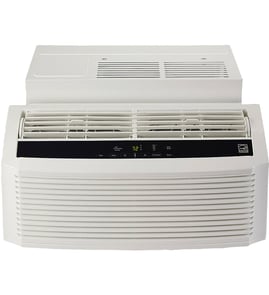




How big a room will a 5kW air con cool?
A 5 kW room air conditioner typically cools about 215 to 375 sq ft (roughly 20 to 35 sq m) in average conditions. For Kenmore model 58075184500, the best match depends on insulation, sun exposure, and how well the unit is installed and sealed; see the owner's manual for sizing and operating guidance.
Quick sizing guide (5 kW class)
Use this as a practical starting point for a typical U.S. home with average ceiling height.
- 215 to 275 sq ft: hot sun, poor insulation, lots of air leaks
- 275 to 325 sq ft: average insulation, moderate sun
- 325 to 375 sq ft: shaded room, good insulation, tight windows and doors
- If you are cooling multiple rooms, performance drops fast unless air can flow freely between spaces
| Room conditions | Realistic coverage for 5 kW | What you will notice |
|---|---|---|
| High heat load (sunny, leaky) | 215 to 275 sq ft | Longer run time, warmer corners |
| Average conditions | 275 to 325 sq ft | Steady cycling, comfortable center |
| Low heat load (shaded, tight) | 325 to 375 sq ft | Faster pull-down, shorter cycles |
What changes the room size it can cool
These factors usually matter more than the number on the box:
- Sun exposure (south and west facing rooms need more capacity)
- Insulation and air leaks (drafty windows and doors waste cooling)
- Ceiling height (taller ceilings increase the air volume)
- Occupancy and appliances (people, cooking, and electronics add heat)
- Installation quality (gaps around the unit let hot outdoor air in)
Why it matters
If the room is too large for the capacity, the air conditioner can run almost constantly and still feel warm. The manual notes that under heavy heat or humidity load, the unit may need to run longer and more often to hold the set temperature.
Tips to get the most cooling from 58075184500
- Set the vent control to CLOSE for maximum cooling (recirculates indoor air)
- Start on the highest COOL setting, then adjust once the room pulls down
- Keep the air filter clean to prevent restricted airflow
- Make sure the unit tilts and drains correctly; a clogged or missing drain path can contribute to water issues (see room air conditioner drain pipe 3H02773A)
Last updated: January 2026
How much do AC spare parts usually cost?
AC spare parts usually range from under $10 for small hardware up to several hundred dollars for major sealed-system components. For Kenmore model 58075184500, common replacement parts on this unit span roughly $5 to $600+, depending on what failed and how complex the repair is; check the owner's manual first to confirm symptoms and safe access.
Typical price ranges (what you can expect)
Prices vary by part type, availability, and whether the repair involves electrical or refrigeration work.
- Small plastic or mounting parts (brackets, links, locks): often $5 to $40
- Controls and sensors (switches, thermostats): often $30 to $100
- Air-moving parts (blower wheel, fan hardware): often $50 to $150
- Electrical assemblies (power cord, heater assembly): often $100 to $200
- Major refrigeration parts (compressor, condenser): often $400 to $700+
Examples for Kenmore 58075184500
| Part type | Example part on this model | Typical cost impact |
|---|---|---|
| Drain component | Room air conditioner drain pipe 3H02773A | Low cost, high value for leak control |
| Control | Rotary switch (2H00598F) | Moderate cost, restores basic operation |
| Cooling system | Compressor (2520UMBK2XA) | High cost, often the biggest repair decision |
Why costs vary so much
A window or room air conditioner has a mix of simple mechanical parts and high-value components.
- Labor and access: deeper disassembly usually increases total repair cost
- Electrical safety: power cord and control repairs must be done carefully
- Sealed refrigeration system: compressor and refrigerant-side repairs are typically the most expensive
- Availability: “in stock” parts usually cost less than hard-to-source items
How we recommend choosing the right part (and avoiding returns)
- Match the model number 58075184500 exactly
- Confirm the symptom in the troubleshooting section of the owner's manual
- Inspect for obvious issues first (loose connectors, broken plastic, clogged airflow)
- Price the repair as part cost + tools + time, not just the part
- If the issue points to the sealed system (weak cooling, compressor problems), compare repair cost to replacement value
Last updated: January 2026
What are the 5 main parts of AC?
On the Kenmore 58075184500 room air conditioner, the core cooling system is built around five main pieces: the compressor, condenser, evaporator coil, a metering device (capillary tube or expansion device), and refrigerant. Together, they move heat from inside your room to outdoors.
How those 5 parts work together
In a window AC like the Kenmore 58075184500, the refrigerant circulates through a sealed loop:
- Compressor: pumps refrigerant and raises its pressure and temperature.
- Condenser: releases heat outdoors as the refrigerant cools and condenses.
- Metering device (capillary tube/expansion device): drops pressure so refrigerant can absorb heat again.
- Evaporator coil: absorbs heat indoors; moisture can also condense off the coil, lowering humidity.
- Refrigerant: the working fluid that changes pressure and state to carry heat.
For a labeled diagram of the major components on this model (including the evaporator coil, condenser, and compressor), use the owner's manual.
Parts you will also see on this model (not part of the “main 5”)
Most cooling complaints involve airflow or controls, so these supporting parts matter too:
- Air filter and inlet grille (dirty filter reduces airflow and can lead to icing)
- Fan motor and blower wheel (moves air across the evaporator and condenser)
- Control board or rotary switch (sets mode, fan speed, temperature)
- Thermostat/thermistor (senses temperature and cycles cooling)
- Base pan and drain path (manages condensate)
If you are troubleshooting water leaks, a damaged or missing drain component can be a factor; this model uses a drain pipe such as the room air conditioner drain pipe 3H02773A.
Quick reference: what each “main 5” does
| Main part | What it does | Common symptom if it fails |
|---|---|---|
| Compressor | Pressurizes refrigerant | Hums, trips breaker, no cooling |
| Condenser | Dumps heat outdoors | Poor cooling, high head pressure |
| Metering device | Lowers pressure/controls flow | Icing or weak cooling |
| Evaporator coil | Absorbs indoor heat | Icing, water dripping, weak airflow |
| Refrigerant | Carries heat through the cycle | Gradual loss of cooling (sealed system) |
Why it matters
Knowing the “main 5” helps you separate sealed-system cooling issues (compressor, coils, refrigerant) from serviceable airflow and control issues (filter, blower wheel, thermostat, switches). That saves time when diagnosing “not cooling,” “iced up,” or “leaking water” symptoms.
Last updated: January 2026